
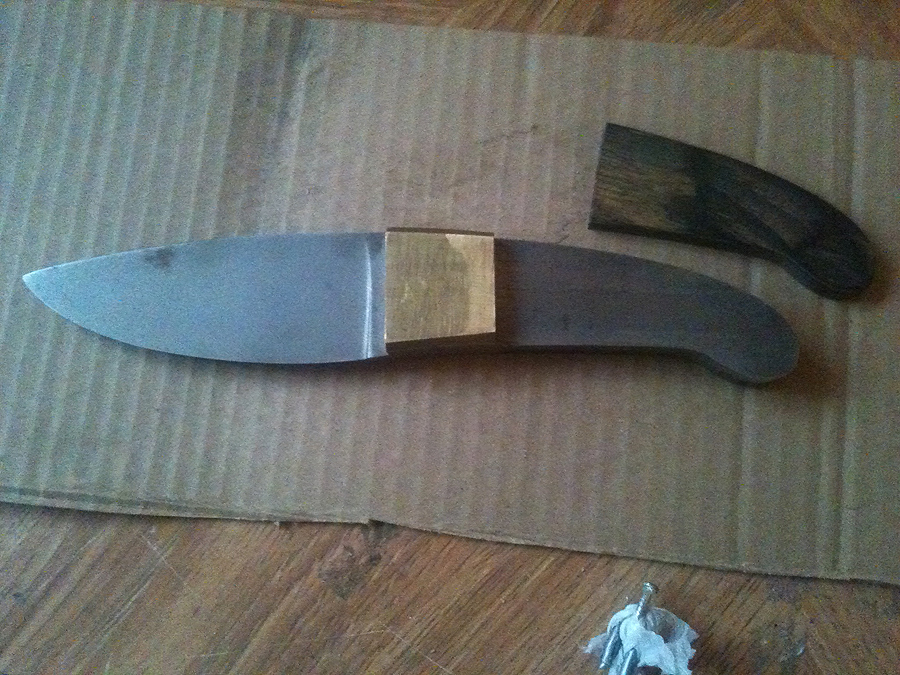
Guy at work gave me a half finished knife

Joined
Jul 19, 2014
Messages
92
It's made out of ATS-34 and has pretty well been finished up to the point of heat treat (which he had done). However, he forgot to drill holes for his pins before that, and he told me he simply could not get through the hard steel with the drill press. So he tried to simply use "generic 10 ton epoxy" to secure the scales and brass guard onto it, one of the scales fell off, but the rest I simply cannot pry off.

He lost interest in it and just gave it to me to do whatever with. I'd like to finish it up and give it back to him as a functional tool.

From what I understand of this steel, it's far beyond my capability's to anneal myself, or re heat treat. I normally work with 1084 and a charcoal forge, magnet and toaster oven. Is there any chance of drilling through the steel? Something he perhaps missed? I seem to doubt it because he's a competent welder and metal worker so he knows what he's doing I assume.

It seems like it would be a real pain to send it away to have it softened, spend 5 minutes drilling holes and then send it off to be treated again.

How do I deal with this 10 ton epoxy? I tried getting into a gap and prying, but there is just no way. I imagine there is some solvent which will break it right down?

Lastly, he told me he made some sort of spinning disk dealy to do the bevels, like a sheet of sand paper on a horizontal disk attached to a motor. This sounds extremely difficult to grind a bevel with, and yet I have no problem admitting that the flat grind on his first knife is cleaner then any I have produced with my 1X30 grinder. Does anybody use a similar method?

Mandatory picture:
0DvKeCN.jpg
 
That's gonna be a good looking Knife , if you don't hand any way to grind down the bevels check out Gough custom on you tube he shows you how to set up a file jig ,that is assuming you have home files then after you do that he goes on to show you how to do a satin finish on the blade by finishing up with hand sanding. Kinda lol abor intensive but with a little time and patience it will come out great .. Hope this helps
Thanks,
Matthew
 
Some of us routinely use a disk sander to flatten bevels, and a few grind their bevels with a disk.

A bit of heat will loosen that epoxy. You won't hurt the steel at anything under 400 degrees or so.

Good luck on the drilling. Carbide may be your only shot.
 
Some of us routinely use a disk sander to flatten bevels, and a few grind their bevels with a disk.

A bit of heat will loosen that epoxy. You won't hurt the steel at anything under 400 degrees or so.

Good luck on the drilling. Carbide may be your only shot.

I don't mind losing the scales, or liners they have. I would like to keep the brass however, if possible. I have never worked with brass before so I am unsure if I can heat that without ruining it. I know it doesn't need to be heat treated or anything for a guard but, I don't know I would expect heat to possibly damage it.

Even if I have to sacrifice the brass it's no big deal I suppose. I guess I would put the blade into a can of water just to be safe and then take a blow torch to the spine and, uh "belly?" I imagine that would do it?


The most frustrating thing about this knife is he made it about 5 years ago, and he bought everything, the steel, brass, scales, liners, pins, ect from a knife making shop in town, he even had it heat treated there. However the place shut down like a year before I started making knives lol, that would have been soo great.
 
Use a carbide drill bit and leave the one scale on. Then glue the other scale in and flip and drill it and then pin and finish knife.
 
Use a carbide drill bit and leave the one scale on. Then glue the other scale in and flip and drill it and then pin and finish knife.

I'm actually not really a fan of the scales. Is there any way somebody can tell what type of wood that is? I'm sure it's a good wood, but the green isint pleasing with the red liners IMO, kind of an ugly contrast. Besides if I give him the knife back finished, I kind of want to put my own twist on it instead of simply finishing what he started you know?

I'll pick up a carbide drill bit at home depot this weekend, but I seem to remember him telling me, ages ago when he first mentioned the knife, that he did try a carbide bit with no luck.
Like I said, the guy is a great welder/mechanic/craftsman/hands on kind of work guy. I kind of assume he tried every thing you can do to get through steel.
Not that I won't try myself, but I'm not sure I should anticipate success.

If I can't drill it, are there any other options to get through the steel?
I mean, for a second I was about to ask if it was possible to plunge the blade into ice water, while hitting the tang with the plasma cutter to make a small hole and then try and go from there some how, extreme filing or die grinding, but you can't really hook a plasma cutter up to something in water can you? I admit I'm rather ignorant about all this stuff.
There has to be some way, perhaps if I used a punch, with some luck I could knock in a couple of "pilot holes" in which I then use a tapered die grinder file bit to "drill" through...?
 
"Punching it may cause it to break. I've used inexpensive masonary bits to drill hardened ATS-34 as well as regular carbide. Run your drill on the slow side but maintain a reasonable amount of down pressure. The bit will just skiff by if you don't have the right pressure .
Frank
 
I mean, for a second I was about to ask if it was possible to plunge the blade into ice water, while hitting the tang with the plasma cutter to make a small hole and then try and go from there some how, extreme filing or die grinding, but you can't really hook a plasma cutter up to something in water can you? I admit I'm rather ignorant about all this stuff.?

You can use plasma on something in partially water. Attach the grounding clamp and cut as normal.
Its done all the time in industry also. The workpiece is just laying on the surface of water on supports.
Mostly its a collection method for swarf dust & fumes.
 
To apply heat, I would just put it in the oven at 375 degrees and watch it in case the wood starts to char or burn. I don't believe such would affect the brass at all.
 
I had a local machine shop drill holes in 3-4 blades that I forgot to drill for $10. This was after spending $40 on carbide bits. Moral of the story is take it to a pro. It's usually cheaper in the long run.
 
ATS-34 doesn't anneal like carbon steel.
Carbide bit is the way to go.
 
Back
Top