H1 Questions

Joined
Oct 21, 2008
Messages
99
I have to admit I'm pretty fascinated by H-1, and have read just about everything I can find about this 'steel' (actually technically 'ceramic'). Still, I have a few questions, maybe someone here can answer them...
1. How far does the work hardening go? I understand the steel will go from high 50s to mid 60s over time, depending on whether the blade is PE or SE, but does the hardness 'plateau' at some point? I'm wondering whether there might be any long-term brittleness issues, though I suspect not since the spine would not be work hardening.
2. Seems like the work-hardening gives you pretty much a differential temper, over time. Would the steel be suitable for a katana-type blade?
3. All the spyderco blades in H-1 seem to be hollow ground, why is this? It seems like a convex grind would be pretty cool...
4. I guess the more general question here is, do the characteristics of H-1 limit blade type, or would H-1 be suitable for everything from thin chef knives to big, convex choppers?

Hopefully I'm not asking questions that have already been answered at some point (heh, 'point', get it?). By the way, my first H-1 blade, a Rock Salt, should be arriving in the mail any day, I'm psyched!
 
great questions id like to know the answers to myself. i can give you one that i just read in a thread recently. the H1 blades are hollow ground because it grinds both sides at once in a jig. thus work hardening both sides at the same time. where as a flat ground blade you grind one side at a time. this results in grinding one side but fully work hardening the blade so that the second side is VERY dificult to grind.

this is a bummer for me becuase im not a fan of hollow grind but REALLY wanna try H1.
 
These are quotes from Sal (Mr. Spyderco himself) on the Spyderco Forums

"H1 is a work hardened steel. that means that it "changes" while it is being formed, ground, polished, sharpened, etc. Flat grinding is done one side at a time. Grinding the first side "changes" the blade making it very difficult to grind the other side. Hollow grinding grinds both sides of the blade at the same time so the "changing" occurs at the same time on both sides."

"Flat grinding and hollow grinding are the most common types of grinds done by CNC grinding machines on knives and shears. At this time, hollow grinding is the only option for H1."
 
I have to admit I'm pretty fascinated by H-1, and have read just about everything I can find about this 'steel' (actually technically 'ceramic'). Still, I have a few questions, maybe someone here can answer them...

Hi Naga,

thanx for the interest. We too are fascinated by H1.

1. How far does the work hardening go? I understand the steel will go from high 50s to mid 60s over time, depending on whether the blade is PE or SE, but does the hardness 'plateau' at some point? I'm wondering whether there might be any long-term brittleness issues, though I suspect not since the spine would not be work hardening.

We can go from the "stock" hardness to the hi 50's in the original rolling of the sheet. Then we get additional hardening in surface grinding, bevel grinding, serrating and sharpening.

Whether or not it actually gets harder from hand sharpening, we hve little data and cannot demonstrate, although some of our customers attest to this. Whether or not there is a threshhold leading to brittleness, we've not experienced this, but we've only been working with the material for a few years..

2. Seems like the work-hardening gives you pretty much a differential temper, over time. Would the steel be suitable for a katana-type blade?

It's not a temper or a heat treat as it is not a transformation process. Dick Barber said it was technically "differential hardening". I don't know if it would be suitable for a Katana blade, but I believe that would be blasphemy to the sword makers of Japan.

The steel is very expensive and the larger the blade, the higher the cost, for the material and working it.

3. All the spyderco blades in H-1 seem to be hollow ground, why is this? It seems like a convex grind would be pretty cool...

The maker feels that he cannot effectively flat grind the blade and at this time, we are limited to a hollow grind with a maximum of 17mm.

4. I guess the more general question here is, do the characteristics of H-1 limit blade type, or would H-1 be suitable for everything from thin chef knives to big, convex choppers?

I'm sure there are limitations such as the grind, but as we try different models and learn more about the material, we'll offer more products.


Hopefully I'm not asking questions that have already been answered at some point (heh, 'point', get it?). By the way, my first H-1 blade, a Rock Salt, should be arriving in the mail any day, I'm psyched!

A very special model indeed, both in design (Ed Schempp did a great job) and a large "hunk" of ergonomic sharp H1. I would certainly want a Rock Salt in my bug-out bag.

sal
 
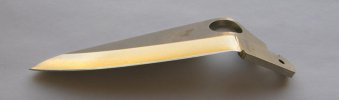
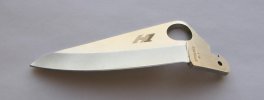
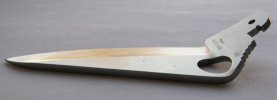
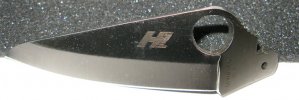
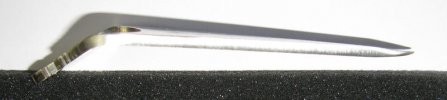
Sal asked me to share a few pics of a Pacific Salt blade we recently did some testing on... :eek::D
 

Attachments

  • BentH1.jpg
    BentH1.jpg
    11.9 KB · Views: 305
  • BentH1_2.jpg
    BentH1_2.jpg
    14.5 KB · Views: 304
  • BentH1_3.jpg
    BentH1_3.jpg
    16.8 KB · Views: 292
  • BentH1_4.jpg
    BentH1_4.jpg
    32.8 KB · Views: 163
  • BentH1_5.jpg
    BentH1_5.jpg
    19.3 KB · Views: 257
Thanks for the thorough reply, Sal. It's cool to have a bit of access to the people 'behind the scenes'.

That's certainly a bit of destructive testing there :eek: Interesting that it bent so far with such minimal fracturing.
 
How does H1 compare to other steels in performance, does the edge roll like S30V or does it dull evenly like S90V. How is the edge retention and how does it sharpen.
 
How does H1 compare to other steels in performance, does the edge roll like S30V or does it dull evenly like S90V. How is the edge retention and how does it sharpen.

I've got a SE Pac Salt here with a rolled edge from hitting a big staple in a box. If the SE didn't chip out, I doubt the PE will either. I expect a little time on a steel will fix the roll. :thumbup:
 
I haven't done any formal testing, but to me it seems that my one H-1 blade keeps a good edge a bit longer if I leave it as it comes off a fine diamond stone. If I strop it to a super refined edge, it seems to dull a tad faster. Anyone else notice this or is it in my head?
 
Stropping probably just straightens the burr out, and there's not much "meat" behind the edge. I usually go to an 800 on an Edge Pro, and then knock the burr off with a fine ceramic rod. My edges last a good long while with this method. :thumbup:
 
Back
Top