H1 Super Sharp

I never said anyone was wrong. If you got that from my post then I guess I can assume you are saying I am lying in yours? I am trying to figure out what is going on. And it is not just me it is also 2 other people that I personally know who own the knives and have used and sharpened them and have the same experience. I also gave the time period of 2 years because they have been sharpened a lot and should be 'broken in' by now.

So they are hard use because you don't have to perform maintenance on them? I didn't think maintenance had anything to do with actually using the knife. And I would also think that most FRN knives would break at the pivot long before the blade would bend or snap. So again, unless the sharpness doesn't really matter I don't understand the hard use claim.

I'm not trolling as I love Spyderco knives and have lots of them and praise them for the most part. But I'm also not a fanboy who is not going to question something.

OK, my apologies and at my defensive tone ;)

I am stumped as to why you would get terrible edge maintenance, what would you compare it to? 420, 440A, AUS-6?

FRN is insanely tough, and I wouldn't really worry about its tensile strength, again it will bend before breaking.

Hard use to me means being able to be used for hard tasks and not really pure slicers. ;)
 
I have said it before and I will say it again here.

I find H1 to have terrible edge holding. It is great to be able to take a knife on the boat and swimming and not worrying about rust. But the length of time the knife stays sharp is very short for me. And it is not just me because I gave 2 as gifts to my dad and a friend and my friend gave his back because it losses it's edge so quick.

I guess I'm just curious if everyone that loves this steel so much just don't care about edge retention?

Interesting, that's not been my experience. Maybe you use your knives harder than I do mine. I haven't had my Aqua Salt long enough to make any judgments, but I've had a Salt 1 and Pacific Salt for quite awhile and they seem to hold an edge about as well as knives I have in AUS 8.

I don't doubt your experiences at all but I would like to learn more.

Are your H1 knives PE or SE?

May I ask what specific uses you have for your H1 knives?

Are you noticing rolling on the edge?

What angle do you have them sharpened at?

What other blade steel do you use in a saltwater environment that performs better?
 
Interesting, that's not been my experience. Maybe you use your knives harder than I do mine. I haven't had my Aqua Salt long enough to make any judgments, but I've had a Salt 1 and Pacific Salt for quite awhile and they seem to hold an edge about as well as knives I have in AUS 8.

I don't doubt your experiences at all but I would like to learn more.

Are your H1 knives PE or SE?

May I ask what specific uses you have for your H1 knives?

Are you noticing rolling on the edge?

What angle do you have them sharpened at?

What other blade steel do you use in a saltwater environment that performs better?


I'm not sure what I would compare the edge retention to. I have gotten rid of all my knives with cheaper steel. The lowest I have is VG10/154CM/Kershaw's new steel. It dulls quite a bit quicker than any of those.

All 3 of the knives I have experience with are plain edge Salt 1. I haven't noticed a rolled edge. Mine is right about 20 degrees per side and I use it for anything I need a knife for. On the boat that is cutting fishing line, maybe some bait or opening food packaging. I will go swimming in the salt water quite a bit and will take it with me. I tried using a native in S30V and had rust at the end of the day even after rinsing in fresh water after getting out of the salt water so I didn't do that much.

For use in the salt water it is great and there really isnt a replacement if you are looking for something that will not rust. I do take my other knives with me and use them on the boat if I am not going to be in the water.

When I am not using the knife on the boat I use it for anything I need a knife for around the house. Breaking down boxes, cutting paper or plastic, rope and just the normal EDC tasks.

Since I am talking about it again I am going to go get it hair popping sharp and do some cutting and try to document how quickly it looses it's edge.
 
VG10, 154cm, and 14C28N (Kershaw's new steel) will hold an edge a lot longer than H1 in my opinion.

If you were accustomed to using 440A, AUS 6 or AUS 8 I think you'd be more satisfied with H1.

It's my understanding that VG10 is suppose to have pretty good corrosion resistance. In your experience how does it hold up in a saltwater environment?

I also sharpen my H1 knives at 20*.

I have PE blades also but the SE blades are supposed to be a lot harder due to the work hardening associated with grinding the serrations. You might want to try one of them.

Before you sharpen yours again hold it up to a bright light and see if you can see any rolling. A magnifying glass or jewelers loupe might help.

At the first sign of any rolling or edge loss I'll give my Salt knives 5 or 10 light strokes on the white Sharpmaker rods and the edge is razor sharp again.

Most of your uses are similar to mine except I suspect you use much heavier fishing line down there in Florida than I do up here. Do you think the heavy weight line could be a significant contributing factor in edge loss?
 
I am also finding H-1 to be a great-sharpening steel, and not bad at edge retention. I have the Rock Salt, Aqua Salt and the Pacific Salt, and they have all seen use and sharpening, though the Aqua Salt is going out today for a regrind. I would love to see more knives offered in H-1 steel.
 
I have said it before and I will say it again here.

I find H1 to have terrible edge holding. It is great to be able to take a knife on the boat and swimming and not worrying about rust. But the length of time the knife stays sharp is very short for me. And it is not just me because I gave 2 as gifts to my dad and a friend and my friend gave his back because it losses it's edge so quick.

These were all purchased over 2 years ago and have been sharpened many times. I just don't understand why they are liked so much unless the average person is just use to a dull edge. I really don't get the hard use claim because the first couple times it is used it is dull?

And no I do not have a wire edge. I have used different ways to sharpen including paper wheels. The slotted polishing wheel has never left behind a wire edge for me on any steel.

I guess I'm just curious if everyone that loves this steel so much just don't care about edge retention?

I haven't used my Salts enough to judge edge holding but I was also wondering about the "work hardening" effect on the edge. I sharpen my knives using paper wheels. That means my sharpening happens in the opposite direction of most other systems, since the wheel is going away from the edge and with very little pressure on the edge. So in my mind, I wouldn't get the full effect of "work hardening" in my H-1 blades. What do you guys think of this idea?
 
I've used various PE salts and at first I was not impressed with their edge holding. My SE salts had excellent edge retention straight out of the box though.

With my PE salts, after reprofiling to a more acute edge around ten degrees per side and sharpening them frequently over a year, the edge retention got much better. This is similar to what I've noticed with other steels in that reprofiling them seems to bring the best out in their performance, but with H1 the effect on edge retention in particular was more noticeable. Obviously they cut better in general with the thin edge.

I noticed that H1 will sharpen quickly and take an extremely sharp edge, but with a high degree of polish the edge quickly loses it's excellent push cutting ability, but will stay working sharp for a long time as long as you don't mind slicing instead of push cutting.

This led me to experiment with low grit edges on PE H1, which I had good results with. This type of edge seems to work well with the nature of the steel, as it performs strongly during a slice.
 
This led me to experiment with low grit edges on PE H1, which I had good results with. This type of edge seems to work well with the nature of the steel, as it performs strongly during a slice.

Let's see if I understand what you are saying; low grit = micro-serrations?

Because the steel is relatively soft a rough (micro-serrated) edge holds a good working edge longer than a highly polished edge?
 
With my PE salts, after reprofiling to a more acute edge around ten degrees per side and sharpening them frequently over a year, the edge retention got much better.

I'll echo this. The edge holding of my PE Atlantic/Pacific improved dramatically when I reduced the angle from @20* to @10*.
 
I've been touching mine up with the 220 stone on the Edge Pro. I find that the more coarse edge works better for my uses. I definitely wouldn't say they have poor edge holding, though. I've been beating the crap out of a number of Salts for a fair amount of time now, and have yet to be disappointed. Comparing them to S30V, 154CM, etc. isn't really apples to apples.
 
It's my understanding that VG10 is suppose to have pretty good corrosion resistance. In your experience how does it hold up in a saltwater environment?

My experience when living in Fl. and doing a lot of inlet and deep sea fishing is that there isn't a "stainless" steel, including vg10, that is a good alternative. All of them will rust in a very short time period.

I witnessed my endura 4 surface rust in just a couple of hours exposure to light spray from running around the inlet on a somewhat windy day. No immersion or even full contact splashing.

My leatherman was even worse. I finally found a protectant that kept rust at bay but it wasn't something that I used on anything that might contact any kind of food.

The salt series had just come out when I moved to Iowa so I didn't get to put it through it's paces but no knife steel that I used held up to the real world of saltwater fishing and activities.

As always these were my experiences and YMMV
 
My experience when living in Fl. and doing a lot of inlet and deep sea fishing is that there isn't a "stainless" steel, including vg10, that is a good alternative. All of them will rust in a very short time period.

I witnessed my endura 4 surface rust in just a couple of hours exposure to light spray from running around the inlet on a somewhat windy day. No immersion or even full contact splashing.

My leatherman was even worse. I finally found a protectant that kept rust at bay but it wasn't something that I used on anything that might contact any kind of food.

The salt series had just come out when I moved to Iowa so I didn't get to put it through it's paces but no knife steel that I used held up to the real world of saltwater fishing and activities.

As always these were my experiences and YMMV

Thank you for the reply. It's always nice to get first hand information. Let me ask about another steel. Did you ever use AUS 8. I believe the SOG Seal Team Elite is made in AUS 8. Do you have any experience with it?
 
I haven't used my Salts enough to judge edge holding but I was also wondering about the "work hardening" effect on the edge. I sharpen my knives using paper wheels. That means my sharpening happens in the opposite direction of most other systems, since the wheel is going away from the edge and with very little pressure on the edge. So in my mind, I wouldn't get the full effect of "work hardening" in my H-1 blades. What do you guys think of this idea?

I don't know much about paper wheels. I don't know that the direction makes a difference, but I would assume that you would get less results with lighter pressure. In the end I imagine you'll get the same work hardening effects it might just take you a little longer.
 
I tried to get to the bottom of this question a year ago and never did understand it and did not want to act like a troll, so I left the thread to die. :o

http://www.spyderco.com/forums/showthread.php?t=36728&highlight=work+hardening

Very cool link. Thanks for posting.

Originally Posted by TazKristi
H1 is a precipitation-hardened alloy. And yes, it is also work-hardened. Meaning that anything that you do that causes heat through friction will harden the steel further; it’s also important to note that tests have shown that it does not become brittle. The work-hardened properties of H1 have been proven by analysis independently performed by Crucible Specialty Metals. It is this that explains why an H1 blade with a SpyderEdge has better edge retention than it's PlainEdge counterpart. In the end, the analysis from Crucible found the Rc at the spine was 58, however at the edge it had increased in both the PlainEdge (to 65 Rc) and the SpyderEdge (to 68 Rc).

The Salt Series knives are being made and promoted to a market where corrosion resistance is important.

So, is H1 possibly just another flavor-of-the-month? Possibly, but hype can only go so far.

Kristi
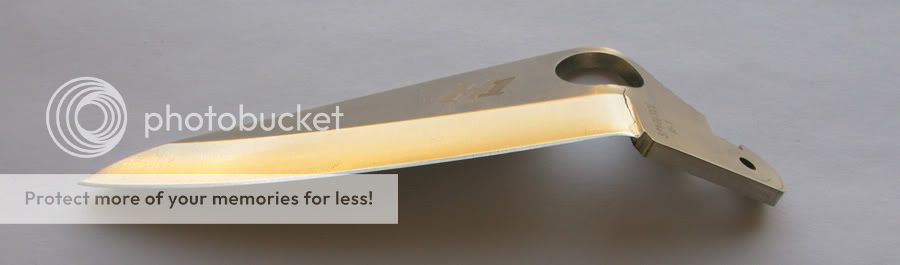
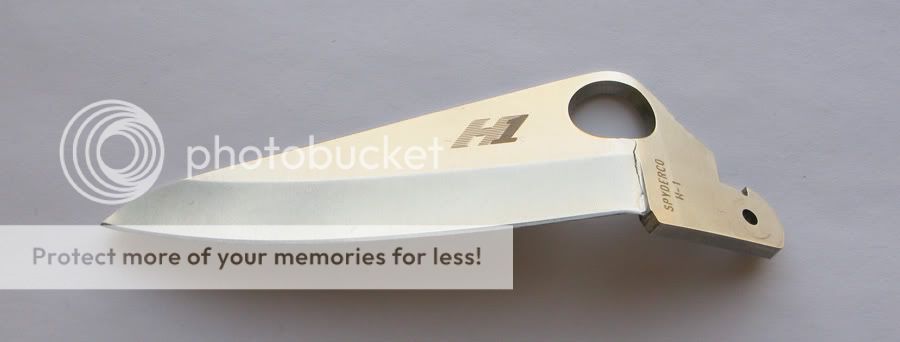
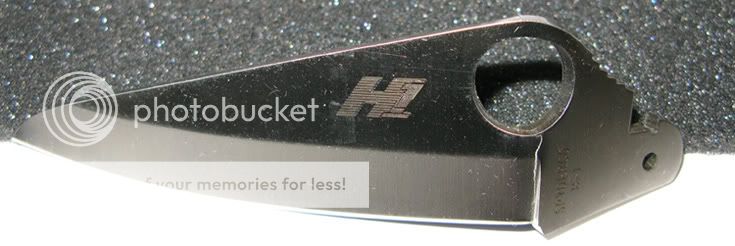
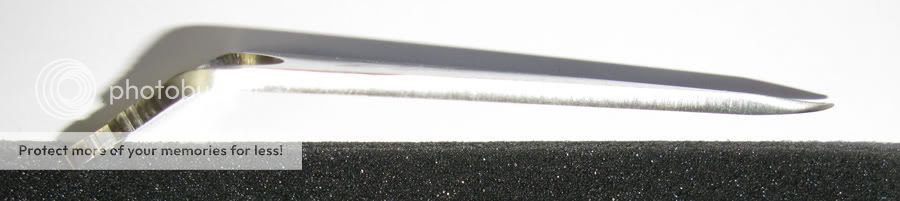
These are photos of an H1 blade tested by Spyderco showing that the blade bends instead of breaking.

BentH1.jpg


BentH1_2.jpg


BentH1_3.jpg


BentH1_4.jpg


BentH1_5.jpg
 
Thank you for the reply. It's always nice to get first hand information. Let me ask about another steel. Did you ever use AUS 8. I believe the SOG Seal Team Elite is made in AUS 8. Do you have any experience with it?

No problem.

The only aus-8 blade that i have is my original delica but I never took that out with me. I did use a small buck fixed blade as a bait/beater knife but I don't remember if it was a 440 or aus series steel. Regardless it rusted quickly and aggressively.

A couple of things that i found made a big difference in a saltwater environment.

1.) A highly polished blade helped. Any porous or rough steel (the file on my leatherman for instance) rusts more quickly and more aggressively.

2.) As long as you rinse off your blade as soon as possible rust can be kept at bay. The surface rust on my endura was really more of a staining that i could quickly rub off with some ultra fine steel wool. I never let it get past this stage so I don't know how quickly it would progress or how aggressively it would progress on vg10.

Anything that I took out I soaked with "Sheath" protectant by Birchwood-Casey. That stuff is amazing and pretty much halted rust in my leatherman even after it would get dunked in saltwater. Again though the stuff smells horrible and I wouldn't directly use it on anything that I would ingest.
 
Those pictures make me sad and intrigued.

On the one hand it's sad to see any Spyderco blade damaged, but on the other hand it's nice that Spyderco does such extensive testing. The point of the pictures is to show that H1 is not a brittle steel and that it will bend before breaking. I would imagine that in normal use there is no way one could get a H1 blade to bend like that. The handle would likely fail long before you got that kind of damage.

H1 has proven itself to be a very tough, versatile steel suitable for a wide variety of uses.

TLR, thanks for your reply.:)
 
Back
Top