H1 super steel??

Joined
May 8, 2001
Messages
2,548
I was thinking it might be nice to have a PM version of H1 with a high carbide volume (with small carbides and a fine grain from the PM process), matching the "super" steels in edge holding (in plain edges, serrated H1 is already in the VG10 class) and keeping the rust proof qualities of H1.


Has anyone done any any experiments along these lines?


Thanks.


Frank
 
One question. How do you form carbides when most of the carbon has been replaced by nitrogen?
 
The only steel that comes close to what you want is Nitrobe 77.

[video=youtube;8UQ2oRRYK_s]http://www.youtube.com/watch?v=8UQ2oRRYK_s[/video]

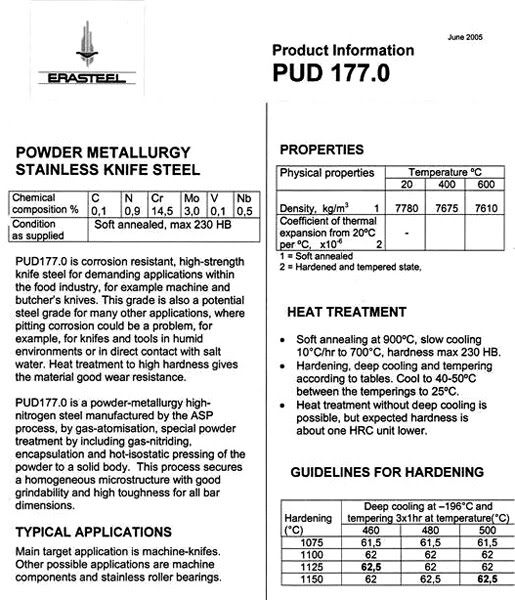
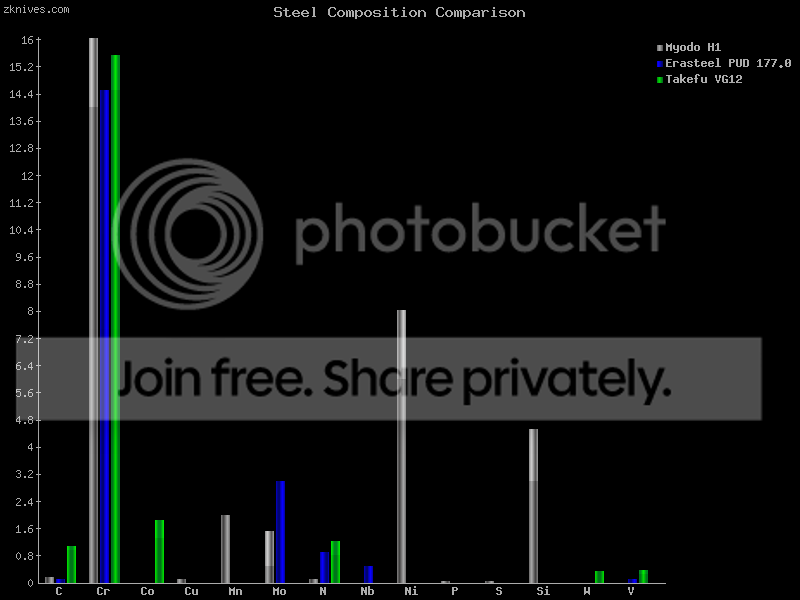
As can be seen from the chart posted NITROBE 77 has almost no Carbon (0.1%) which has been replaced with Nitrogen at 0.9%.
Being the local sole agent for Damasteel I received an experimental batch and have been using it for the last year .
It is absolutely stainless and can be put in a dishwasher!
It is tougher than RWL 34 at a hardness of 62HRC .
Its most impressive feature is its super sharpness. As a result of the size of the molecules it has a much finer edge geometry than RWL34 making it sharper.

It machines, grinds and polishes fantastically but it does have drawbacks for the maker.
There is de-nitrogenisation of the surface during heat treating.
Still in the experimental stage we do not know exactly how deep this is so I am heat treating at full thickness and grinding hard.
The heat treating is complex with four (yes 4) cryogenic quenches in liquid nitrogen between hardening at 1100°C and three 1 hour tempering cycles at 480°C .
Nitrobe 77 shows more potential as the ultimate knife steel than anything I have worked with to date.
There are a number of excellent blade steels available but Nitrobe 77 is harder sharper and tougher than anything I have ever used.

Hi Oubaas,
cost of steel is roughly 30% more than RWL-34 but thats not all since the heat treating is far more costly than normal with 4 sub-zero quenches and 3 tempering cycles at 500℃.....!
BUT IT'S WORTH IT.
Des

When compared to other steels like 440C or N690 etc. Machining , drilling and milling is a pleasure especially polishing.(The grain structure is extremely fine , hence its phenominal sharpness as well)
I grind all my blades hard with Ceramic belts.
Many knifemakers grinding soft feel the belts getting blunt rather quickly , but my view is that they are actually clogging up with a build up ,(visible as a shine on the belt surface) and this does not happen when grinding hard.
This build up can be removed with a fine diamond dresser!
This steel is tempered at 500℃ so is far less sensitive to burn ,or softening from over heating , while grinding.
I still never let the blades get hotter than I can hold.
:biggrin:


However...there is no more stock available in the world :( I should receive a custom with it near the end of the year if all goes well. Still on the waiting list.
 
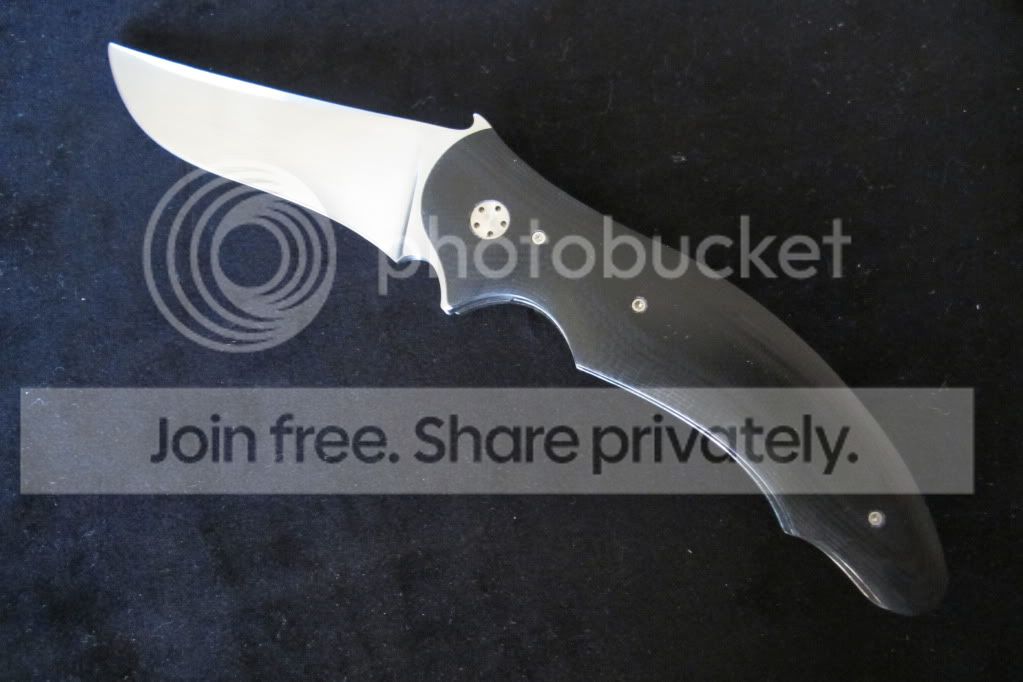
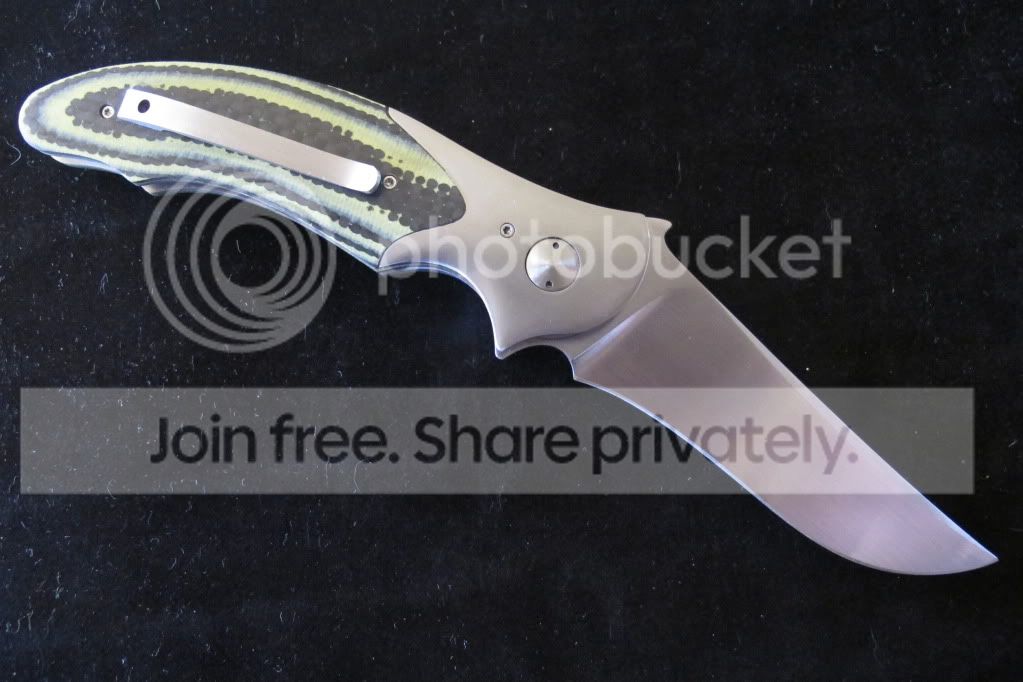
There are some available by a local South African maker that was experimenting with a knife design.

IMG_0567.jpg


IMG_0553.jpg
 
I was thinking it might be nice to have a PM version of H1 with a high carbide volume (with small carbides and a fine grain from the PM process), matching the "super" steels in edge holding (in plain edges, serrated H1 is already in the VG10 class) and keeping the rust proof qualities of H1.


Has anyone done any any experiments along these lines?


Thanks.


Frank

This pretty much describes Vanax 75 (used in the Kershaw Tilt).

I don't know if it's "rust proof", but it is a Nitrogen alloy (with 9% Vanadium:eek:) so it'll be pretty good.


I still wonder if Carpenter steel does Nitrogen alloys, if so they could probably mix up an equivalent for a sprint run.
 
I was thinking it might be nice to have a PM version of H1 with a high carbide volume (with small carbides and a fine grain from the PM process)

I was under the impression that H1 was already a particle/powder metal (not a steel, technically).
 
I was under the impression that H1 was already a particle/powder metal (not a steel, technically).

Correct me if I am wrong, but does not all of the base of all alloys are Iron (Fe) or "raw steel",from there different transition metals are added, in this case, some non metals. These create alloys.

http://www.ptable.com/

nitrobe77a.jpg


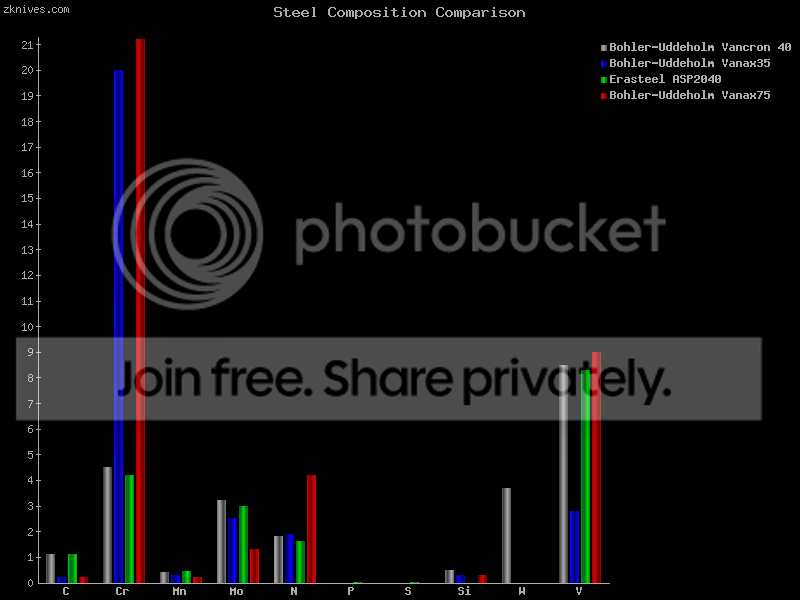
Here are some comparisons.

Nitrogenalloys.png


Nitrobecompared.png
 
Last edited:
The "traditional" definition of steel, was an iron alloy with a certain minimum amount of carbon in it, IIRC H1 is just below that line. A mere technicality, but would be nice to get the final word on that someday. In regards to the OP, first thing that came to mind were Vanax 35 and 75. I don't know if they have the same interesting "work hardening" ability of H1, and I imagine their ultimate rust resistance won't quite match up. Vanax35 might be close though.
 
Back
Top