Hafting an axe without an eye.

Joined
Oct 31, 2004
Messages
1,442
Hi everyone,

I'd like to try making a hand axe, but I don't have the knowledge or tools to make an eye in the axe head. I know that a there are a lot of ancient techniques for hafting an axe (e.g. a stone axe) that don't require the head to have an eye — could someone school me on them?
Thanks,
Chris
 
Guy by the name of Pipeman I believe made a couple hawks without an eye, he used a file as the bit and instead of making an eye with the file he carved out a slot in the haft itself.
 
Guy by the name of Pipeman I believe made a couple hawks without an eye, he used a file as the bit and instead of making an eye with the file he carved out a slot in the haft itself.

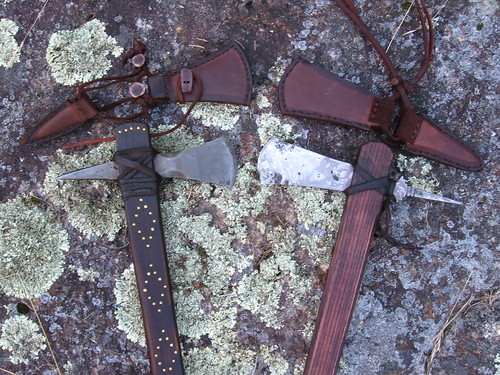
Here are a couple of pics. The blades were actually forged from old high end Sorby chisels. I wouldn't call them axes but they throw very well.

Regards

Robin

4150389265_787286b414.jpg

4459857069_f4bfe960f6.jpg

4451772778_d05ccb6f98.jpg
 
Thanks for the photos, Pipeman! Are there any tricks you'd be willing to share?

- Chris

Hey Chris, there are No secrets ;-)

The biggy is to have shoulders on both ends where they meet the haft. In other words, the part that is inside the haft is narrower than the spike and the head where they meet the haft. The hafts on both of the spike hawks are made from Ash hockey stick handles, split down th middle with a tight notch to hold the head in place. Lots of epoxy in the blade slot and lots to join the handle pieces back together. LOTS of clamps. John Cohea makes this type of hawk but uses heavier hafting material and pins them in place. The striped one I throw a lot and have had no problems with cracking or breaking the haft. As you cansee the thin blade went right through the hickory have on my other thrower. Chisels are SHARP ;-)))

Hope this helps

Regards

Robin
 
Thanks, Pipeman, that's a huge help. I have one or two knives on deck right now, but after that I think I'll give this a try.

- Chris
 
Old school, new school, it's all good.

Chris

blind threaded holes in tool steel head... lets me use difficult to forge alloys, loads grade 8 bolts in compression rather than shear, keeps thickness down (no bolt heads sticking out the sides) As far as I know, I'm the only person using this method. It won't work with wood handles... I use t6061T6 aluminum alloy.

splitterbirdmedium.jpg
 
Hey dude,

Depending on if you have welding gear or access to someone who could do it for you, you could weld a piece of steel pipe to the back of the head to serve as an eye. That would dictate the shape of the head too though...no spikes on the back or anything....

Another option might be to rig up a rugged steel ferrule with a slot drilled through it to accept the head. Drill a rivet hole or two in the head. Mount the ferrule on a handle and drill through the side of it to line up with the hole (or holes) in the head. This bit would be rather fiddly. put the head through the slot, lining up the rivet holes in the head and the ferrule/handle. put through and pein over some solid steel rod to hold the whole thing together.
It'll look a bit post-apocalyptic and you'll need dynamite to get it apart if the handle breaks, but it should do the trick without forging an eye or needing to befriend a welder. Just a thought...
 
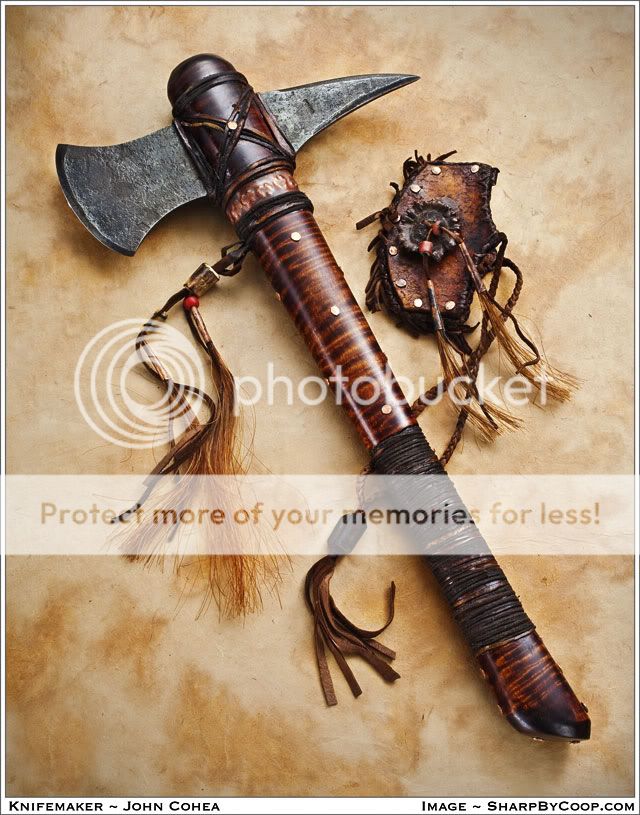
Here's a couple of mine made as you are talking about. These are real popular for me right now, and the second one was just featured in an article in the Sept. issue of Blade magazine!I mount my heads by drilling a slot in the haft while the stock is square. I drill the slot undersize then heat the spike end of the head and burn it the rest of the way through from the front side of the haft. Once the haft is shaped, head heat treated, ect, the head is pinned in place with 4 steel pins, then wrapped in wet rawhide lace in a way that the pins are hidden from view. Hope this helps!
K05565-Cohea-John-M-final1.jpg

orig-2.jpg

ha.jpg
 
Last edited:
How do these designs deal with torque? I/E having the bit deep in a piece of wood and turning the handle so the edge of the blade twists to widen a gap in the wood (like for accurately slow-splitting bow staves).
 
Here's a couple of mine made as you are talking about. These are real popular for me right now, and the second one was just featured in an article in the Sept. issue of Blade magazine!I mount my heads by drilling a slot in the haft while the stock is square. I drill the slot undersize then heat the spike end of the head and burn it the rest of the way through from the front side of the haft. Once the haft is shaped, head heat treated, ect, the head is pinned in place with 4 steel pins, then wrapped in wet rawhide lace in a way that the pins are hidden from view. Hope this helps!
K05565-Cohea-John-M-final1.jpg

orig-2.jpg

ha.jpg

Love your stuff John
Great hawks, great knives, great sheaths, my kinda art.

Best regards

Robin
 
How do these designs deal with torque? I/E having the bit deep in a piece of wood and turning the handle so the edge of the blade twists to widen a gap in the wood (like for accurately slow-splitting bow staves).

I guess my opinion on through the haft hawks is that they make great throwers and even great fighters a 150 years ago but they aren't axes. I throw the bigger one in the picture all the time and I love it but I pull it straight out of the tree with no prying sideways. The ones I made are very light and there's not much wood around the "tang". I think Johns would handle a lot more torque than mine. I can't see them being used for splitting bows because the handle would likely get in the way. Seems to me that a really fine hatchet may work best for that chore.


Best regards

Robin
 
How do these designs deal with torque? I/E having the bit deep in a piece of wood and turning the handle so the edge of the blade twists to widen a gap in the wood (like for accurately slow-splitting bow staves).

Thanks Robin for the compliments! As Robin noted, his method of construction (two piece haft) would handle little totque Mine would be more likely to handle torque due to the construction being more solid.The way I burn the head into the haft makes for a tight fit, then the four steel pins and the way the wet rawhide shrinks around the head and haft makes for a very solid unit.I test these things by chopping seasoned oak logs, with absolutely no movement of the head.These things are pretty to look at, but make no mistake about it, they are a 100% functional tool/weapon!
 
John Cohea: Very nice! I was kind of thinking of drilling undersize then burning through, so it's nice to know it works. How thick do you make your heads?
Wnease: Really cool and creative way to do it. Too high tech for me right now, but thanks for sharing.
 
John Cohea: Very nice! I was kind of thinking of drilling undersize then burning through, so it's nice to know it works. How thick do you make your heads?
Wnease: Really cool and creative way to do it. Too high tech for me right now, but thanks for sharing.

I am currently using late model Ford truck leaf springs, and they are usually around 3/8" thick. I start with a 7" length, upset the blade end and then widen, then I draw down the spike end leaving the middle as is. I usually shoot for a head length of around 9" with a 3 to 4 inch wide cutting edge.
 
Back
Top