Hamon Advice

Joined
Jul 19, 2008
Messages
199
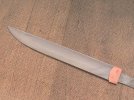
I was unpacking some things and I found this blade that I made more than a year ago, but couldn't finish before moving. It's 1095, 9 inches, and was clay coated to get a hamon. I hand sanded it to 2000 grit and etched in vinegar and dish soap. At this point is has a nice hamon, but there is still a lot of activity that I can see if the light hits just right, and I would like to bring it all out so it pops off the blade.

So my question is: What can I do to really make the hamon stand out better? Here are some photos, but they don't show all the activity that I think could still come out.
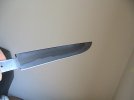
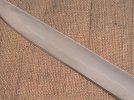
IMG_0355.jpg

IMG_0862.jpg

IMG_0859.jpg
 
Maybe hit it for a few minutes with some diluted ferric chloride?
 
Well, you are going to have to experiment, and you may have to redo things before you get it right, two steps forward, one step back, that kind of thing.

The best advice I've had is to use multiple weak etches, perhaps many multiple etches, like the one you did, with very little in the way of abrasives in between. If you can find it there is a oxide remover called Noxon that does wonders for removing the gunky oxide residues after the etching but is non-abrasive. You may find that a dilute ferric etch folowed lightly by high grit paper followed by weak etches and fine pumice ground finer with a mortar and pestle works. Or variations-combinations thereof. Or the same media with different backings like felt, leather or cotton makeup pads. Or not polishing to as high a grit before etching, etc. etc. etc... Brian Vanspeybroeck recomends trying tiny amounts of Flitz thinned out with mineral oil which works very well but there is a fine line between having it too agressive. Patience is key!

I'm working on some 1084 blades with beautiful hamon which have a ton of activity as well, but getting interesting stuff to show is a whole 'nuther thing. And then getting it to show in a photo is probably the most challenging.
 
i have found threw trial and error thats some things work well on some knifes to make the hamon pop and it wont work on the next not sure why but just seems that way sometimes. usually i go to about 1200-1500 wet sand paper and do the strokes all the same way, i clean it well with acetone and then do multiple 12-15 seconds dips in Fc diluted 1 to 4. inbetween dips i gets cleaned up with Mirlon 2500 grit scotch pad. After the last dip with the same mirlon pads i will use various compunds weeted with the mirlon pads and make a slurry. i have used pumice stone, cerium oxide, aluminum oxide 6 micron, and lapping powder grade 600. do any of those, or combinations of will make that hamon pop and show things maybe you arent even seeing now.
 
the lapping powders and various other powders can be had from a lapidry store. I have one 5 minutes from my house and they have a wonderful selection of stuff. Check your phone book. the pumice can be had from most woodwoorking stores. i believe there is 3 grades. 2f, 4f and rootenstone.
 
I've grown pretty fond of the powder abrasives for removing oxides.

I bought 600X, 1000X, and 0.3 micron from Mager Scientific off of Don Fogg's recommendation a few years back.

http://www.magersci.com/index.html

I did a REAL quick look and only saw the stuff in their clearance section, so they may have discontinued it. The rock polishing and gem stone supply stores usually have several varieties, as was mentioned.

It works much differently than the equivalent grit on paper, so you really have to play around with it. I just mix it with water in the bottom divot of a soda pop can (you've gotta turn the can upside down first ;) :p ).

This is after first sanding the blade to an EXTREMELY CLEAN AND EVEN 1500 to 2000 grit with paper and blocks.... and then etching with warm vinegar/soap. The knife I won the Peck award with took 27 etches to get it where I was happy with it! (that's etching and removing oxides every time!).

It looks really good so far... please show it when you're all done :) :thumbup:
 
Good advice from Nick. I need to try the powdered abrasives myself. I found the Noxon at a local Ace Hardware and it works very well. If you try it you want the finest grade of pumice and like I said it can stand to be ground even finer. This is spurring me on to work on the tanto I have, it's at 1500 grit right now with no etches. This is however my second round of polishing with it as the first go around didn't come out as I would have liked.
 
You've really peaked my interest Guy... what part of the hardware store did you find Noxon in? Like automotive?

I've got a nice ACE down the street (the ONLY thing that's close in my tiny town, lol) :) but I doubt if they'd know what Noxon is if I just ask.

Thanks Guy! :)
 
You've really peaked my interest Guy... what part of the hardware store did you find Noxon in? Like automotive?

I've got a nice ACE down the street (the ONLY thing that's close in my tiny town, lol) :) but I doubt if they'd know what Noxon is if I just ask.

Thanks Guy! :)

Hey Nick, I've been trying the Noxon also on the advice of Brian Vanspeybroeck and it does work very well. Among other things it has ammonia in it and it does a very good job of removig etching residues/oxides. Ace is the only place I've found it here and it was in the household cleaning section with other metal polishes like Tarn-X. You never know, I was just happy not to have to order something for a change.
 
Thanks for all the advice everyone. I've been trying some of your suggestions, and they are helping. I will try to post some more pictures as things progress.
 
Back
Top