
Hamon Formulas with Parks #50

Joined
Jul 27, 2003
Messages
5,699
I'm looking for some input - aren't we all - and am hoping I can get some freguent posters here to really open up and share their successes with steels such as 1095/W1/W2, Parks #50 oil and clay quenching to achieve the hamon they are looking for.
Their are makers like Craig Camerer and Matt Lamey who repeatedly nail that hamon exactly as desired and I am looking for that type of input.
I seem to "chase' my successes and am only batting about .500. To top that off, when I fail, I can't seem to spot the variable. I often push that hamon down near the edge for no known reason. I'm beginning to think it's something as simple as my oil temp.
I did one just the other day and that hamon stayed EXACTLY where I placed the Satanite. (Picture included)
Now today I did two and one was pushed down right near the edge. What's that all about?
From steel source to forging, through post forging, to grinding and austenising, soak times, clay placement, etc., I have tried to keep all variables at a constant. Yet end up with varying results.
Now, I'm sure there are those who will pipe in and comment about how it's always really uncertain and "you just gotta play with it". I've heard those before.
Let's just make this about the successes! How you do it when it's exactly like you want!
For instance, Parks #50 states that it is a water speed oil "at room temperature". Whose shop are we talking about and at what time of year?
Should it be 60, 70, 90, 120, etc? What temp?
Does warming up #50 make it any faster and more likely to keep the hamon near the clay?
I would also be interested in controlled temps such as digital ovens. Some use gas, but I like my oven for the peace of mind. Just me.
I hope some guys who have great success will share on this one.
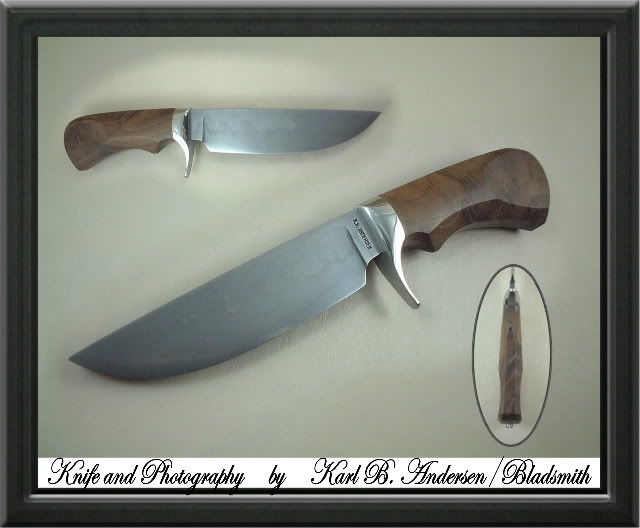
RO6-1.jpg
 
My #1 question is how thick is your clay? For me, my oil is always the exact same temp and use a digital oven, and even when doing sets of knives that were all normalized together, ground together and heat treated together, the #1 thing that makes the hamon vary is the clay thickness. it seems that even very subtle changes in thickness can have a pretty big effect since you are effectively "pushing" heat down from the spine against the cooling coming up from the edge and the oil to prevent it from cooling too fast. Evey time my hamon gets pushed too low, I remember that the clay was a bit thick. I have rarely, if ever, had a hamon surge too high and have started using less and less clay each time to find that sweet spot.
 
I can't recall offhand where I read it, but I do recall reading that parks is a bit faster and a bit more likely to be smooth and even if it is heated to a consistant 140* F.

I'll look through my bookmarks and printed literature to see if I can come up with the source of that, hopefully there will be some more information that will be more helpful.
 
Thanks for your reply David.
You said, " For me, my oil is always the exact same temp..."
What temp?????
And, you use an oven, but at WHAT temp and WHAT time????
My clay is approximately 3/32", maybe less. I have had no success with heavy clay.
Sometimes just a smear.
 
I can't recall offhand where I read it, but I do recall reading that parks is a bit faster and a bit more likely to be smooth and even if it is heated to a consistant 140* F.

I'll look through my bookmarks and printed literature to see if I can come up with the source of that, hopefully there will be some more information that will be more helpful.

That was exactly my next step, Dan, was to raise my oil temp.
I'm gonna get all of these dots connected and info like that is just what I'm lookin' for.
Thanks.
 
Hey Karl,
I'm no Matt Lamey, but here's what I've learned the hard way:

The less clay I use, the better I like the result. Use too much, and the hamon gets too close to the edge.

I soak at 1450 for 15 to 20 minutes.

I don't always preheat the oil, at least in warm weather.

Don't use anti-scale compound on the blades in addition to the clay.

Try to get each side as identical as possible, or you'll have massive warpage. Don't ask me how I know. :mad:

Hope this helps.

Phillip
 
Karl,

I know you are going to say that you would rather not have any blade crack but... why don't you try water at 110 degrees instead of oil? If I want a great hamon that is my choice. I am not saying that you can't get a great hamon with a fast oil but for me water seems to do the trick.

Other than that there are certainly a number of variables to play with including one that is not mentioned much: the thickness of the blade itself and its profile. You can make a hamon without clay just based on this variable alone.
 
I would listen to anything you have to say, Jesus! I also agree with the hamon and no clay approach. I just did exactly that, but the entire front 1/4 of the blade was dead soft. The remainder was a WILD hamon.
I was prompted to make this thread by Matt Lamey's knife in the "custom thread" - http://www.bladeforums.com/forums/showthread.php?t=557321
That knife was NOT created using NO clay - he put that hamon right where he wanted it like it was painted on.
Thanks for your input, Phillip.
I've possibly been undercutting my soak time a bit and on the next attempt was going to bump it up a few minutes to ensure I had everything up to temp.
I don't use any anti-scale. To speak of, knock on wood, I've never had "massive warpage" at any time since I started making knives. I think your symmetry of grind has as much to do with warpage as anything else. Different mass cools at different rates = warpage.
 
First, that is a GREAT looking knife Karl, like every knife I've seen of yours :thumbup:

Excellent thread and questions. You've hit everything I've been struggling with right on the head ! Anxiously awaiting more input from others.

Jesus, could you please explain a bit more about what you mean by being able to create hamon without clay ? Hamon or quench line ? And when you talk about using water do you mean a brine solution or straight H2O ?

Like David Schoot, I have been slowly adjusting my clay thickness to find that perfect level. Moving in the less clay = more activity direction. What a difference just a slight change can make !
 
I would listen to anything you have to say, Jesus! I also agree with the hamon and no clay approach. I just did exactly that, but the entire front 1/4 of the blade was dead soft. The remainder was a WILD hamon.
I was prompted to make this thread by Matt Lamey's knife in the "custom thread" - http://www.bladeforums.com/forums/showthread.php?t=557321
That knife was NOT created using NO clay - he put that hamon right where he wanted it like it was painted on.
Thanks for your input, Phillip.
I've possibly been undercutting my soak time a bit and on the next attempt was going to bump it up a few minutes to ensure I had everything up to temp.
I don't use any anti-scale. To speak of, knock on wood, I've never had "massive warpage" at any time since I started making knives. I think your symmetry of grind has as much to do with warpage as anything else. Different mass cools at different rates = warpage.

There's more to warpage than mass cooling at different rates. What happened to me the last hamon I did was, one side had slightly less clay, so more of the blade was exposed to the quench. This means more martensite formed on that side of the blade. Martensite is less dense than pearlite, so that side expanded more than the other side when they cooled below the Ms point. Which resulted in massive warpage. :(

This sort of thing isn't a problem with deep hardening steels, like O1 and 52100, but it happens a lot to me with W2. It's irritating.
 
Oh, I couldn't agree more, Phillip. I'm just saying that I don't have a problem with warpage - I watch the symmetry, and that includes equal martensite formation from clay placement.
Since you said "This means more martensite formed on that side of the blade. Martensite is less dense than pearlite, so that side expanded more than the other side when they cooled below the Ms point. Which resulted in massive warpage.", only further illustrates what I meant by symmetry, if even on an atomic level.
 
Expensive equipment does not always translate into superior heat treat. Ive sold very expensive digitally controlled ovens to go back to a good propane fired heat treat forge that gives me MUCH better results.

Heat treat is a funny thing, I can give another maker the exact way Ive treated a blade, both using steel from the same batch etc... and we will come out with different results. IF it were as simple as whats written in a book then there would be little to no trouble out there with heat treating, and it wouldnt really even be a topic.

The above quote is by Matt Lamey, posted by Tai Goo in another thread.

Karl, practice, practice, practice. The elusive hamon can be frustrating. I have thrown away blades after 5 quenches, then have the next come out fantastic on the first quench.
 
Oh, I couldn't agree more, Phillip. I'm just saying that I don't have a problem with warpage - I watch the symmetry, and that includes equal martensite formation from clay placement.
Since you said "This means more martensite formed on that side of the blade. Martensite is less dense than pearlite, so that side expanded more than the other side when they cooled below the Ms point. Which resulted in massive warpage.", only further illustrates what I meant by symmetry, if even on an atomic level.


Exactly, symmetry is what I was trying to use too many words to say. :D

If you don't have warpage, great! I wish I could say the same for myself. :(
Guess I need to practice more. :)
 
Karl, i didnt know this thread was here or I would have posted earlier. I replied to your email with what works for me. I think part of the reason folks get into trouble is application of clay that is too thick and insulates too much, resulting in areas to near the edge that didnt convert. I dropped my temp down to 1450, used to quinch at 1500. At 1450 you can apply the clay a little lighter, and still follow it fairly well, and a side benefit i found was that there is less warpage (for me) at 1450. Ive gone as low as 1400 on some blades (depending on thickness, width etc) with good results as well. You have to be always aware that clay thickness, blade geometry, soak time etc. are all very critical to the end result. When i quinch at anything at or above 1450 I dont soak at all. If im messing around below 1450 (usually expereminting) I will normally put a short soak (5 min or less).

Don hit on the biggest thing, just gotta try different things from other makers and you will eventually come up with your own formula that works best for your situation.
 
Warpage is funny. I had been doing some small little blades and always got a tiny bit of movement when i quenched, but easilly ground it out in my final grinding. I thought to myself "it is what it is." Then i did a batch of 6 damascus knives that didnt have clay and they came out just as they did before the quench. Now that I think back, almost all my small warpages have been on clay coated blades. That clay makes things pretty but its a love-hate relationship!

I still have a crazy idea I am going to try one day....instead of using clay, im thinking of making a "stencil" out of something that can be clamped to a blade and act almost like clay when quenched....i still havent brainstormed exactly how that will work, but if my evil plan ever comes into existence, I will let you know.
 
Thanks a ton Matt and Don.
You've given me a lot to think about.
I just made a successive attempt on a recurve Bowie with some changes that I had calculated, and it was a complete, utter 100% failure.
Guess this is a learning day.
I'm turned around 180 degrees.
I go hotter and I should have gone cooler for less time not more time, etc.
When when of you Big Dogs is ready to do a Clay Hamon/Quenching class, sign me up.
 
I've often thought that there might be an element of "Hado" involved:
https://www.hado.net/

I think it helps if you can focus your attention, clear your mind of distracting thoughts, anticipate and visualize the type of hamon you want, and think beautiful thoughts. For sure it couldn't hurt anything... :)
 
I've often thought that there might be an element of "Hado" involved:
https://www.hado.net/

I think it helps if you can focus your attention, clear your mind of distracting thoughts, anticipate and visualize the type of hamon you want, and think beautiful thoughts. For sure it couldn't hurt anything... :)

I couldn't agree more!
I do that every morning when my feet hit the floor.
Probably the most important moment of my day.
 
Karl, I don't have as much experience with clay quench lines as Don and Matt, maybe only 20 or so. I've been more interested in the quench line effects I can get without clay, multiple and rainbow color banding, perpendicular zebra stripes etc... However, with the clay quench lines I have used a variety of "formulas", different clay recipes, clay thickness, steel types, geometries, temps and timing, and have had a 100% success rate,... so far. I judged the temps by eye, and the soak times, intuitively in conjuction with what the books and charts said. They all came out pretty close to what I anticipated. Hado was the only constant "formula" I used in any of it. However, I do believe that the physical requirements must be met first, but beyond that,... how can I explain why some just turn out better than others? I'm sure that there must be some underlying scientific explanations for it, but they might be slightly beyond conventional science at this point in history. I'm sure the traditional Japanese swordsmiths were aware of it though. What "Hado" claims is that our thoughts effect our physical actions on a subconscious level and the subtle expressions of all matter. I don't think it's too much of a stretch to draw a relationship between the crystallization of water and the re-crystallization of steel. :)

Don't heat treat when you are in a negative mood...

Some days and some moments,... everything just clicks! :)

I'm curious what Matt and Don think about it?
 
Last edited:
Back
Top