Hamon Goodness (or NOT!)

Joined
May 17, 2006
Messages
450
I hesitated at posting this at first because I was somewhat ashamed of my first attempt at producing a hamon. I am going to suck up that shame however for the sake of learning for all of the would be hamon makers on the forum. I've spoken with a few of what I consider to be the "pros" at this stuff and am eager to give it another go. A little bit of backround info so that you know what I started with and how it DIDN'T work: Blade is 1095. 1/4" thick at the spine. Full flat ground and I left approx 1/8" on the edge in order to do a convex after all is said and done. Blade is 10" from handle to top edge and approx 2.75" wide. After rough finish I used furnace cement as a "clay" and applied it about half way down the blade surface in a wavy pattern that I thought would start the hamon line well. I let that stuff dry overnight and then it was on to heat treat. This is where things went downhill, although I didn't have a clue at this point. The heat treat seemed to go well. Ran up the oven to 1475 for 10 minutes and then quenched in oil. The cement held on but seemed to bubble a bit during quench. After initial cooling, the cement broke off real easy and I had what looked to be a really nice start to a differentially treated blade. The steel under the cement looked virtually untouched and the exposed steel had all the scaling and blackness I usually see on just quenched steel. (On a side note, the smoke build up in Ken's shop was unreal at this point. When we cracked the door I'm sure the neighbors thought there were some rastafarians having a good time in there.) When I got home, I cleaned up the blade initally with some 220 grit and I could see some grain patterns right along the line where the cement was. Good news I thought. I ran a file over the spine and it was soft and it skated over the edge so I thought I was in business. (I also learned during this experiment not to trust the file test on a differentially treated blade...you'll see why) I tempered the blade at 400 for 1.5 hours twice. It got to that nice straw brown color both times so again I thought "this is too easy". After temper, I sanded off the scale and such with a hand belt sander and got it back to "white steel" (a Matt Lamey expression) and proceeded to run up the grits in different directions all the way to 400 lengthwise. At this point I was starting to see some really shiny areas around the choil and the top edge of the blade. This is when I started to have my doubts that the hamon was where I wanted it to be. It's kind of hard to describe the areas other than that they seem to shine up just a little more than the rest of the blade. (I'm sure the pros know what I am talking about here) Anyway, I kind of shrugged it off and thought that it must be just some strange metalurgic thing that my jarhead brain can't comprehend so I moved on to attaching the handles and getting them all cleaned up. I used rubber for these BTW and I LOVE this stuff. So now the blade was good to go and ready for etching. I filled a 4" wide x 2' long PVC pipe with vinegar and set a space heater next to it to warm it up and dunked the blade in hoping for the best. (mind you, at this point I was still somewhat confident in myself...lol) 2.5 hours later I pulled the blade out and neutralized with windex and went on to polishing with chrome polish. Well, this is where the "oh crap" set in and I realized just how much of a novice I really am. Here are some pics of the result:
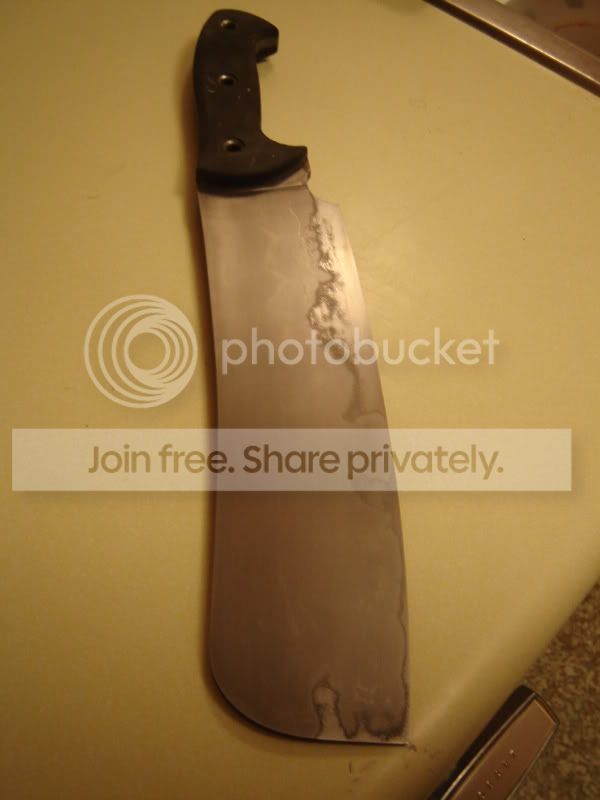
DSC01061.jpg

DSC01059.jpg

DSC01058.jpg

You can probably see where the cement was and how far the hamon got "pushed". There is actually a very thin line of martensite running all along the whole edge except for one spot right in the middle of the blade. (probably why the file skated....and why I don't trust that method anymore) Anyway, I've sought out some pros and appealed to their greater knowledge and I have some things that I am going to try and do correctly this time around and try to fix this one. Hopefully, this wasn't too long winded but like I said, I am hoping that some newbies like me benefit from my mishap...plus I needed to vent a little frustration. Thanks to Stacy Apelt, Matt Lamey, and Chuck Richards for their patience in answering my questions and to Ken Coats who will have to endure more of my knifemaking experimentation in the future. On the plus side, the hamon does "pop"....
 
Thanks for sharing, it's good to know.. BTW that knife looks very nice, great effort, sorry for the hamon problem but all of us did and doing these kinds of errors, sharing them is very helpful for community IMHO.

One question: Do you use natural rubber or synthetic one and how do you prepare. I have found some pallets of rubber, do you cast yours or just grind to shape...
 
Thanks for sharing, it's good to know.. BTW that knife looks very nice, great effort, sorry for the hamon problem but all of us did and doing these kinds of errors, sharing them is very helpful for community IMHO.

One question: Do you use natural rubber or synthetic one and how do you prepare. I have found some pallets of rubber, do you cast yours or just grind to shape...

It's stall matt rubber. It has a thin layer of gray on top and when you get through that it has swirl patterns of gray/black kind of like the old woodland cammie's pattern along with the occasional yellow/white spot from recycled tires. I just cut it to shape like any other scales and clamp it to the blade. It grinds super easy and shapes really well using anywhere from 50 grit to 220. I noticed that you don't see much difference in the finish at 50 or 220. Kind of weird that way. The 50 grit belt eats it off QUICK though. Got to watch it or it flies off faster than you want. Hand sand at 220 to round the edges and you are good to go. Amazing stuff. My new favorite.
 
What kind of oil are you quenching in? I may have missed that. My guess is too thick of clay, too slow of a quenchant.
 
What kind of oil are you quenching in? I may have missed that. My guess is too thick of clay, too slow of a quenchant.

Those are the theories that have been suggested. I'm going to try the brine solution that Stacy suggested and pray I don't end up with a cracked blade. Not really sure what Ken uses as a quench oil but I would gather it's too slow for hamon work on 1095. We also quenched "tip" down and straight in. Stacy suggested I do it edge in which I imagine will have a significantly different effect. Also, I had no idea about the "down for 3 up for 3 and down to cool" method. What I find strange, is that the area closer to the choil ended up retaining more martensite. That area would have been later into the quench and also at a higher temperature in the tank than the area closer to the top of the blade. You would think that the top would have a wider "hard" area.
 
I spoke with Garrett last night. He seems to have a good idea of what he wants to accomplish. As you all can see, he is learning that a hamon is a very tricky quarry.

[ BTW, the word hamon means edge ripple or wave. It refers to the lines left on the edge of shore by the waves, or to the ripples in the pond at the edge. Ha means edge. As far as I know, the word is pronounced HA, as in ha-ha-ha (laughing) - Mon and in moan. It does not rhyme with Hammond as in the organ. (again, this is how I understand the word) ]


I gave him some advice and information on forming a hamon. Then I told him that if he really wanted to get his feet wet (bad pun), he should add 2-3 pounds of salt to five gallons of hot water, and do an interrupted quench. I explained that this will make him a member of one of two clubs. The rather hard to join club where you haver successfully water quenched a 1095 blade, or the PING club. I advised that the heartbreak of attending several PING club meetings is the dues you will pay to enter the water quenched hamon club.


For those learning or wanting to try a hamon, here is some info on how it forms. Knowing this allows you to adjust the results as you develop your quenching method. There are no set procedures to get a perfect hamon. Every set of circumstances(forge, clay, metal, blade, etc.) will yield somewhat different results. It is a continuous learning experience that some Japanese smiths take as lifetime to try and master. Walter Sorrell's video on hamon is a good learning tool for those who want more info.

The steel for a hamon needs to be shallow hardening and have as few alloying ingredients as possible.W-1,W-2 are two of the best. 1095 works well,too.Most 10XX steels are shallow hardening enough to work. 5160 would be one of the worst. Stainless and air hardening steels are not suitable at all.

The hamon ( literally - 'the ripple along the edge') is the junction point between two different structures in the steel. It differs from a temper line, which is the junction of two different hardnesses in the same steel structure.
A refractory clay is used to coat the spine and part of the blade. Any clay or similar material that will take the high temperatures and hold up during quench will work. APG-36, satanite, potters clay, secret mixes of ash and mud, etc. all will work.This clay does not insulate the steel, but just slows down the transfer of heat during the quench.
The structures we are talking about are martensite, which forms the edge, and pearlite, which forms the spine. As the steel is heated to quenching temperature (1450F-1475F for 1095) the structure becomes austenite. The blade is held at this temperature for a long enough period for the entire blade, including the part under the clay, to come to an even temperature.
At quench (using 1095 as an example) the steel has about 1 second to drop below the pearlite nose. That is the point where the steel either converts to softer pearlite or continues down to hard martensite. It takes a fast quench media to do this. Fast oil will work, but for maximum speed, water or brine are the top contenders.
The exposed edge steel will drop below this nose pretty easily. The steel under the clay will not get in contact with the quench medium and thus won't cool fast enough to miss the nose. This sends it to a life as pearlite. The heat under the clay is still very high, maybe still 1400F, and will leach,or bleed, down into the blade surface toward the edge. This is where the techniques of clay coating and quenching come in. You want it to auto-temper the steel just a little below the clay edge. Too far and the soft steel goes all the way down to the edge. Too little, and there is little or no hamon.
In a water quench the steel cools much faster, and the stresses can break or crack the blade. An interrupted quench allows a short respite from these stresses as the steel auto-tempers. A technique used by some folks is something like.... IN-2-3 (converts the edge to martensite) : OUT-2-3 (allows the steel under the edge to go into pearlite): In till cool (to stop the auto-tempering from going too far toward the edge).

Making the clay thicker or thinner, the temperature of the quenchant, brine or plain water, time in-out, all affect the hamon.

Have fun and try a couple water quenches, Don't spend hours and hours preparing a blade for this procedure. The failure rate can be significant. Don't water quench a blade that you can't afford the loss of, either financially, or emotionally.

Stacy
 
As a many-time member of the PING club, I offer my condolences over your next few blades quenched in water. Ive only had one success with water and I think it was luck!

A few times I made it through the quench fine and heard the PING as I ran to the oven for tempering. Another made it to the oven and cracked during the temper. Those blades are so fragile after the quench that I swear you could crack them by looking at them funny.

One I did in water survived but took a negative recurve on quench. being a glutton for punishment, I tried it again. This time it took nearly a 1/2" curve (sori?) and literally tore the blade into two parts lenghtwise right along the clay line. The forces in a quench are crazy if you think about how much force it would take to shear a 15" piece of steel lengthwise like that.

Have you tried skipping the clay altogether and starting with a simple edge quench? You can get some really nice hamons using no clay at all and it might help get your feet wet. If you leave the spine above the quench, theres almost no way it can harden with 1095. That might also confirm if your quench oil is fast enough since if your blade under the quench doesn't harden, you know something is wrong.

Just keep experimenting. The science is out there, but getting it to work and getting what you want is all trial and error.
 
Very good explanation Stacy. One of your most important points in there (in my opinion though!) might be easy to gloss over when reading it though. It should be stressed, a hamon is very different from a temper line. I've seen quite a few makers / collectors / etc trying to sell knives with temper lines as ones with a hamon.

A temper line is formed when a knife is fully hardened into martensite, and then the martensitic structure is tempered further along the back of the knife by keeping the edge under water while higher heat is played across the exposed area. This is very different from the transition line between martensite and pearlite / bainite that Stacy explained above.

A little bit of material chemistry goes a very long way with knife making. Hamons are one of the ways that I show in the class I taught on intro to bladesmithing that the chemistry and physics of knifemaking can be used artistically even with minimal understanding.

Excellent thread ! And yes, the pronunciation that Stacy gave is right, based on the characters used to write it ha mo n, soft a long o. I wince when i hear people say things like hay-man or the like =P

Oh and as far as the ping of death, I find it easier to get a hamon with a bit of a thicker edge geometry left on the blade before claying and quenching. This helps both avoiding the ping, and allowing extra meat to grind off to clean up and polish the hamon.
 
At this point, I don't want to give up even if it results in a destroyed blade. Since I don't yet have my own heat treat set-up this will probably be the last one I try for a while. I don't want to push my luck with Ken's patience and I have other projects that require my attention as well. I just wanted to push forward into what I consider a really interesting part of knife making. Not that there is anything wrong with a fully treated blade, (I will still make many of those) there's just something about a blade with that sweet flame pattern of the hamon that just sings to me. Plus, you gotta admit that if it works, this will make a really sweet looking chopper. Ken and I were just saying that I have had too much good luck so far with my blades and I am bound to have a failure about now. I'm hoping that the first hamon attempt satisfies Murphy's law for the time being but I have a feeling that I will be a proud member of the ping club pretty soon. This has really jump started my motivation as of late though. I really want to get this to work so that I can say that I've accomplished it and now it's time to have fun with it. It's kind of like my first blade, it was sooo much work but once it was done I knew that it could be done and now grinding out a knife isn't nearly the ordeal that I used to think it was. We'll just have to see how this one turns out the second time around.
 
Get yourself some Tuff Quinch from Texaco or some of the Parks quinch oil. I use Tuff Quinch, warmed to about 120+/-.

The design on that knife is very nice, one thing you can always do if you dont get enough conversion is to simply re heat the blade and re quinch. If you are running lines of clay down to the edge, lighten them up a bit, or just stay completely off the edge. Always try for at least 1/4 of the blade (up the edge) to harden, especially on a chopper.

Keep us posted, and again, I like that overall design alot.
 
Good lookin knife. But wondering why you put the handle on?
Take the handle off and re-heat treat, if you can.....
 
Good lookin knife. But wondering why you put the handle on?
Take the handle off and re-heat treat, if you can.....

I did that in order to etch the blade. I normally shape the handle to final finish with it on the blade. If I were to have waited, I would've had to grind on etched steel which wouldn't have matched the flats or spine. I'm learning though. I'm going to run a light etch after heat treat clean up to see where the hamon is before I put the handles back on. Plus, the handles are shaped now so I don't have that to worry about. I just hope they come off without too much hassle. I did save myself a little grief by leaving the edge thick even now. I'm going to leave that as the last step in getting the blade finished. I think a polished convex edge will look great after getting the hamon correct on this one.
 
Garrett, I am far from a Hamon expert, but I do know one thing for sure. When guys like Don Hanson and Matt Lamey offer advice on Hamons/heat treating and whatnot, a wise person should listen. :thumbup::)
 
Garrett, I am far from a Hamon expert, but I do know one thing for sure. When guys like Don Hanson and Matt Lamey offer advice on Hamons/heat treating and whatnot, a wise person should listen. :thumbup::)

Heard that. I wouldn't have even the slightest chance at making this work if it wasn't for the pros on this site. I know its said a lot but this site is great for newbies like me. I'd be lost in the sauce without it.
 
Garrett, I am far from a Hamon expert, but I do know one thing for sure. When guys like Don Hanson and Matt Lamey offer advice on Hamons/heat treating and whatnot, a wise person should listen. :thumbup::)

Thanks Danbo, but Stacy and David S. and others bring a lot of good info to the table also :thumbup:

My best advice, is to use less clay than you think you will need ;)
 
I've got tons of patience, its just been a while since the smoke in my shop was to thick to see thru. The guench oil was from sheffield knifemakers supply, tho the gallon can its in is from Brownells. So far Garrett and I have had alot of fun with these snow plow blades he's obsessed with making but I told him one day we're going to have something that does'nt work, well maybe not the way we intended. I think the oil is a Texaco product.
Ken.
 
That is one hellacious knife Garrett!!!
I love the way you did the handle!!
It looks super comfortable and designed for easy blade control!!
Did you build the knife with a specific purpose in mind?
It will make some one a darn fine camp/out in the boonies survival knife!!!!!


PS- Hamon looks fine to me!! :D
 
I am no expert. From what I can tell it looks like alot of heat was heald in the clay. The steel didn't cool as quick as it should have. With great info from Don and others I found that the clay doesn't have to be very thick at all. I went to about 1/8" and have gotten good results. I do use Parks #50 quinch oil. Also found I get better results if I do a quick edge quinch (3 count then out for 3 then submerge the intire blade and let cool.
I still play with water brine. Its just fun. and when the ping doesn't happen its awsome. I could be President of the ping club.
By the way thats a cool looking knife.
 
That is one hellacious knife Garrett!!!
I love the way you did the handle!!
It looks super comfortable and designed for easy blade control!!
Did you build the knife with a specific purpose in mind?
It will make some one a darn fine camp/out in the boonies survival knife!!!!!


PS- Hamon looks fine to me!! :D

I kind of patterned it after the competition blades that I've seen. It is obviously much bigger than those but it still retains similar qualities. There was an article in Blade a few months back on stall matt handles being used in competition so I thought I'd give one a try with my own twist. Once completed, I think it will make a heck of a chopper. The stall matt gives it a awesome grip. Thanks for all the comments guys.
 
I know of two things that will push the hamon down to the edge like that. blade thickness and how heavy the clay is applied. from reading your posts it sound like both are at work here. I am however no Don Hansen the hamon super hero.
 
Back
Top