Hamon help

BKT

Joined
Feb 15, 2016
Messages
167
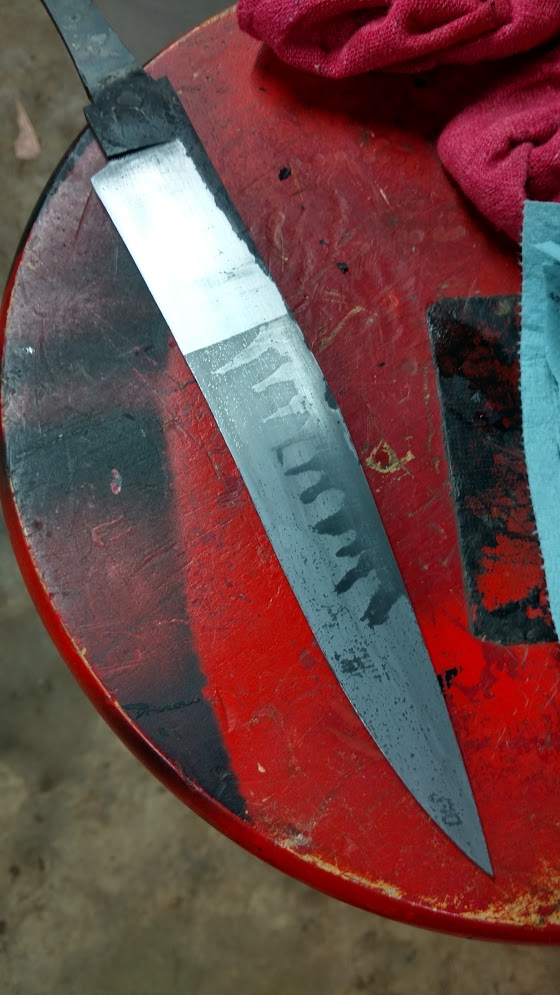
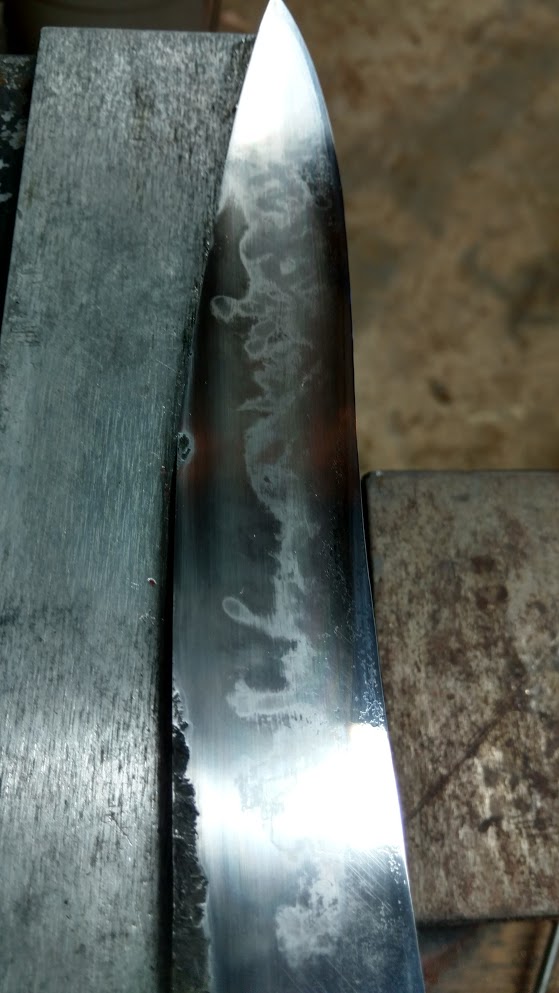
Working with Aldos W2 ad Rutlands black on this bowie. My hamon (if you even want to call it that) came out a little weird. I followed the procedure cited by Mr Hanson here: http://www.bladeforums.com/forums/showthread.php/1397069-W2?p=16103739#post16103739

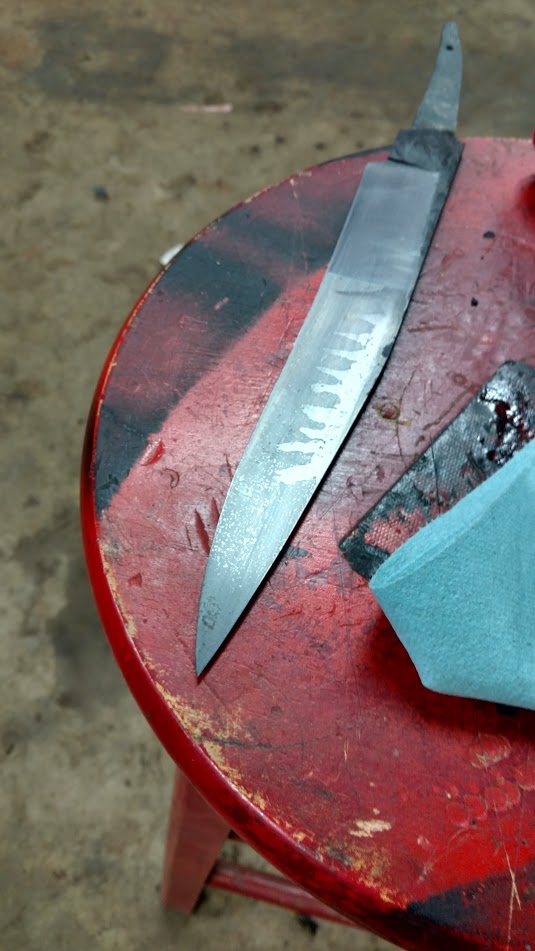
I was sort of hoping for some more whispy, and I seem to have gotten very exact lines of where the clay was. Not a lot of activity, just a very precise outline of where the clay was. I quickly hand sanded off the scale to 220 and etched for 20 seconds or so. Should I keep going to 1000?

Any tips?
R4tjNie.jpg


iK0SZpP.jpg
 
Last edited:
It looks like you haven't started the sanding process yet. As you sand, those clear clay outlines may fade and you may be able to bring out details. Also, why is there a demarcation line on your blade? If it's from dipping your blade in ferric chloride, make sure you dip the entire blade in or that demarcation line will be a real pain to get rid of. In any case, I'd work the blade a while before becoming concerned. Just my two cents worth:)
 
It appears as if where the clay was is slightly raised. I am guessing from the thin layer of decrarb that formed on the areas that were not covered in clay, where as the areas under the clay did not form decarb. Is this normal? Do I just have to sand this down?
 
It appears as if where the clay was is slightly raised. I am guessing from the thin layer of decrarb that formed on the areas that were not covered in clay, where as the areas under the clay did not form decarb. Is this normal? Do I just have to sand this down?
Work it for awhile, start with 220 grit and bring it to 400 grit and then submerge it in a ferric chloride mixture of 4 or 5 parts water to one part Ferric chloride. It should pop then. That will give you a good idea of what you really have. It's just hard to tell what you have by looking at it now. One thing is for sure though, you will have a hamon, I'm just not sure it extends the length of your blade.
 
As David stated, you are just starting. The decarb/steel boundary as you sand is mistaken for a hamon. You have to get through all the decarb first. I leave an extra 0.015" on each side of my blade when going for a hamon. This allows me to grind off all of the decarb on the grinder rather than by hand. I find decarb a pain to sand by hand.

If you want fine whispy details, go to 1200 or 1500g, 2500 for a non user, and use white vinegar for the initial three etches, then switch to lemon juice. The vinegar brings out the white hamon, and the lemon juice darkens the hardened steel. This is called a hybrid polish. It looks more like the traditional Japanese methods, and less like the grey/black contrast that ferric chloride gives you.

This one was sanded to 1200g.

27255734430_0c13101906_b.jpg
[/url]image by Wjkrywko, on Flickr[/IMG]

I think that is what you are looking for.
 
Sorry guys...Many things are new to me here and I am just excited/nervous. New evenheat, never worked with W2, and never done a hamon. So I am in uncharted territory and sadly I have this terrible perfectionist complex.

Thank you for the tips.
 
Sorry guys...Many things are new to me here and I am just excited/nervous. New evenheat, never worked with W2, and never done a hamon. So I am in uncharted territory and sadly I have this terrible perfectionist complex.

Thank you for the tips.
No need to apologize, and let us know how it turns out.
 
I like to add a very thin layer of Santanite to my entire blade to prevent scaling and minimize decarb. This helps a lot as I hand sand to see if I have a hamon.


Sent from my iPhone using Tapatalk
 
To save time on the hybrid polish, I often etch first in ferric chloride to get some depth with less cycles, then go to heated fresh lemon juice and loose abrasives to scrub oxides. That alone will whiten a hamon beautifully.

v2kJgtZPKojxu0CYHZDEZKD4Ce1BBK71AEg6BTSbR0isCv0i6MnSAMCSk-36iV0W_qeWsLma9an3XQ=w1366-h768-rw-no


ExTLxJVU215k1VbTlw-ao3NGHoJ1f3hiZrmBYtWfWOHw7AgFFjrmKWm9i9kvigVgC10YjzPWI-x-Zg=w1366-h768-rw-no
 
Possibly, yes. :)

This is why I went straight to hand sanding. I took my edge thickness down to .015" knowing that I had to preserve as much of the surface as possible to bring out the activity in the hamon. How much can I actually take off before I begin eating into the hamon?
 
To save time on the hybrid polish, I often etch first in ferric chloride to get some depth with less cycles, then go to heated fresh lemon juice and loose abrasives to scrub oxides. That alone will whiten a hamon beautifully.

Love those clouds. Definitely trying this lemon juice trick. Thanks.
 
the hamon goes all the way through the blade, you wont sand it away :) a good thing about a hamon is if you dont like how it came out, you can start over and make a new one.
 
To save time on the hybrid polish, I often etch first in ferric chloride to get some depth with less cycles, then go to heated fresh lemon juice and loose abrasives to scrub oxides. That alone will whiten a hamon beautifully.

v2kJgtZPKojxu0CYHZDEZKD4Ce1BBK71AEg6BTSbR0isCv0i6MnSAMCSk-36iV0W_qeWsLma9an3XQ=w1366-h768-rw-no


ExTLxJVU215k1VbTlw-ao3NGHoJ1f3hiZrmBYtWfWOHw7AgFFjrmKWm9i9kvigVgC10YjzPWI-x-Zg=w1366-h768-rw-no

Agreed. I like the vinegar because it's slower. I can watch and stop where I like it. A drop of dish soap acts as a surfactant break the surface tension and minimize spots. I bring the lemon juice to near boiling.

Pics aren't showing on the iPad.
 
This is why I went straight to hand sanding. I took my edge thickness down to .015" knowing that I had to preserve as much of the surface as possible to bring out the activity in the hamon. How much can I actually take off before I begin eating into the hamon?

You might have decarb right through the whole edge. I've done that a few times and that is why I leave the extra thickness now. This is needed especially if you do normalizing and thermal cycling steps.
 
This is why I went straight to hand sanding. I took my edge thickness down to .015" knowing that I had to preserve as much of the surface as possible to bring out the activity in the hamon. How much can I actually take off before I begin eating into the hamon?
You wont eat into the hamon, you will revel it.

What you're seeing in the photo above is just on the surface, the hamon is underneath.
 
Back
Top