Hamon question

Joined
Feb 24, 2000
Messages
1,951
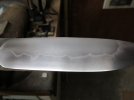
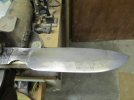
I am working on bringing out the hamon on this w-2 blade. I have been etching with hot vinegar the Nick Wheeler way, and then polishing with 1500 silicon carbide grit. I have done 5 five minute etches, and 5 ten minute etches with the hot vinegar.
In the first picture taken right after the vinegar etch there is a lot of activity down toward the edge of the blade. In the second picture taken after the polish, the lower activity is gone.
What do I need to do to make that lower activity not disappear?
 

Attachments

  • 004 (640x480).jpg
    004 (640x480).jpg
    42.3 KB · Views: 109
  • 010 (640x480).jpg
    010 (640x480).jpg
    28.9 KB · Views: 106
be a bit more light with the touch on polishing and/or polish with a less aggressive media.
 
Thanks, I have been scrubbing pretty hard when I have been polishing. What less aggressive media would you recommend?
 
I would try light pull strokes with your 1500 grit loose powder, like you would do a finishing hand sanding with your paper. Really light strokes with your finger going length wise, one direction. Enough to remove just the crud...
 
Work the non-activity areas when polishing. Leave the wisps and clouds alone. One trick is to polish with the powder, re-etch, paint over all the hamon you want to keep with nail polish or lacquer, and then re-polish the exposed metal. Once done, dissolve the paint with acetone and clean gently as needed.
Also, 1500 grit is not near fine enough for the final polishing. You want very fine polishes. Using chrome oxide, red rouge, and tin oxide all work well for the final hamon polish. Use a drop of water or oil to rub them on with a gun cleaning patch or makeup pad. Each one gives a different look, and often it takes some experimentation which to use on what part of the blade. The area above the hamon will colour and polish different than the area below.
 
Last edited:
That 1500 silicon carbide grit is actually a pretty darn fine media if you have the same stuff I do. It's a floury powder that barely feels abrasive to the touch, and does little more than scrub the oxides and perhaps blend the finish just a little. Lighter pressure probably would help though.
 
Salem, my 1500 silicon carbide seems pretty fine to me also. I saw the hamon you got on your knife, and it is beautiful. I might try your method on my next knife and see how it turns out.
I was going to try lemon juice, but the store was out. Maybe I can get some this week.
I did order some Chrome oxide from e-bay and I will try that.
Thanks to everyone for your suggestions.
 
Hey Tom-


I had a friend/student here this weekend, so I had missed your post/message.

First I'd say make sure your blade is warm (I use a heat gun). Make sure your vinegar has soap, but only a few-five drops, not too much.

Like Matt said, lighter pressure on the polishing.

I use either a little slice of polishing felt with the 1500 slurry, or a cheap cotton make-up pad.

IMHO- 1500X sc powder is perfect for the hybrid etching/polishing that us westerners do. I just polished a W1 blade with lots of white, whispy stuff in it, and used the 1500X powder. :)
 
Thanks, Nick, after seeing pictures of your hamons, I really respect your advice and opinion on the subject. I have used a heat gun on the blade, and warmed the vinegar with a few drops of soap. I have been using a cotton make-up pad on the 1500 grit polishing. I will try to do it with lighter pressure.
I have so far done 4 five minute cycles and 5 ten minute cycles in the vinegar and then polished. I think there is a lot of activity in the blade, I just need to bring it out.
Thanks again, and thanks to all for your suggestions.
 
Back
Top