Hamon?

Joined
Feb 22, 2017
Messages
89
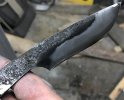
So I got some furnace cement and tried to get a Hamon on some 1084. I know it's not the best for it, but what the heck right. I put some on, HT, and got this
ccd7bdc3fefb452360d5bc7ac16aeffb.jpg


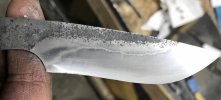
So after tempering, I cleaned it up to 800,then "etched" it in some hot vinegar/lemon juice, and polished to 1500 and now it looks like this.

My question is since the line I ended up with is totally different than what I put on there initially.. What am I actually doing / looking at?

Thanks!

-sent with tapatalk
 
OK,
First ... Good Job!

The first photo is just the difference caused by the decarb and the surface erosion from the clay covering some areas and and the exposed areas exposed to the atmosphere.
The second photo shows the actual line of demarcation between the pearlitic steel upper bevel and the martensitic edge. Knowing what the pattern will look like and exactly where it will fall is a art more than a science. The steel type is one of the main factors. since 1084 hs a little alloying, it will usually have a more suguha hamon. Faster steel will show more varying patterns like midare and gunome. The thickness of the clay and the temperatures in the HT also determine where the hamon falls.
Lastly, the final finishing process - shiage togi - will determine how well a hamon shows. Your may have a lot more in it, but the finishing technique only shows some of what is there. Buffing a blade is a hamon killer.


I suggest buying some 1/8" or thinner W2 and doing a lot of experimentation.
 
Thank you!
I don't recall, is w2 a steel I would be able to home heat treat simply using my little taigoo type "forge" and canola oil? Because that is all I got, hence the 1084.

I plan on building a better forge, but as far as a kiln or HT oven.. That's kind of out of my reach for a while.


-sent with tapatalk
 
Looks very good for a first attempt, much better than mine! The hamon will not follow the clay exactly like stacy said it's an art more than science. I'm not sure how you applied your clay to the blade, but if you put some ashi, Japanese for little legs, you should get more of a wavy hamon. I know this isn't the best picture but here is an example of a recent result using Rutland black cement on 1095 with a thin coat of clay near the spine and little legs going down the width of the blade

5c9a524cc021ec02652179f4f2111dd1.jpg


Sent from my SM-N915V using Tapatalk
 
And just to note, I'm not sure if I used the correct terminology with "ashi". Stacy can probably correct me if I'm wrong

Sent from my SM-N915V using Tapatalk
 
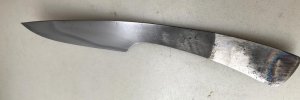
Looking good! I've been screwing around with some saw blade steel and Rutlands and getting some results. I too am new to clay quench. So far I've been happy and have a Ton more steel to screw with to perfect: here's a few of mine:
 

Attachments

  • IMG_1679.jpg
    IMG_1679.jpg
    48.9 KB · Views: 30
  • IMG_1681.jpg
    IMG_1681.jpg
    35.9 KB · Views: 27
  • IMG_1643.jpg
    IMG_1643.jpg
    23 KB · Views: 28
Looks very good for a first attempt, much better than mine! The hamon will not follow the clay exactly like stacy said it's an art more than science. I'm not sure how you applied your clay to the blade, but if you put some ashi, Japanese for little legs, you should get more of a wavy hamon. I know this isn't the best picture but here is an example of a recent result using Rutland black cement on 1095 with a thin coat of clay near the spine and little legs going down the width of the blade

5c9a524cc021ec02652179f4f2111dd1.jpg


Sent from my SM-N915V using Tapatalk

Ashi look like little lightning bolts coming down from the hamon.
 
I don't recall, is w2 a steel I would be able to home heat treat simply using my little taigoo type "forge" and canola oil? Because that is all I got, hence the 1084.

I plan on building a better forge, but as far as a kiln or HT oven.. That's kind of out of my reach for a while.

I think the W in W2 stands for water quenching, canola oil is too slow from what I've read. You can do water or brine but risk the tink of death, or use a faster oil quenchant than canola. W2 is hypereuctectoid and needs a longer soak too in order to get good performance I think.

You might want to try 15N20. I only have a two brick forge and canola oil and got some of it because I can't find 1084 in 1/8" thickness or thinner for the kitchen knives I make. I only HT one knife from it so far, but it seems to make a tough knife without needing an extended soak and the canola oil was fast enough to harden. I actually dropped the tempered and sharpened knife on a hard tile floor without any damage to the blade or edge, LOL. I bought a little from Aldo New Jersey Steel Baron, and he said this batch was giving really nice hamon. The only issue may be that it doesn't tend to be available much thicker than maybe 1/8" it seems.
 
I think the W in W2 stands for water quenching, canola oil is too slow from what I've read. You can do water or brine but risk the tink of death, or use a faster oil quenchant than canola. W2 is hypereuctectoid and needs a longer soak too in order to get good performance I think.

You might want to try 15N20. I only have a two brick forge and canola oil and got some of it because I can't find 1084 in 1/8" thickness or thinner for the kitchen knives I make. I only HT one knife from it so far, but it seems to make a tough knife without needing an extended soak and the canola oil was fast enough to harden. I actually dropped the tempered and sharpened knife on a hard tile floor without any damage to the blade or edge, LOL. I bought a little from Aldo New Jersey Steel Baron, and he said this batch was giving really nice hamon. The only issue may be that it doesn't tend to be available much thicker than maybe 1/8" it seems.
Thanks! I'll check that out

-sent with tapatalk
 
Back
Top