-
The BladeForums.com 2024 Traditional Knife is available! Price is $250 ea (shipped within CONUS).
Order here: https://www.bladeforums.com/help/2024-traditional/
You are using an out of date browser. It may not display this or other websites correctly.
You should upgrade or use an alternative browser.
You should upgrade or use an alternative browser.
hand filing plunges
- Thread starter foxbat34
- Start date


- Joined
- Oct 6, 2008
- Messages
- 4,076
Check 123 blocks or the file guide at USAknifemaker and elsewhere. They're good for plunges and for tang shoulders on narrow-tang styles. This way you can set up your plunge to line up nicely without moving your guide.
Both work, but the file guide is a little handier, and I don't think the 123 blocks are hardened (could be wrong, though.) You could make a set easily enough if you want to, just be real careful to keep everything square and straight (that's the whole point, after all).
You can use a flat or round file, depending how you want your plunge to look. Grind one edge of your file smooth (or grind a smooth flat on your rattail). This is called a "safe" or "blind" side and goes against the guide.
This a great and popular way to get nice clean plunges and straight shoulders. Enjoy!
Both work, but the file guide is a little handier, and I don't think the 123 blocks are hardened (could be wrong, though.) You could make a set easily enough if you want to, just be real careful to keep everything square and straight (that's the whole point, after all).
You can use a flat or round file, depending how you want your plunge to look. Grind one edge of your file smooth (or grind a smooth flat on your rattail). This is called a "safe" or "blind" side and goes against the guide.
This a great and popular way to get nice clean plunges and straight shoulders. Enjoy!
Last edited:

- Joined
- Aug 6, 2003
- Messages
- 484
For most blades I use a homemade file guide and a small half round file with a flat ground on one side, like James says. For big choppers I use the same set up, but a larger file. For some small blades I have used a chainsaw file, but I like the half round file better. I used a flat file for a few blades when I was starting out, because I liked the look of the sharp transition it created, but I grew wary of the stress riser it caused and started using the half round.
Most makers that I know use their grinder, but I can't seem to keep them even that way.
Todd
Most makers that I know use their grinder, but I can't seem to keep them even that way.
Todd
Most makers that I know use their grinder, but I can't seem to keep them even that way.
Todd
Thats the trouble Im having, Thanks for the help.
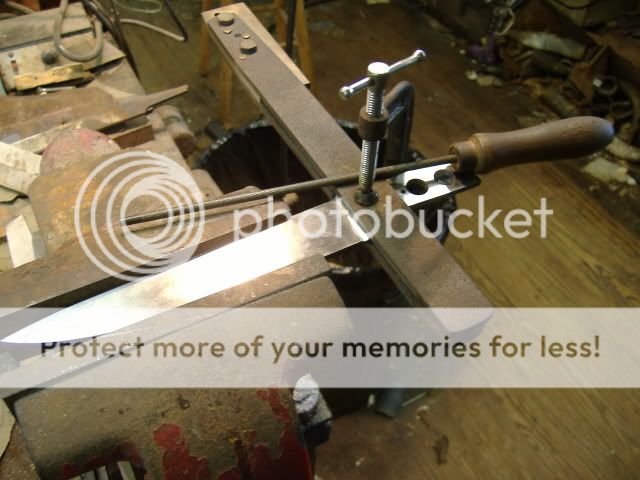
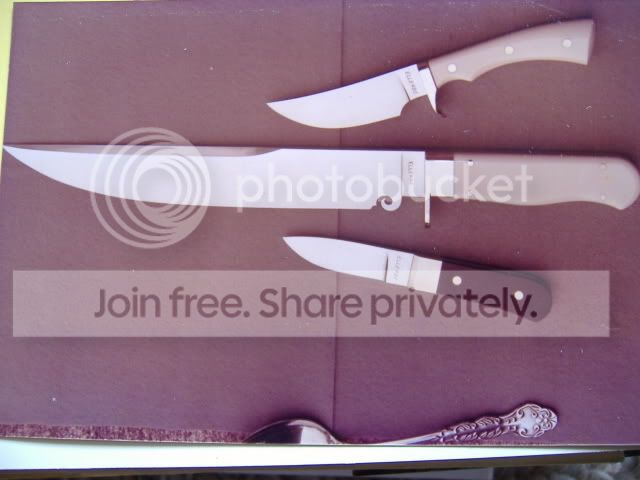
I use a round file, no flat on it, with a homemade file guide. I don't find a flat at all necessary, or even desirable for me. My rule of thimb is a file the diameter of the steel. This gives a very crisp line. I file to my pre-marked edge lines, then grind to the center of my file cut blending the grind with the file cut. The final junction is hand filed. Just takes a few minutes to make a near perfect blend. My file jigs are made from files with a sandwiched spacer close to the size of my steel. I have three of these which cover the range of sizes I work with. I ground the teeth off of the working sides, and squared the two files edges on a table sander. The guide is C-clamped to the blade, which is held in a common vise. Top photo is recent. Bottom photo taken in 1984.