
Hand Rubbing Question

Joined
Aug 19, 2007
Messages
71
I started my first knife in high school, ten years ago, and never finished it. Now I am returning to working on knives and would like to finally finish my first blade. I have been reading the handrubbing tutorials in the sticky and understand the concept of hand rubbing but I have a couple questions.

First is about sandpapers. I realise that it or preference on how high you want to go, but unsure if I should be using wet or dry sandpapers or the fabric type of sandpaper or the paper type of sand paper.

Also the tutorials talk about using baby oil (http://beknivessite2.homestead.com/handrubbing.html) or a cutting fluid (http://www.engnath.com/public/manframe.htm). Do you guys use this when hand rubbing? Any suggestions on what to use if you do?

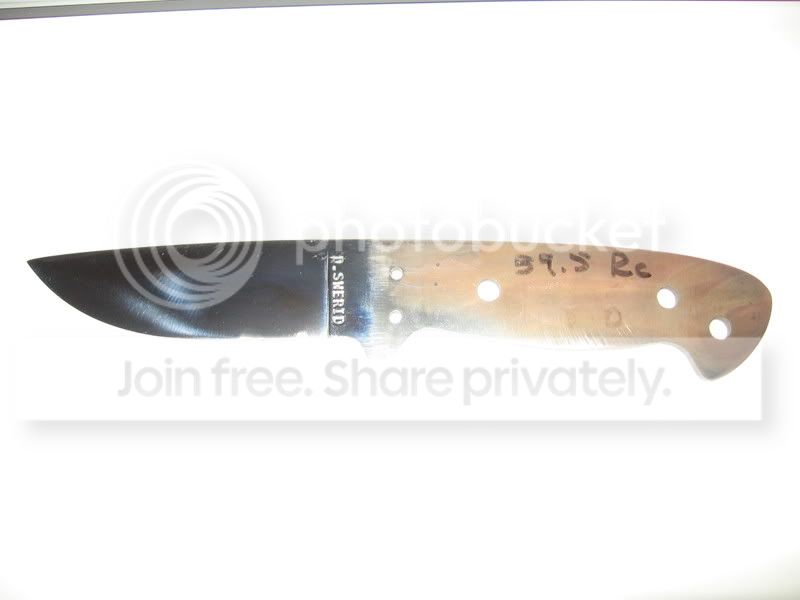
Here's an image of the knife I am working on (sorry about the brightness, but I want to show the scrathes in it).
IMG_1794.jpg


I did this knife all by filework. It took forever and is probably why it's still unfinished. There are still a bunch of scratches in it especially in front of the ricasso beside the plunge line and some faint ones on the ricasso and the grind.

I plan on using nickle-silver for the bolsters and haven't quite figured out the handle material yet. I plan this knife to be carried with me at work so it will most likely be some durable wood and I'll save my pieces of mammoth tooth for something else.

Any advice would be greatly appreciated.
 
I can't really give you any advice, except: KEEP AT IT! This blade looks BOSS! The more work you put on a blade, the more proud you'll be to use it! Good job!!!
 
82Stang....Nice looking blade there!!
I cant speak for other but as for sandpaper I get mine from the local autobody store...i think its 3M wet/dry...its black in color...not the cheep stuff...its up to you on how high you want to take the grit. For lube I use WD40 but have heard people use windex also...keep at it!
 
I tried Windex (well, the cheap home-brand) the other day and it works great!

Cheers Rody
 
Thanks for the kind words! I'll have to try the windex and see how it works. I am thinking of putting a set of Amboyna Burl handles on it. It's mainly orange with one corner that's white and I'll put the white part near the thong hole. I hope it turns out good!
 
3-M Wet/Dry all the way. Local auto body supply store. Be prepared for "sticker-shock". They don't give that stuff away.

I have used WD-40, and lots of other stuff, but I find that good old Windex with vinegar is the best. It is not that standard blue Windex, but is clear. I get mine at Lowe's.

Robert
 
I didn't realize they made windex with vinegar! There I have learnt my one new thing for the day. ;D
 
I always thought vinegar was acidic and could etch the steel but if you guys say it works great I'll be one to try it.
 
Hey guys! I took the blade out into the garage today and hand rubbed up to 2000 grit. Most of the scratches are out of it and you can see a mirror finish at certain angles. However, at the rest of the angles the metal seems to be hazy, all most milky. I don't think I can get a good enough picture to show what I am talking about. Would going up higher in the grit line get rid of this effect? Or should I start looking at buffing compounds? I would really like a mirror finished at all angles.
 
The big clue in that question is "MOST of the scratches are gone". If there are any scratches, then you moved up to a finer grit too soon.The hazy areas are spots where there are micro-pitting that you haven't sanded down to.Go back and re-sand the blade, starting at 200 grit. Sand until completely smooth before moving up the grits. Change direction of the stroke by about 30 degrees each grit size change, and sand until all scratches are gone from the last grit. When they are gone, sand a little more, then go to the next grit. Keeping the blade well lubricated with Windex or something is important. If the sanding swarf and grit get too dry,they make a paste and can gall the steel and make it hazy.This happens if you sand back and forth and the mud from the sandpaper and steel gets rolled back and forth into tiny balls that do two things. One is they act as larger grit size, and two is that the burnish the steel.

Once in a while, you will encounter a "cloud" that won't really sand away. Going back and trying again will usually make it better. Remember to use plenty of lubricant ,especially on the higher grits.But, on some stainless steels, you never can get the "cloud" to completely disappear.

A final polishing by hand with Flitz or simichrome will often get that last haze . Glue a piece of hard smooth leather to a 12" long piece of 1X2 hardwood. Charge this with the polish and take smooth firm strokes from the ricasso to the tip. Add polish to the blade surface as needed, but don't overdo it. This will bring up a gleaming shine after hand sanding to 2000/2500.

Use patience
Go slow
Sand in only one direction above 400 grit (no back and forth)
Keep it wet
Have fun

Stacy
 
Last edited:
Back
Top