
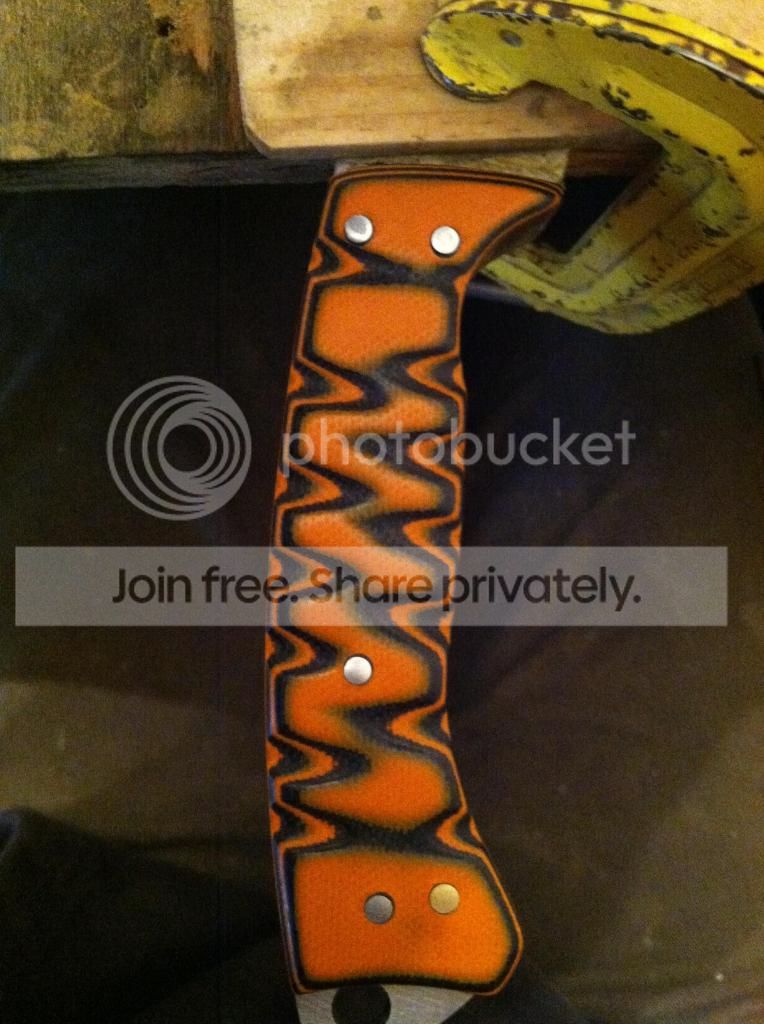
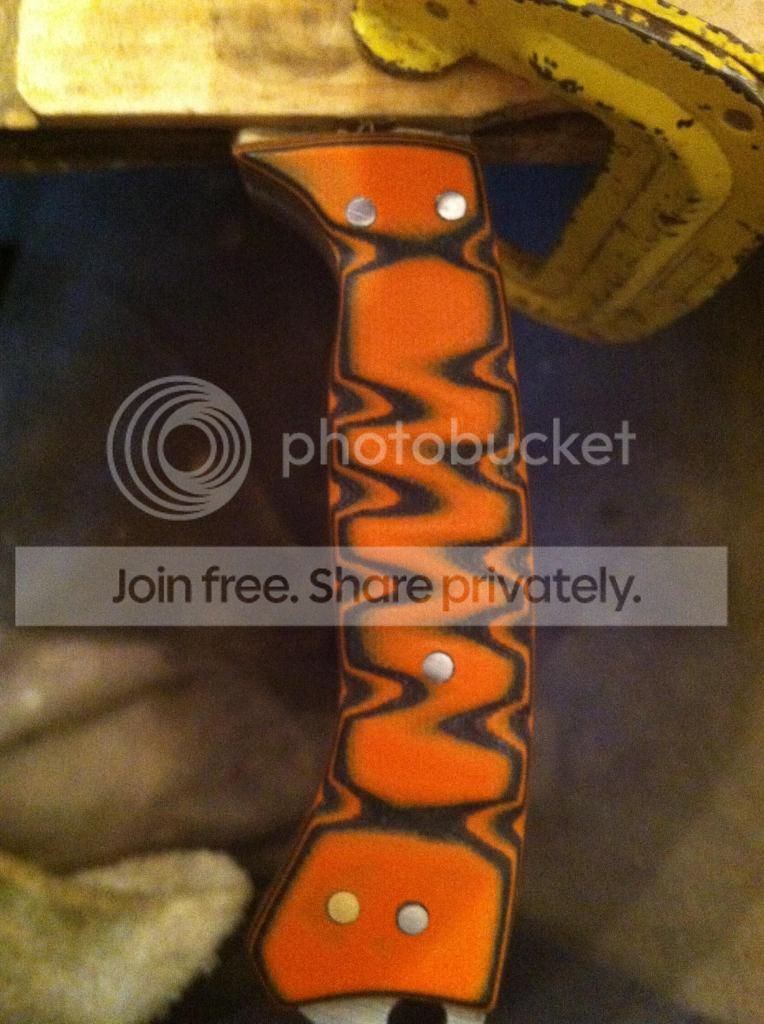
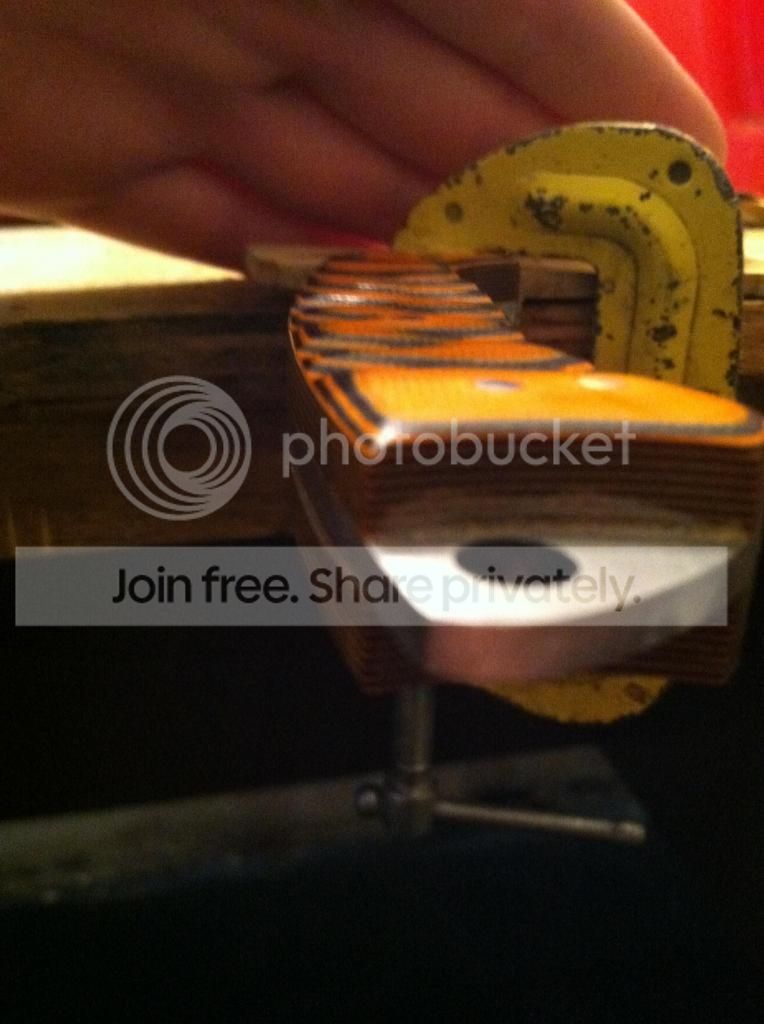
Handle critique wanted.

Joined
May 23, 2013
Messages
169
image_zpsda4a30ce.jpg

image_zps6e58b0db.jpg

image_zpsbca7a80b.jpg


These are black/orange 1/4" g10, from Masecraft. I'm learning to do different patterns in multi color handle material. I use 440c blade blanks to practice handle making on.

Rough shaping: Belt grinder, Dremel, assorted needle files. Sandpaper, 120-2000 grit. Finish, TruOil, because i lack a buffing wheel in my shop.

After roughing out, start with 220 grit paper and work my way up through 400, 600, 1200, 2000 grit paper. Bout an hour per side.

Question: I have read that a quality fiberglass sealer such as Meguiars is the way to go if you lack a buffer. Anyone use that method? Second, what polishing compounds won't blur color layers on g10?

Thanks in advance for input.
 
As you'll most likely hear, (I heard it) and its even written in the stickies, flat handles aren't good. People favor handles with more curve in them. Your design is textures and fit well but is also relatively flat. I am now trying to focus on my handle design and shaping to get better at it.
Just my humble $.02

quote from Stacy
The Things I Advise New Knife Makers Against.
1) Blocky handles
Many look like a stick of wood with the corners rounded off.
Try and make the handle surfaces a continuous curve, with the overall cross section being ovoid ( the shape of a
chicken egg). Having the butt drop slightly fromthe spine adds a look of flow. A bit of palm swell adds more of
the same flow. Avoid huge and deep finger choils unless the knife needs them. In the beginning, it is probably
best to leave thumb rest grooves and deep choils off the knife
 
Thanks sandeggo. I agree, but the customer has hands close to my size, and he requested full tgickness handle with "zig zags" and minimal edge chamfer. So i tried to stay close to that on this practice knife.
 
I agree with Stacy unless the customer specifies something different, as your customer has. I like how you have made the pattern - very good looking handle.

Tim
 
This "customer" is my uncle. The only things i sell to people not related to me are customized production knives.
EDIT: I dont feel I have the finish skills yet to charge custom prices. I am rather impressed with the performance of some of these blade blanks. They rarely come straight or symmetrically ground, but danged if the one's I have tested held up well to cutting and some bending tests.
 
Last edited:
Okay, this is going to be nitpicky because you asked for feedback. That's a really nice look and your uncle will be thrilled, but I've some ideas for when you make the next one.

1. The pattern on each scale is not symmetrical. On the top picture the first "notch" in the zig-zag is on the belly side. on the bottom picture the first notch in the zig-zag is on the spine side. You basically started on the Right on both scales. Should have started on the Left on one of them.

2. Plan out your pin spacing so it works within the file pattern. Lay out your filing pattern around the pins. On one scale, you actually cut into the pin in a notch, the other side is standing free.

3. The brass pin at the butt seems odd. Is it an artistic element? Maybe a different size or more centered in the lower region of the butt would have made it flow better. Where it is makes it look like your either ran out of silver pin or tried to cover up a mistake.

Again, that's a nice looking handle, I'm just pointing out some thoughts for the next one.
 
Yeah the brass pin...put stainless pins in and didn't notice the brass one until after the acraglass set. Put pins in after a 14 hour workday, so just sloppy work there. Pin spacing wasnt my choice, neither was lanyard hole. Blade came with pin holes.
The symmetry bothers me too...the black is more pronounced on left side, due to me spending less time with the 1200 cuz I ran out. I'm gonna fix that though.

Thanks for taking the time to look and post. I appreciate it.
 
Did you do the anzo scallops while the scales were on the tang?

Looks pretty good to me, I'm sure they will be thrilled as others have said.
 
I haven't done many G10 handles, don't like the stuff much to work with, but it seems pretty soft for sanding. I have taken it to 800grit, then used Rustins Burnishing Cream on a cloth or leather with a rigid backing stick to polish. The burnishing cream is sold for polishing lacquer furniture and it does a good job on stabilised wood and G10. Not sure where you would get it in the US. Fewer places seem to have it in the UK now, but it is still available, just that my search engine insists on biasing results for the UK, hard to get it to look at the US market.

Nit picking...is it just the photo, or do a number of the pins have a halo of glue showing from having over-size holes?
 
I think it looks great, and to get that look you had to go with a flatter handle, that is really ok, if someone were going to use a knife all day such a butchering then the optimal handle would be best. But we must some time give up a little for art.

Looks like the pins stick a little proud of the handle, this may be a change to give them a wack and fill in the space around the pin. but overall looks good.
 
The pins have a shadow

What size are your holes vs the pins ?
3/16" pins and tang holes. I left the pins a few thousandths above the handle to allow for peening before sanding them flat. So they do have a slight halo of epoxy around them currently. Also took pics with my crappy iphone since gf dropped the Nikon in Lake Bonaparte.
 
The fact that more black shows up on the left scale is due to slightly less hand sanding on the right scale. It's driving me nuts until my new grits arrive from Trugrit.
 
I think it looks great, and to get that look you had to go with a flatter handle, that is really ok, if someone were going to use a knife all day such a butchering then the optimal handle would be best. But we must some time give up a little for art.

Looks like the pins stick a little proud of the handle, this may be a change to give them a wack and fill in the space around the pin. but overall looks good.

Hey Patrick, thanks for your comment. I went to your website, but just got a "404 page not found error" on each link I clicked, which sucks because I saw a couple of your kitchen knives a few months back. Wonderful fit and finish. Do you have a Youtube channel?
 
Last edited:
Did you do the anzo scallops while the scales were on the tang?

Looks pretty good to me, I'm sure they will be thrilled as others have said.

Thanks Omega. Yes I did them very gently with a drum on the dremel, after the acraglass set, then used wooden dowels with sandpaper to dish out the sharp edges.
 
Last edited:
Thanks Omega. Yes I did them very gently with a drum on the dremel, after the acraglass set, then used wooden dowels with sandpaper to dish out the sharp edges.
I find scale symmetry easier if I put a drop of CA between them and grind them at the same time. That said I haven't done scallops. Most of mine have been done using a sander, dremel and "shoeshining" with paper. I've tried doing them with temp pins on the scale but just handling the scales together is easier for me.
 
I find scale symmetry easier if I put a drop of CA between them and grind them at the same time. That said I haven't done scallops. Most of mine have been done using a sander, dremel and "shoeshining" with paper. I've tried doing them with temp pins on the scale but just handling the scales together is easier for me.

Thanks brother! CA to hold scales together! Totally facepalming myself. I run the pins through the scales and put a drop of CA on the pins, then knock em out when rough profiling. Such simple things you never think of. DOH!
 
Back
Top