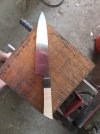
With some of the Japanese knives, I think is an issue of balance, especially on the bigger blades. Some of them have tiny tangs, so very little steel to counterbalance. A well made Western style chefs knife may be the easiest full tag knife to get the balance right.
You're absolutely correct, although I think there are some pretty big misconceptions about how many of these types of knives should "balance", especially when people are used to making non-kitchen knives. Hell I'd go so far as to say that there are a lot of misconceptions about balance in general, you can balance any knife somewhere, and whether it's lively ham fisted and swinging around in the air, is irrelevant for a large chef's knife. I of course don't claim to be a chef knife expert, I make mostly pocket knives, but I do know a couple of pretty serious, award winning, traditionally educated, and reasonably well known chefs, that I've made some pieces for, and they've complained to me quite a bit about handle weight and size in some of the customs they've paid insane money for, on top of other things. Obviously, we're talking mostly western style pieces though.
Regardless, we both know, that you can size the handle based on appropriate proportion to the eye, and compensate internally for weight if we leave enough material in the tang to remove what's necessary to get it where we want it.
I've seen a lot of makers with big hands, make handles that are 3/4 of an inch or more longer than a ham fisted grip (which is only appropriate for using very specific knives in very specific tasks), that would hit butt first even if you dropped them tip first (I'm exaggerating, but not remotely "balanced"). Maybe they considered that a design feature. =D IMO though, a lighter knife, will almost always feel more "free" in the hand, but some people confuse balance and liveliness with leverage, loving the feel of momentum generated by it, like swinging a baseball bat.
Anyway, I digress. ;D