Handle shaping

I find this is one of the hardest parts in making a knife for me. It feels like sometimes shaping can get out of control.

What I found works for me (most of the time), is to cut in hard angles on both sides using a flat platen. Having hard angles, I find it easier to compare from side to side for symmetry. After that, I slowly round the edges of the angles out, and then finish with hand sanding.
 
I eyeball it, and then use lots of different lighting situations to tell if things are symmetrical. I find that my shop light doesn't catch all the issues with handle shaping. I need to take it to natural light to really evaluate.
 
Like bmilleker, I knock off the corners at 45 degrees, then make the bottom and top profile grinds for the finger groove and butt drop, then start rounding it all together. Take a little off all areas at a time ... not all of it of in any one place. This way you can neak up on the final shape, and make adjustments before you go too far. A VS or slow speed grinder is almost a requirement for getting good handles.

If something goes wrong with a handle and it gets too messed up, just break/grind/chisel it off and start from scratch. It is only wood.
 
I do a lot of handle shaping with a 6" wheel. It's good for taking off a lot of material, but also for getting palm swells started . Using a wheel allows me to replicate the same contour in both sides of the handle. Typically, for a "coke bottle" style handle, I use the 6" to remove material between what will be the palm swell and the butt. starting with the handle 90 degrees to the wheel (point up) and then turning the edge side of the knife towards the wheel. Of course this gets it started, I then blend my major removed areas together. By starting each side of this area at the same spot and rotating the blade the same distance, this area winds up pretty close to symmetrical. All the remaining areas are easier for me to do, as they don't have the compound curves found between the swell and butt.
 
I do it different ways on different knives if my tang isn't tapered I can use a surface gauge to scribe a few guide lines. If the blade is tapered I found some 1/8 and 1/4 tape at an art supply store that I line up with the edge of the tang and use that as a guide . As far as taking off material I start with the disc then wheels on the belt grinder and finish with files (which I have really been liking lately). What Kevin said on how to keep things even then eye balls.
Gilbert
 
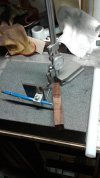
I looked through some old wip photos and found this one. Not sure if it will help. For me, it is important to get consistent, symmetric reference lines on the front and back of the handle. These help in keeping things balanced from side to side. The lines drawn here were done with a Sharpie mounted in my height gauge.
Erin

17521597094_6342136cd9_z.jpg
 
1508882931488-7823268.jpg I made the one with the marker out of angle iron it's fine for handles(I used it before I got the other one I would also put a scribe in it for marking metal ), the other is great for marking metal or scratching lines in handle material it has a carbide tip. I got this one from Grizzly.
Gilbert
 
Can,i see a,pic of the height gauge

Sharpe... this is the best photo of my height gauge that I could find. It looks similar to the one that Gilbert showed in his photo (also Grizzly). I'm not actually using it in this pic... it's just sitting in the background on my surface plate. Basically I'll attach a Sharpie or pencil where the wedge-shaped carbide scribe sits.

22335976506_c2121b5dbd_z.jpg
 
Do u run the 1,inch belt right on ur 2x72 grinder?
I just got those scalloped 1" belts from Pops for doing handles and they are awesome. They really helped me because I wasn't chasing gouges
Do u run the 1 inch belt right on ur 2x72 grinder?
 
One thing to consider when shaping wood handles is to use hand tools rather than power tools. A spokeshave, some carving chisels, and a few small block planes are a good start. They remove material slowly which means mistakes happen slowly as well. You end up with tool marks that you can hand sand out after general shaping. For non-wood handles, files (especially the float-types) have worked well for me.

Just a thought from a fellow newbie.
 
Eye balls and a slack belt. Regardless of the handle material.
 
Back
Top