hardness of hard woods

Joined
Jun 24, 2009
Messages
5,040
"Janka Hardness Test For Hardwoods" is a definitive catalog of relative hardness of many woods. brought to my attention by K.D. Strick this is a real eye opener for wood knowledge.ligume vitaum is 3 times harder than zebrawood. snakewood is twice as a hard as zebra. hickory & zebra are fairly close in hardness.
 
Last edited:
"Janka Hardness Test For Hardwoods" is a definite catalog of relative hardness of many woods. brought to my attention by K.D. Strick this is a real eye opener for wood knowledge.ligume vitaum is 3 times harder than zebrawood. snakewood is twice as a hard as zebra. hickory & zebra are fairly close in hardness.

Just stumbled on this myself while reading up on lignum vitae today. Very cool.
 
Last edited:
ligum vitae seems to be one of the very hardest & i remember in times past that bearings were made for industry of this hardwood.
 
That's cool Dennis. Thanks for that. It's good info.
 
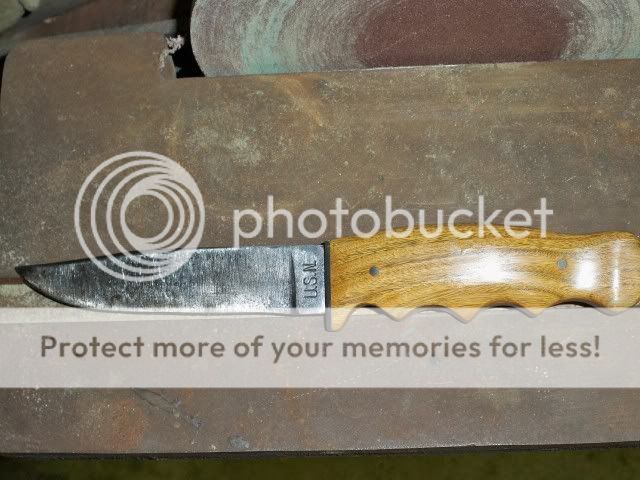
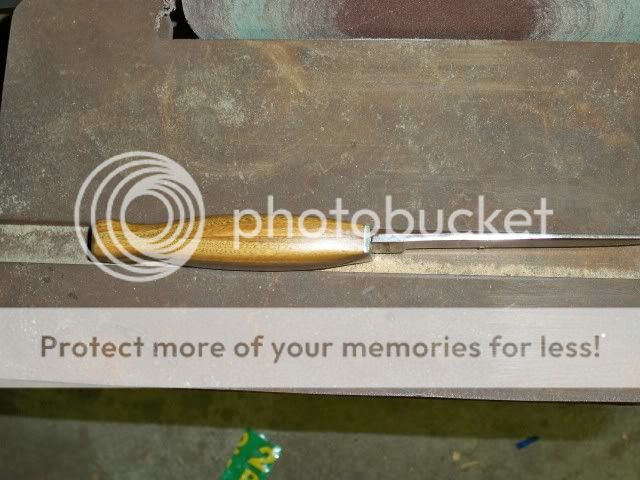
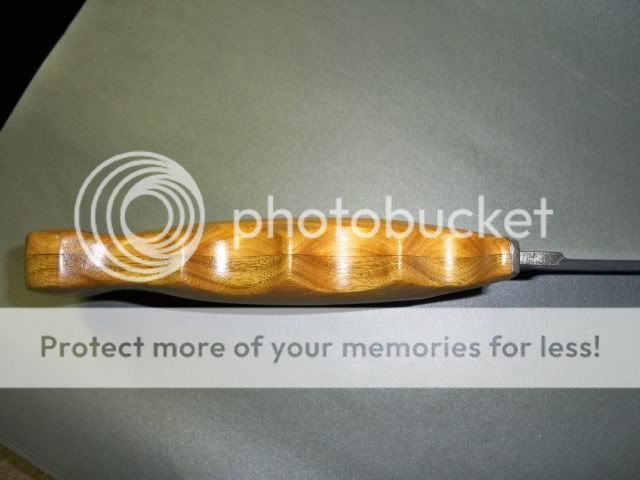
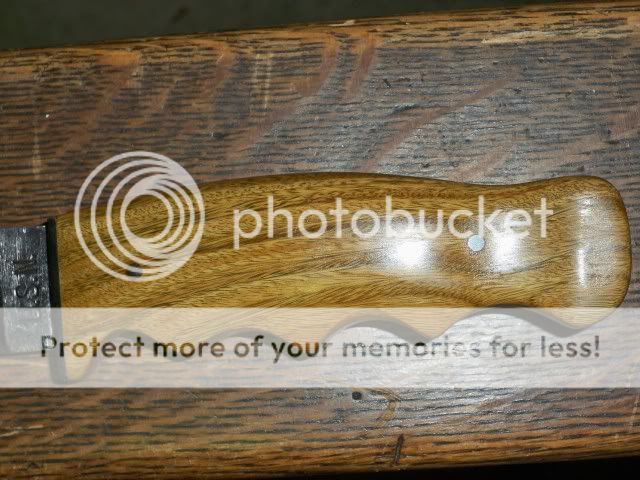
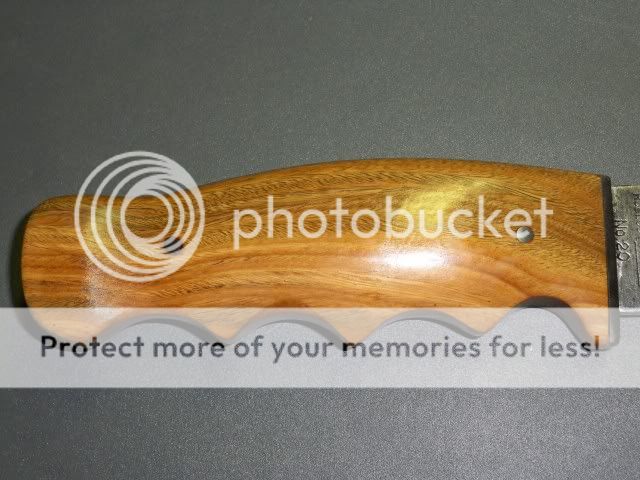
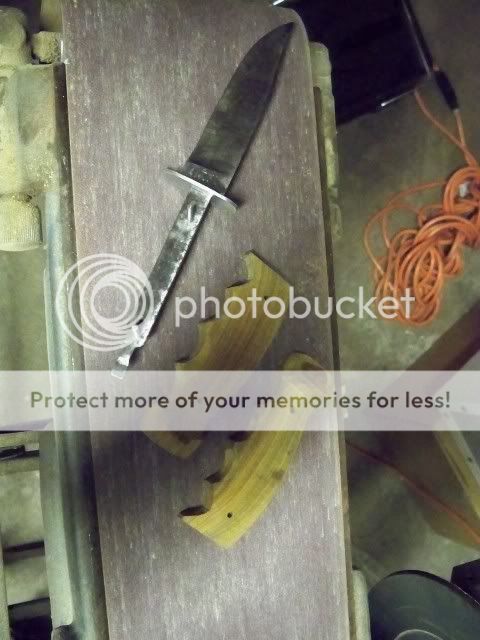
I made some scales from Lignum vitae for an old Robeson fixed blade Navy knife. I really enjoyed the green colored sawdust. It had an odd smell, but kind of aromatic. The grain is wonderful to look at. A buddy of mine, who I showed my rehandle job looked at me and said, "you know that knife is a cheapy, mass produced one right?" I said, yeah I know, it was my first rehandle.
100_0488.jpg


100_0490.jpg


100_0492.jpg


100_0496.jpg


100_0500.jpg


100_0498.jpg

100_0200.jpg


If you look at the wheel of my sander, you will see the sawdust. I picked up that vintage Craftsman sander for 20 dollars at a garage sale. I spent more than double that on belts, LOL. The wood is very easy to work with and very dense grained. I burned a pin by heating it up too much and left it a bit proud, and also the blade sits a little too high in the scales, but hey, I was happy of the results, and a big fan of Lignum Vitae.
 
cj65 damn good job, we do'nt see much of this material used. may i ask if you needed a sealer or were the natural oils enough. excellent pics along with a very attractive wood.thanks for posting.
 
Gliricidia sepium is harder than a wedding pecker..........
Tabebuia ipe, t. Ochracia and Diphysa robinoides.
If you see any of those blanks at distributors take a try at them. Hard and beautiful.
 
"Janka Hardness Test For Hardwoods" is a definite catalog of relative hardness of many woods. brought to my attention by K.D. Strick this is a real eye opener for wood knowledge.ligume vitaum is 3 times harder than zebrawood. snakewood is twice as a hard as zebra. hickory & zebra are fairly close in hardness.

Great info. Thank you for sharing
 
cj65 damn good job, we do'nt see much of this material used. may i ask if you needed a sealer or were the natural oils enough. excellent pics along with a very attractive wood.thanks for posting.

I think a big reason lignum vitae isn't used is that it is CITES listed as endangered. It is illegal to harvest and import just like elephant ivory and Brazillian rosewood.

Fortunately there are several lignum lookalikes. I've used a fair amount of verawood (bulnesia sp.). It is hard and waxy with "herringbone" grain like real lignum vitae (guaiacum officinale) but more green in color and easily available. It is often sold as the real stuff.
 
I think a big reason lignum vitae isn't used is that it is CITES listed as endangered. It is illegal to harvest and import just like elephant ivory and Brazillian rosewood.

Fortunately there are several lignum lookalikes. I've used a fair amount of verawood (bulnesia sp.). It is hard and waxy with "herringbone" grain like real lignum vitae (guaiacum officinale) but more green in color and easily available. It is often sold as the real stuff.

I have heard that as well. I know how green and aromatic the wood pictured is, This should be an identifying characteristic to truly discern the species. Mr. Dobson, can you give me your opinion as to what wood that looks like to you? I bought it from Bell Forest Products. It is not of great concern, just curiosity.
 
Last edited:
cj65 damn good job, we do'nt see much of this material used. may i ask if you needed a sealer or were the natural oils enough. excellent pics along with a very attractive wood.thanks for posting.

Thank you sir! I heard it was important to seal and have a sealer that would penetrate. I bought at the Pasadena CA Knife show 2 yrs back some product called:Starbond. It is a cyanoacrylate adhesive, which I heard is a steroid induced super glue. It is supposed to penetrate and stabilize wood with many coats. I seemed to have failed in getting it to penetrate. I had a spot that ran, so I sanded it down, and now have more of a satin finish, but it still looks good. Thank you for again for your compliments. The jury may be out as to exactly this type of wood that I used, hopefully one more knowledgeable can enlighten us.
 
I have only worked with bulnesia and never the real lignum vitae (though I have seen a block of it). Your experience sounds a lot like mine. The wood is very waxy, not oily like a rosewood. It produces a green, aromatic dust that sticks to stuff but not too badly (easily clean your belts off with rubber). It polishes to a high gloss without a finishing agent but does not glue well.

I found the most interesting characteristic was its striking color change after cutting. Leaving the handle in the sun for only an hour turns the wood from a golden color to a dark green. It even exudes a waxy green substance that can be buffed out. I finished it with a coat of oil, but I'm not sure it needed it.
 
I have only worked with bulnesia and never the real lignum vitae (though I have seen a block of it). Your experience sounds a lot like mine. The wood is very waxy, not oily like a rosewood. It produces a green, aromatic dust that sticks to stuff but not too badly (easily clean your belts off with rubber). It polishes to a high gloss without a finishing agent but does not glue well.

I found the most interesting characteristic was its striking color change after cutting. Leaving the handle in the sun for only an hour turns the wood from a golden color to a dark green. It even exudes a waxy green substance that can be buffed out. I finished it with a coat of oil, but I'm not sure it needed it.

That sounds just about right-I bet what I have is Bulnesia. Waxy is a good way to describe it. It does finish very easily, as you said. Thank you!
 
thanks guys for all the info. being from texas i'm happy with mesquite & bodark. bodark is also known as osage orange. these are certainly hard enough for most uses on knives. however mesquite has to be stabalized.
 
thanks guys for all the info. being from texas i'm happy with mesquite & bodark. bodark is also known as osage orange. these are certainly hard enough for most uses on knives. however mesquite has to be stabalized.

I just got some of that osage orange (also spelled bois d'arc). I'm looking forward to doing something with it. The stuff I got is perfectly quartersawn and looks great.

I've heard many conflicting opinions on whether mesquite should be stabilized. It is one if the most stable woods on Earth, but it isn't super dense. To me, it's sort of in a gray area regarding stabilization (it depends on use).
 
Thanks Dennis for starting this thread and providing those interesting facts, I find this kind of stuff very fascinating. And thank you to the others for adding more insight. I'm just now starting to make handles and scales out of wood and g10/micarta and these threads are very helpful. Oh and CJ I like how you formed those finger grooves into that handle.

Oh I just remembered, and wanted to add that a while back there was a classic sebenza on the exchange that was listed as a lignum vitae inlay. I'm sure that on this example it would be the real thing coming from Mr. Reeves. That is very interesting about how strong and dense it is. I wonder how its chip/scratch resistance is compared to the micarta inlays. Any idea Phillip?
 
IIRC, at one time, Lignum Vitae was used in pier and dock making as the foundation timber.
It was found to be more resistant to the salt water erosion than other species of timber.
Not sure how true that is, it just popped up in the steel sieve I call "my memory", as I was reading this thread.

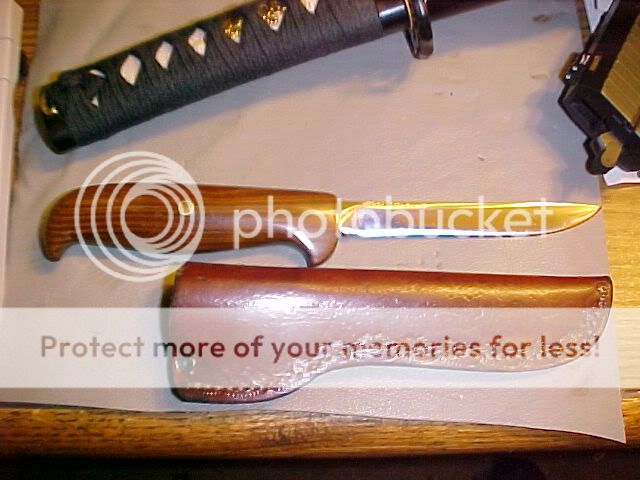
Here's a (crappy) pic of a knife (with Lignum Vitae handle) I made from a planer blade many moons ago:

MVC-003F-4.jpg
 
I have a bunch of Lignum Vitae, the Argentine variety, that I was going to use for scales, but I've heard horror stories about it checking badly once they were mounted on the tang. :grumpy:
Any problems with you guys?
- Thanks!
 
Back
Top