hardness of hard woods

thanks philip for reminding myself as to the correct spelling of bois d'arc.we talked about this wood many times when i was growing up so the colloquial spelling was'nt corrected till many years later. hope i did'nt confuse members with initial spelling.in texas this wood is known as the100yr. fence posts. seems impervious to bugs & rot .was the favorite bow material of the osage indians with some bows reaching a draw strength of 60 lbs. [ almost unheard of in those days ] mesquite seens o.k. in smaller scales but gary randall when asked to make identical knives for my brother & 2 nephews with mesquite from the ranch ,told my brother that it needed to be stabilized. after completing this stage Randall was sent the wood to make handles for 3 identical knives with names & birth dates respectfully. this is a practice no longer performed by randall. thank you guys for all the info.
 
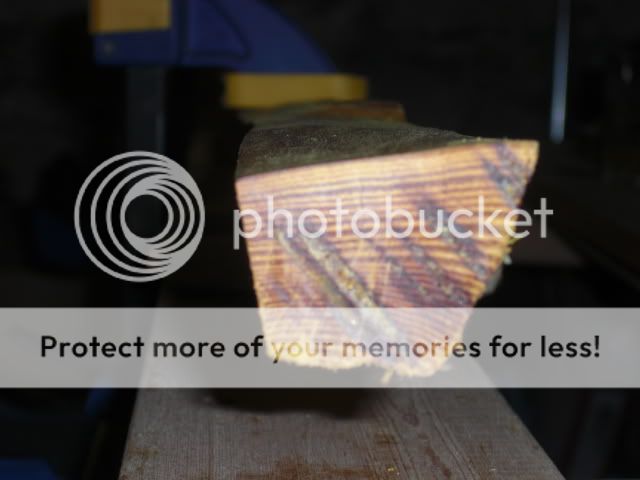
Osage is really dense and waxy. Here is a picture of the end of a bow stave I was working on. For reference, it's about 1 3/8" wide.
bowstave013.jpg

It is not, however, impervious to insects. I have another stave that isn't finished yet that is completely shot through with worm holes. :mad:
 
I have handled a blade with Argentine lignum vitae. It hasn't cracked. I finished the handle in multiple coats of clear natural Watco.
It is a very heavy wood. It was not hard to work with sharp tools. I have an old mallet made of the real lignum vitae. It seems slightly harder - it is difficult to tell.

I have a variety of tropical very hard woods, some sitting as blocks out in the garage. The way to avoid checking or splitting is to keep the wood as it arrives in the garage for a year. Cut it down to scales, then dry it in your home for at least 3-6 months before using it. This type of wood typically comes air dried from vendors (with waxed ends), and is likely to be pretty wet when it comes. If you use it too soon, you can count on splitting.
I have some Kingwood scales, cut from a thick block, that I have been watching for more than 1 year - in the house. I plan to use them to handle a few blades, including O1 Enzos and a Fallkniven F1. I also have some tulipwood that I may use - but the tulipwood, while hard and dense, doesn't seem as tough as the Kingwood. It seems splintery when cut.
Kingwood is a type of Rosewood that is close in hardness and density to the ironwoods.
 
I have handled a blade with Argentine lignum vitae. It hasn't cracked. I finished the handle in multiple coats of clear natural Watco.
It is a very heavy wood. It was not hard to work with sharp tools. I have an old mallet made of the real lignum vitae. It seems slightly harder - it is difficult to tell.

I have a variety of tropical very hard woods, some sitting as blocks out in the garage. The way to avoid checking or splitting is to keep the wood as it arrives in the garage for a year. Cut it down to scales, then dry it in your home for at least 3-6 months before using it. This type of wood typically comes air dried from vendors (with waxed ends), and is likely to be pretty wet when it comes. If you use it too soon, you can count on splitting.
I have some Kingwood scales, cut from a thick block, that I have been watching for more than 1 year - in the house. I plan to use them to handle a few blades, including O1 Enzos and a Fallkniven F1. I also have some tulipwood that I may use - but the tulipwood, while hard and dense, doesn't seem as tough as the Kingwood. It seems splintery when cut.
Kingwood is a type of Rosewood that is close in hardness and density to the ironwoods.

Thanks, Arty. I've been waiting to use the LV.
 
I haven't had any problems with the few verawood (Argenitne LV) handles and projects I've done. I used it for one of my first scales and it's still going strong.

That said, I also haven't had any snakewood check on me. It's either that I'm lucky or the dry, controlled climate here is great. I try to be patient and let it dry our for a few months here.
 
Yep, LV does crack if used too soon. The knife I pictured developed a crack which I repaired with super thin viscosity Cyanoacrylate. No other problems since. That was the handle that prompted me to go out and buy a wood moisture test meter. Harbor Freight if any of y'all are interested. A must have for the wood working knife maker.
 
I carved a garotte (Philipine martial arts stick) out of Argentine lignum vitae. I don't think that I let it sit long enough before using it - I used it before I used the wood for the knife handle. It developed a few surface checks, and I sealed them with super glue.
The wood is very durable, hard and strong - you just need to be patient with it.
 
Back
Top