- Joined
- Nov 25, 2007
- Messages
- 340
Hardness testing and decarb layer
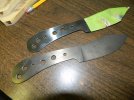
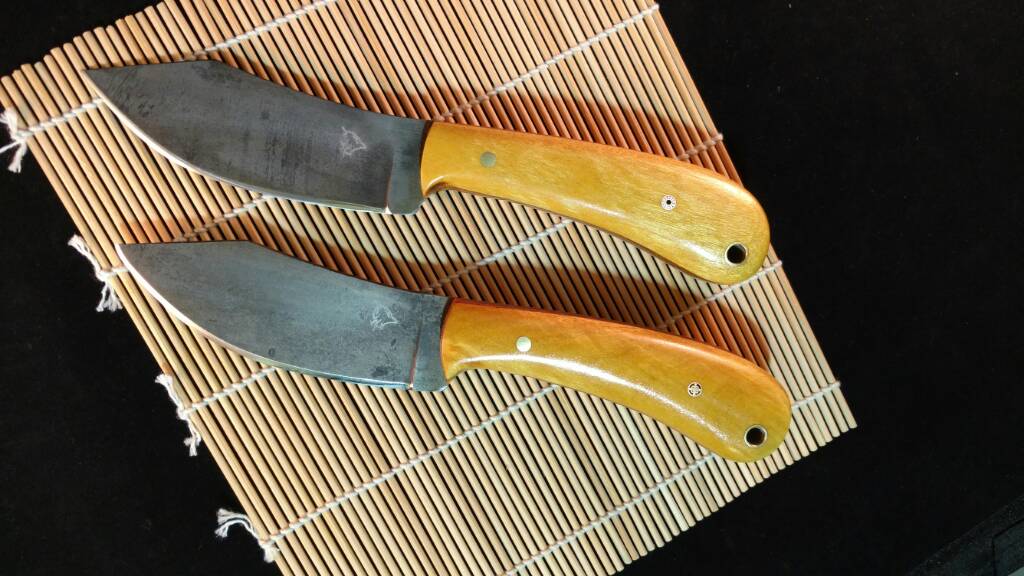
Hey guys, seeking advice from those of you fairly knowledgeable with hardness testers. I did these two blades over the weekend, and my RC numbers are all over the board. I ground the decarb off ( at least I thought I did) one blade with a 120 belt (handle area only), and had really erratic numbers, so I took it back to the grinder and hit it with 50 grit, 80, 120, 280 gator in hopes of removing more of the decarb layer, and evening out my numbers. My numbers still had a 12 point spread from 50-62, but were a bit higher on avg than the first round when I used just the 120 belt. With this knife I like to keep the out of quench look which is why I didnt use an anti-scale coating.
HT- 1480 for 10 min soak (Evenheat kiln)
Steel- 1075/1080 from Admiral
Quench- Mcmaster 11 sec heated to 130 deg
Time to quench approx 1 sec
Temper- 400 for 70 min (in wifes oven)
Testing method- Rockford Rockwell tester verified with a 63 RC test block. (tests within 1 point each time)
Other tests- I sharpened the one blade to approx 20deg (40 inclusive) and just did some manual testing shaving walnut, hammered through corner of walnut, push cutting leather, cardboard and such and had no problems with the edge.
My question is how deep should I be sanding to get past the decarb layer? Am I doing something else wrong; soak time, quench ( should I switch to something faster like canola) , quench heat?
Other variables- the anvil on my tester has play, which always bothers me, but it tests consistently on the test block. Could the knife being tested off center on the handle be causing false readings?
Any help would be appreciated.
Thanks Chris
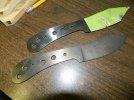
Hey guys, seeking advice from those of you fairly knowledgeable with hardness testers. I did these two blades over the weekend, and my RC numbers are all over the board. I ground the decarb off ( at least I thought I did) one blade with a 120 belt (handle area only), and had really erratic numbers, so I took it back to the grinder and hit it with 50 grit, 80, 120, 280 gator in hopes of removing more of the decarb layer, and evening out my numbers. My numbers still had a 12 point spread from 50-62, but were a bit higher on avg than the first round when I used just the 120 belt. With this knife I like to keep the out of quench look which is why I didnt use an anti-scale coating.
HT- 1480 for 10 min soak (Evenheat kiln)
Steel- 1075/1080 from Admiral
Quench- Mcmaster 11 sec heated to 130 deg
Time to quench approx 1 sec
Temper- 400 for 70 min (in wifes oven)
Testing method- Rockford Rockwell tester verified with a 63 RC test block. (tests within 1 point each time)
Other tests- I sharpened the one blade to approx 20deg (40 inclusive) and just did some manual testing shaving walnut, hammered through corner of walnut, push cutting leather, cardboard and such and had no problems with the edge.
My question is how deep should I be sanding to get past the decarb layer? Am I doing something else wrong; soak time, quench ( should I switch to something faster like canola) , quench heat?
Other variables- the anvil on my tester has play, which always bothers me, but it tests consistently on the test block. Could the knife being tested off center on the handle be causing false readings?
Any help would be appreciated.
Thanks Chris