
-
The BladeForums.com 2024 Traditional Knife is available! Price is $250 ea (shipped within CONUS).
Order here: https://www.bladeforums.com/help/2024-traditional/
You are using an out of date browser. It may not display this or other websites correctly.
You should upgrade or use an alternative browser.
You should upgrade or use an alternative browser.
Has anyone tried a diff. temper on d2?
- Thread starter llecardu
- Start date

- Joined
- Apr 14, 2006
- Messages
- 3,816
Tough to do an and air hardening steel. I tried it once with A2 on a wakasashi, turned it into a horse shoe. You would have to do a full hard then try to draw the spine with a torch, not very effective.

- Joined
- Feb 17, 2007
- Messages
- 3,375
Drawing the spine with a torch will work, but only to about about 800f and it has a secondary temper too.

james terrio
Sharpest Knife in the Light Socket
- Joined
- Apr 15, 2010
- Messages
- 22,618
I can't recall who it was, but someone claimed to have accomplished true diff. tempering on an air-hardening steel... I think it was D2 but I'm not sure about that either. Anyway I do remember it being reported as expensive and time-consuming.
Look up "Friction Forged" D2 blades... that's a little different, but does result in a very hard edge and soft spine/body. Looks like a costly process.
I don't really see the point, frankly. If you want the edge-holding of D2 with higher toughness and equal or better corrosion resistance, just use 3V or Elmax and temper them normally.
Look up "Friction Forged" D2 blades... that's a little different, but does result in a very hard edge and soft spine/body. Looks like a costly process.
I don't really see the point, frankly. If you want the edge-holding of D2 with higher toughness and equal or better corrosion resistance, just use 3V or Elmax and temper them normally.

- Joined
- May 4, 2009
- Messages
- 1,036
It was Phil Hartsfield and he used A-2. He made some of the best "usable" swords you could buy.Toshishiro Obata heavily endorsed his swords. His knife size blades were small tanks that would slice.I can't recall who it was, but someone claimed to have accomplished true diff. tempering on an air-hardening steel... I think it was D2 but I'm not sure about that either.
I don't know what his procedure was, but he did claim he wasn't using a torch.
Now I want to clay up a piece of A-2 and see what happens

Last edited:

- Joined
- Feb 17, 2009
- Messages
- 7,310
It was Phil Hartsfield and he used A-2. He made some of the best "usable" swords you could buy.Toshishiro Obata heavily endorsed his swords. His knife size blades were small tanks that would slice.
I don't know what his procedure was, but he did claim he wasn't using a torch.
Now I want to clay up a piece of A-2 and see what happens
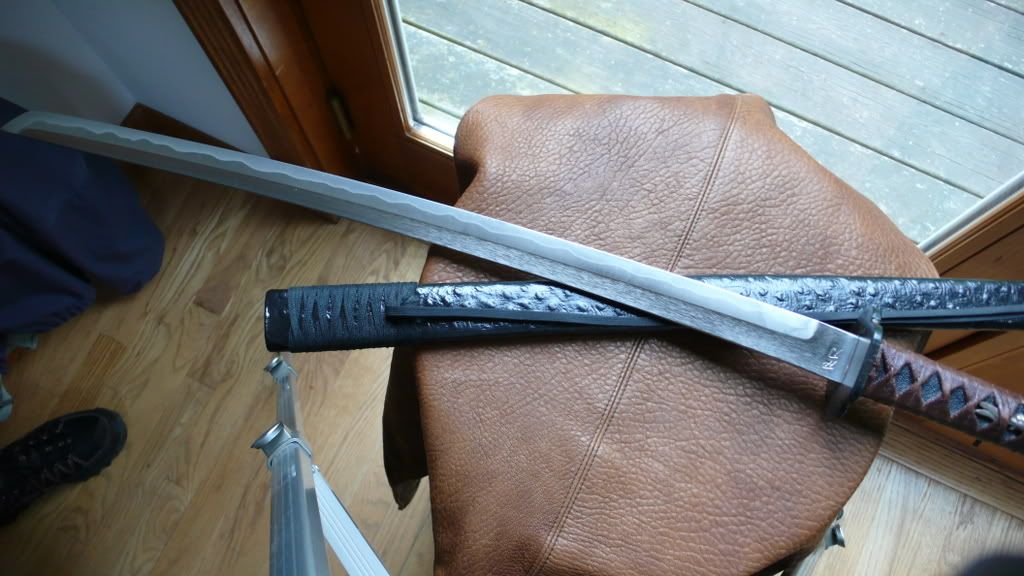
Phils blades were made to be used and they have been. He was tight lipped on his heat treatment but in a video on the samurai sword IIRC he mentions using heat sinks in his process, but it is not clear what he did.
Here is an A2 sword with a nice hamon from Phill
james terrio
Sharpest Knife in the Light Socket
- Joined
- Apr 15, 2010
- Messages
- 22,618
It was Phil Hartsfield and he used A-2.
Thanks for clearing that up, gentlemen


Nathan the Machinist
KnifeMaker / Machinist / Evil Genius
Moderator
Knifemaker / Craftsman / Service Provider
- Joined
- Feb 13, 2007
- Messages
- 19,121
Oh yeah, I've done it in D2 as an experiment. A low temperature austenitization (1700, to avoid grain growth in the 2nd) which got the carbon out of the spheroidized condition and into solution followed by a ~ 900 deg spring temper followed by plasma arc austenization (sounds trick huh? okay, I actually just "heated it with a torch" using a large diffuse arc from a high powered TIG). The end result was really genuinely and truly terrible. This is the first I've ever mentioned it here.
From a heat perspective, I'm pretty sure this is all the "friction forging" is doing, but time and temp control with a "torch" ain't all that great.
I was aiming for an HRC67 edge, not so much a particularly tough spine. I failed. We shall not speak of this again...
From a heat perspective, I'm pretty sure this is all the "friction forging" is doing, but time and temp control with a "torch" ain't all that great.
I was aiming for an HRC67 edge, not so much a particularly tough spine. I failed. We shall not speak of this again...
Last edited:

Stacy E. Apelt - Bladesmith
ilmarinen - MODERATOR
Moderator
Knifemaker / Craftsman / Service Provider
- Joined
- Aug 20, 2004
- Messages
- 38,509
Short rule of thumb on any differential quench - If it air hardens, no. If it oil hardens - maybe. If it water hardens - yes.