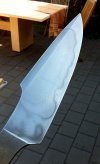
Hear treating + chisel grind

Joined
Aug 4, 2008
Messages
88
Just wondering how one would go about heat treating a blade with an uneven grind, such as a chisel grind?

It's my (incorrect?) understanding that great care must be taken to keep the grind as even as possible on both sides of the blade to prevent warping during the quench. Doesn't a chisel grind violate this rule?

What prevents excessive warp on such blades?

Cheers
 
Just to add I am talking specifically about shallow hardening 1095 with a clay coat
so grinding post heat-treat is out.
 
You preparation prior to heat treating will have a lot to do with your success. Uneven machining (or machining of any type) adds stresses into the steel. If these are not properly dealt with, you can have problems during the quench. This is magnified in thinner blades. The plus with a chisel grind is that they are usually a bit more robust than a typical blade grind. This will help you.

If it were me, I'd do a stress relieving soak at around 1200 for 20 minutes possibly followed by a normalizing cycle prior to hardening.

--nathan
 
You preparation prior to heat treating will have a lot to do with your success. Uneven machining (or machining of any type) adds stresses into the steel. If these are not properly dealt with, you can have problems during the quench. This is magnified in thinner blades. The plus with a chisel grind is that they are usually a bit more robust than a typical blade grind. This will help you.

If it were me, I'd do a stress relieving soak at around 1200 for 20 minutes possibly followed by a normalizing cycle prior to hardening.

--nathan

Thanks Nathan, that all makes sense.
Cheers
 
You should be able to get 3/16ths 1095 fully hardened, depends on your quenchant which is?.....

Hi Sam,
Canola oil for now @ 120f.
I understand that it may fully harden but would'nt grinding away that much metal ruin the hamon?
Could a blade, even of 1/8", be clay coated and quenched and then ground post heat-treat to reveal any significant hamon that far under the surface?

I asked a similar question a while back as to how thick the edge can be left and still achieve a nice hamon, wondering what the outcome would be if most grinding was done entirely after heat treat. Not thick at all was the answer IIRC
 
A hamon is not a surface feature. It's represents a transition zone between martensite in the hardened portion of the blade and pearlite in the unhardened spine, and it runs all the way through the steel.

--Nathan
 
Could a blade, even of 1/8", be clay coated and quenched and then ground post heat-treat to reveal any significant hamon that far under the surface?

I actually tried this yesterday with 8 unground 1095 blanks that were 1/8 and 3/16 thick. Each had satanite applied along the spine in the usual fashion that works for me.

After tempering, I bead blasted the blanks to clean them up then dipped them in ferric chloride. All of the hamons were clearly visible and vivid.

I started hollow grinding them today, which resulted in any trace of the hamon disappearing. I really wanted a hamon on all of these, so I just threw them out.

I thought this would work, but apparently the blades need to be ground to get a decent hamon.
 
Nathan, would subtle details be lost though? As a complete newbie to this it I would think that if this wasn't the case more makers would leave a lot more steel to remove post heat-treat in order to prevent warping/cracking during the quench. I had it in my head that it was more to do with the subtle details in the hamon that pro makers (the ones who can actually bring those details out) went down as close to final dimensions as possible.

ElectricZombie - I tried an experiment also just to see what I would get. Scrap 1/8" thick 1095 that was all bent and twisted in shipping. I straightened it out as best I could but it was visibly twisted and kinked in places so I didn't want to use it on anything important, perfect test subject though.
I did grind a slight bevel onto it, but only very slightly. It was pretty close to the full stock thickness.

This is my first attempt at a hamon too so I cant provide any significant comment as to how my normal hamons come out. I can say it is a lot lower than the clay line.

I soaked this at 1450F and quenched in 120F canola oil.

A really heavy etch brought out what you see in the pics. **edited for clarity, to add - the pic shows the blade ground down close to an edge - so by this stage a lot of material had been removed, and the hamon still showed up. Not sure what went wrong with yours, given that the hamon was there to start with?
 

Attachments

  • hamon test.jpg
    hamon test.jpg
    29.9 KB · Views: 47
Last edited:
Looks like a good hamon so far. The fine details will show up in the final finishing steps. The degree of how far you wish to go will determine how much fine detail you expose. Look up shiagi togi, or better hybrid polishing.

Johnathan,
The surface features disappear when the steel is ground. It is only after etching and polishing that they re-appear. The hamon may well be there on your blades. Sand to 400 or finer and give them an etch in FC and see what shows up.
 
Johnathan,
The surface features disappear when the steel is ground. It is only after etching and polishing that they re-appear. The hamon may well be there on your blades. Sand to 400 or finer and give them an etch in FC and see what shows up.

Thanks for the response.

I ground one of the blanks to about 600 today, and etched it in FC. There is a bit of hamon around .5 long near the tip. No trace of a hamon elsewhere. I didn't do anything different to these in terms of HT or application of satanite, just did not grind them. Not quite sure why I didn't get a hamon this time. When grinding before HT, my hamon success rate has always been 100%. This makes me question the HT quality on these, so I'm going to throw them away.

The only thing that I can come up with is that perhaps the quench wasn't fast enough for an unground blank?

I may just have to go back to grinding before HT on 1095. Not really a big deal except on my chisel ground pieces.
 
Shame to throw them away, could any be re-heat treated?

So just to clarify, all else being equal there would be no difference in the quality and aesthetic features of the hamon if an unground blank of was clayed and HT'ed?
So the only advantage to grinding clay coated blades pre HT is to save on time/belts by grinding in the annealed state?
 
Shame to throw them away, could any be re-heat treated?

I'm not sure. I don't know if the poor hamon might remain after the 2nd heat treat. I'm also unsure if anything different needs to be done to "re-heat treat" a blade. I'd rather be safe and just cut out more blanks than possibly letting a bad knife get out.
 
Back
Top