
Heat treat horizontal split

Joined
Aug 21, 2001
Messages
397
Havn't posted here for awhile, but wondered if anyone has seen this befor.

Heat treated a batch of 6 blades, a large order of Randal Model 3 style. All are cable damascus with a touch of nickle, San Mai with a core of 1084.

After forging, normalized and annealed. Ground, applied PBC coating, normalized x2, heated to 1500 in heat treat oven,and quenched in 100 degree canolla oil. Placed blade in boiling water to take off the oil residue prior to putting in the wifes oven to temper.

When I was done with the last of them, I picked up the first for tempering, and noticed a crack running down the center of the 1084 core, all the way down the spine. Then I noticed 2 others did the same!

The crack is not a delamination, but virtually splits the core down the center. I can't figure out how or why this happened, to 50% of these.

I split one of the blades, ground flat and the 1084 is RC 64, nice white and fine grain. Anyone have a similar experience?

Clint
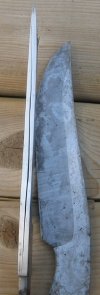
 

Attachments

  • resizesplit.jpg
    resizesplit.jpg
    23.8 KB · Views: 202
I'll ask the guy who supplies me with my damascus. No wait, that's you!

Can you anneal it and re-forge it?

3/16th's
 
It sounds to me like you had a lot of internal stress that normalizing wasn't able to do anything about. The cable and the 1084 might have had such different hardening curves that the quenching process put incredible stress on the core and caused it to fracture. The hardening process for the two steels may not have been similar enough to allow them to handle the stresses created during the quenching part of the process. Some of the heat treat gurus here might be able to explain it better.
 
When you split the blade was the fracture surface clean and light colored or was it dark ? Dark would indicate the crack was there before final HT.
 
For now I'm going with the stress idea, as it is the only thing that sounds like a reasonable explaination. I guess a few more normalizing cycles are in order when dealing with this steel combo, although I havn't had these problems in the past.

Obviously I can't be trusted, Hugh! Good to see your still alive.

Going away for a few days, check up then.

Thanks for your input,

Clint
 
For now I'm going with the stress idea, as it is the only thing that sounds like a reasonable explaination. I guess a few more normalizing cycles are in order when dealing with this steel combo, although I havn't had these problems in the past.

Obviously I can't be trusted, Hugh! Good to see your still alive.

Going away for a few days, check up then.

Thanks for your input,

Clint

I'd trust the opinions of mete and Kevin Cashen, before going with what I say. They are light years ahead of me when it comes to heat treating knives!
 
Like Mete is pointing to, I bet the crack was there before HT. Something done during the welding/forging.

Also, after we have brought high carbon steels to welding temps, normalizing becomes Very important, to reduce the huge grain size. I don't feel two times is enough, more like three or four and with careful attention to temps.
 
Saw something similar in Burt Fosters(MS) lecture on stainless/carbon laminates at Ashokan this year. He was having the same kind of thing happen. I belive it was the result of the different steels cooling at different rates. It just rips the center core right down the middle.
Good luck with the next ones!:thumbup:
Mace
 
I remember years ago some people were complaining that some 1084 from Admiral steel was splitting apart when forging. It would come apart in layers. If you had a similar problem with this steel then the "cracked before heat treat" suggestion would line up perfectly. I never experienced this, but I recall reading about other folks having the problem.
 
I had one do that not too long ago. It was san-mai 1065 core and USS Parche submarine steel. It had many welding rod passes which almost all of it was "mystery metal" from the Navy. Anyway after I quenched it a center crack formed right down the middle just like that. I too think it was from cooling at different rates and the stress has to be tremendous to cause the core to splint in half. I looked it over very closely and the 1065 core was literally broken in two. The welds were still perfect. I do remember when it was still smoking from the quench I took a slight warp out in the vise. I think thats when it cracked.
I rewelded it and normalized it several times, annealed it and re-hardened and immediately tempered it. Its never came back. Looks great.
 
I have seen blades split down the middle too. Wrought iron sides with a high carbon core. When I looked it up iron does have a higher coefficent of thermal expansion than steel, which is what I assumed pulled apart the blade I saw, which had a poorly welded
layered core split along a weld.
 
I know this post is getting old now, but I just got back to the computer. Thanks all for your replys.

Don, I really doubt the cracks were there prior HT, I believe I would have seen something, as the spine was brought to 320 grit prior. As far as enough normalizing, there were 3 normalizing cycles and one full anneal done upon completion of forging, all with an electric furnace and digital controls. Apparently not enough! Seems odd that 3 of 6 would spit the one non-laminated portion of the blade down the centre, when I would think a forging crack would more likely be cross-ways instead of longitudinal

Bruce, your issue sounds identical. Wish I could forge these ones back together like that, but the overall profile and grinds are fairly specific and have gone to far for that. Your submarine steel sounds interesting!

This wasn't Admiral steel, got it at Josh Smiths hammer-in this July.

Thanks again for your input, back to the forge!

Clint
 
Hi Friends,

So, is the conclusion that this is something that just can't be done, or, is there a way that would allow the overall objective to be achieved? Would simply changing the core for something other than 1084 be the easiest approach for the next batch? If so, what would be some better choices for a steel that would be able to hold up to the stresses? And, would there need to be other changes made to the methods and processes to make this workable?

Thanks, Phil
 
Back
Top