
- Joined
- Dec 12, 2013
- Messages
- 3
Hello all. I have been lurking here for quite some time and have learned ALOT from the members here already. I have made several knives over the past couple of years. I decided to make a few knives as Christmas gifts this year. I'm making a bushcraft style knife for my oldest son as a first "real" knife. The blade is of my own design and is about 4.38" long and 1/8" thick 1095 CRA steel.
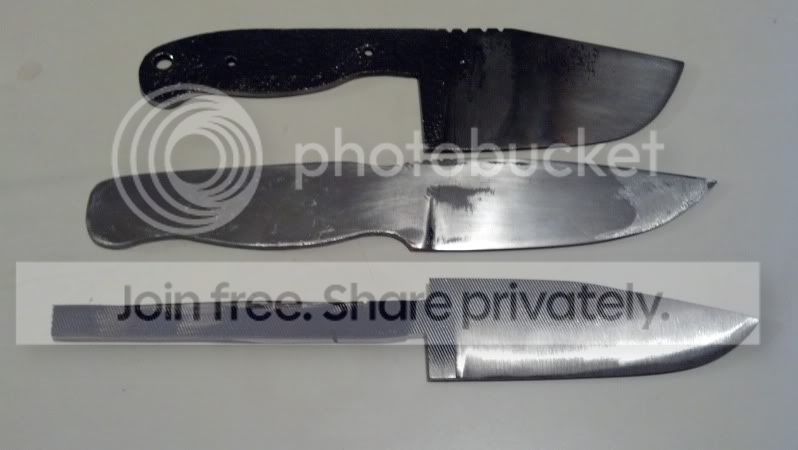
{The center blade is the blade I'm concerned about, the top blade came out at 56 RW beautifully, the lower blade is 46 RW and is destined to be more of a display knife than a work horse so I'm not too worried about its hardness)
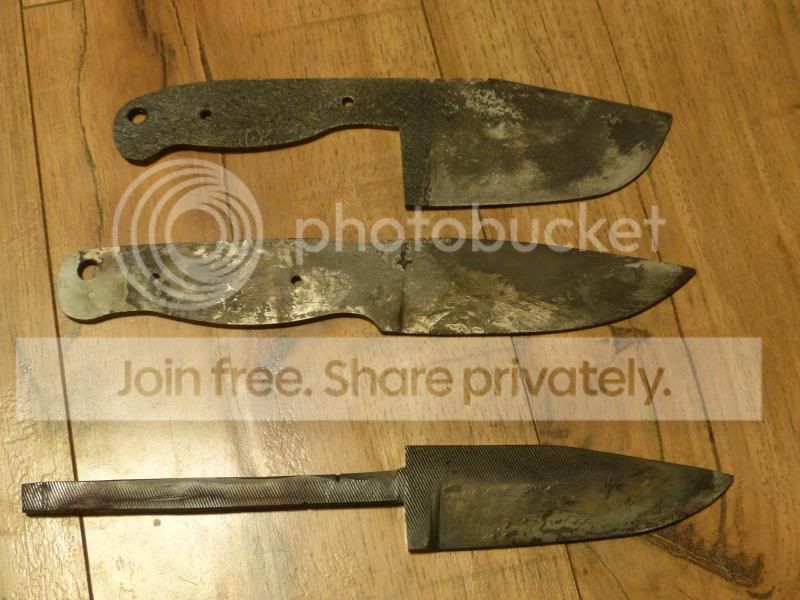
{This is the blade following HT prior to temper}
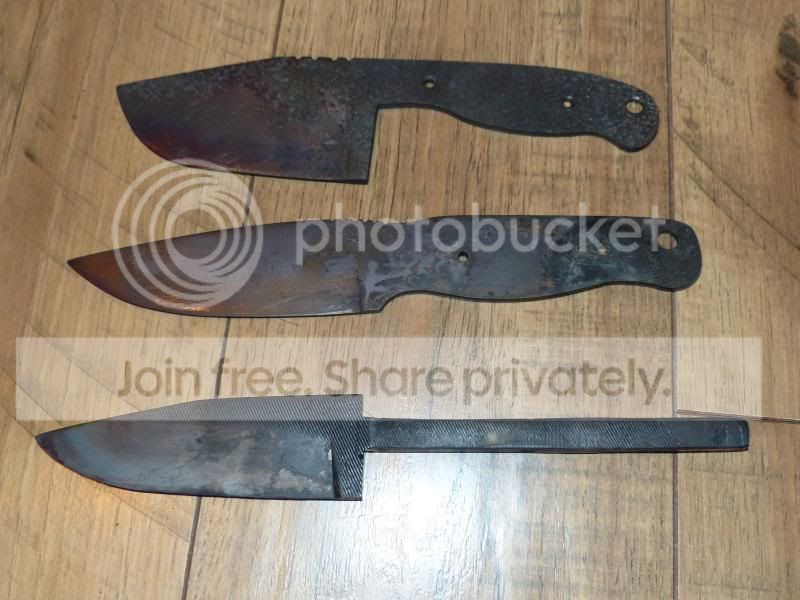
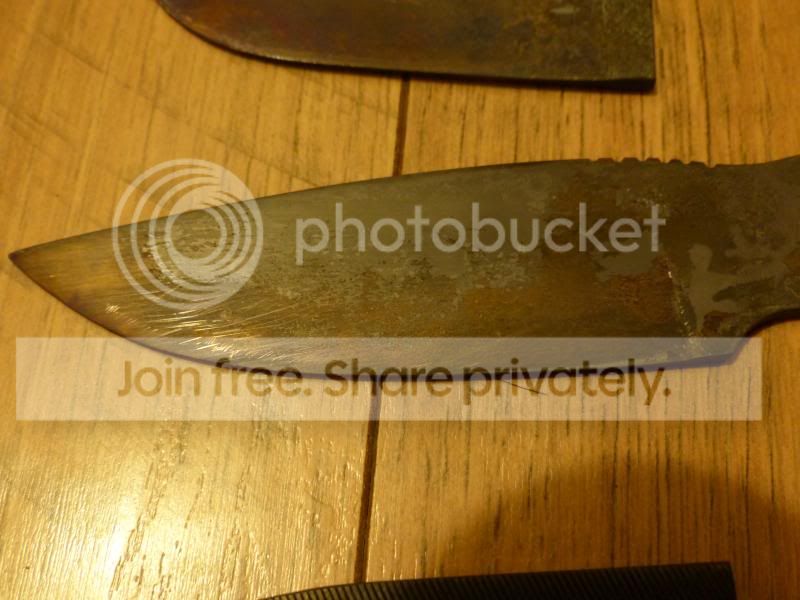
{This is the blade following the temper, by all rights I think it looks perfect in color etc.}
I heat treated the knife (as I have my past knives) with the following procedure:
1. Heated the blade in my forge to non-metallic (approx total time 3min 30sec)
2. Quenched the blade in 135* canola oil
3. Tempered the blade for 2 hrs @ 400* in oven, then cooled slowly to room temp and tempered again @400* for another 2 hrs.
4. Cleaned and polished the blade and is now ready for scales.

{this is the blade polished and ready for scales.....so I thought)
........ Today at work we had a NDE inspection guy from our inspection group come in to train a few of us. In his goodie bag he just happened to have a unltrsonic hardness tester. Through a little sweet talk I was able to twist his arm into testing my new made knife. I was expecting somewhere in the 50-65 range (a mill file dances nicely off of the blade) ......NOPE! 42 on the Rockwell scale (+/- 5 to 10%)
Now I'm bummed! I would like this knife to become a family heirloom for my son but I've screwed something up. I don't like the idea of doing a brass rod test to clarify these results. I can re-HT the blade (although not fun, but dooable with no real damage to the blade) and just clean it up again. I think this is the best idea.
I have researched some more and think my soft blade may be from my tempering process as I think I may have over heated the blade during the temper.
Here is my plan as of now:
1. re HT the blade as before
2. temper in a 315-325* oven for 1 hr 3 times
3. then re-polish and then add scales and finish the knife
What do you think? I'm open to any questions, comments, or criticisms that you more seasoned bladesmiths may have.
Thanks in advance,
lost

{The center blade is the blade I'm concerned about, the top blade came out at 56 RW beautifully, the lower blade is 46 RW and is destined to be more of a display knife than a work horse so I'm not too worried about its hardness)

{This is the blade following HT prior to temper}


{This is the blade following the temper, by all rights I think it looks perfect in color etc.}
I heat treated the knife (as I have my past knives) with the following procedure:
1. Heated the blade in my forge to non-metallic (approx total time 3min 30sec)
2. Quenched the blade in 135* canola oil
3. Tempered the blade for 2 hrs @ 400* in oven, then cooled slowly to room temp and tempered again @400* for another 2 hrs.
4. Cleaned and polished the blade and is now ready for scales.

{this is the blade polished and ready for scales.....so I thought)
........ Today at work we had a NDE inspection guy from our inspection group come in to train a few of us. In his goodie bag he just happened to have a unltrsonic hardness tester. Through a little sweet talk I was able to twist his arm into testing my new made knife. I was expecting somewhere in the 50-65 range (a mill file dances nicely off of the blade) ......NOPE! 42 on the Rockwell scale (+/- 5 to 10%)
Now I'm bummed! I would like this knife to become a family heirloom for my son but I've screwed something up. I don't like the idea of doing a brass rod test to clarify these results. I can re-HT the blade (although not fun, but dooable with no real damage to the blade) and just clean it up again. I think this is the best idea.
I have researched some more and think my soft blade may be from my tempering process as I think I may have over heated the blade during the temper.
Here is my plan as of now:
1. re HT the blade as before
2. temper in a 315-325* oven for 1 hr 3 times
3. then re-polish and then add scales and finish the knife
What do you think? I'm open to any questions, comments, or criticisms that you more seasoned bladesmiths may have.
Thanks in advance,
lost


