Heat treating a large 5160 bowie questions

On a related and already mention topic, you need to know how hard the steel is getting before you can diced where to set the tempering oven. I discovered that when I started using Parks#50, my blades got harder. Suprisingly, it seeme to be even more noticable on 1080 and 1084 as I was soaking W2 and tempering a little hot. 400F worked fine for 1080/84 with Tough Quench, but it leaves it a tad "chippy" when using Parks. I learned that the hard way when some nimrod baggage handler threw my bag onto the tarmac or something. I lost a tiny bit of the tip of a 1084 blade when it bumped up against something hard at high speed...lol. The problem with W2 in Tough Quench was more of an issue of "unintentional edge quenching" and, in hindsight, the edges may have been a point or two softer than they neded to bem but they still worked. They just didn't get everything out of W2 that can be had.:D
 
Those were excellent points Joe. I get nervous whenever I hear tempering temps as low as 350F, yet I hear them often. To me this a clear sign of the number of bladesmiths that are not heating high enough or soaking, or are using quenchants that make pearlite. If you achieved full quench hardness then 350F should be too low for almost any good knifemaking steel to be put into service as anything other than a sushi knife or scalpel. We mustn' t fall into the trap of thinking that we can adjust the hardness in the quench and get the same final results. Tempered martensite will beat pearlite in every category of performance.
 
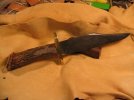
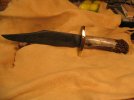
Well, I was going to harden the blade in my propane forge with the old 'non-magnetic, then quench' method. But, I got a suggestion or two from here and used my old Infi-Trol electric furnace instead. I normalized the blade twice, as Mike Williams had suggested. Then, I took it to 1,550 degrees F and soaked it for 15 minutes (something that would be hard to do in propane or coal without a thermocouple. Then, into the pre-heated Tough-Quench (tip first, edge first) and held it until it was 'touchable' - about 150 degrees. Next step, straight into a 350 degree tempering oven for two hours. After letting it cool to room temp I tested the edge with my Tsubosan hardness files. RC55 slid right off and RC60 scratched the edge. So, I'm gonna call it RC57. All along, my intent was to make a blade that looked 'old' - gimme that old time patina. Well, I cleaned the junk off the blade with the electric wire wheel brush and, guess what?? It looks old! I always took my air quenchable blades to a 400 grit before heat treating and did the same with this one. I also left a few hammer marks in it on purpose. So, now I'm debating a second temp cycle, just clean it up with the Emory buffing wheel or leave it like it is. I also got an unwanted/unplanned test when the wire wheel brush tossed the blade across the garage and it didn't break when it hit the concrete. Pictures inbeded (just pinned together, not finished) and comments/suggestions are welcome.
Regards,
Jacque
 

Attachments

  • IMG_0415.JPG
    IMG_0415.JPG
    35.2 KB · Views: 23
  • IMG_0416.JPG
    IMG_0416.JPG
    30.4 KB · Views: 21
Back
Top