Heat treating damascus

Joined
Mar 23, 2007
Messages
42
Hello,

How do you suggest to heat treat a damascus that is made of O1 and W2 (actually Russian version of it called U10). O1 is oil hardening and W2 is water hardening, but fortunately(?) at the same temperature?

So would it be wise to quench it in oil, so O1 gets its meant hardness and W2 will be probably softer, giving the composite better toughness?

At least the pattern looks real nice!

P.S. Story behind choosing W2 is that one guy told me that this Russian steel is actually a pure carbon steel, so equivalent to 1095. But after buying it and digging around in Russian standards I found out it's actually W2 clone with lots of stuff in it (even Cu, how doesn't it melt out?). Fortunately it costs only 2USD per kg ($1USD per lb) here (anyone wants?).

Viljo
 
personally I would heat treat for the O-1, if you use a relatively fast oil the water hardening steel should I think harden at the edge, but even if not I would rather take that option than cracking the O-1.
Hopefully an expert like Kevin Cashen or Mete will see this thread and be able to give you a more definative answer.
-Page
 
Use a fast oil. After the manufacturing of the damascus, the W-2 is severely modified anyway.
Stacy
 
Vilts
Show us some pics! At that price I would LOVE to have some if it's nice stuff!
Matt Doyle
 
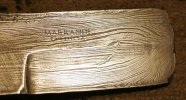
I attached the photo of that O1/W2 damascus billet (with etched name - we tested out stencils). If you meant that you'd like to get a photo of that stock W2, then unfortunately I don't have it and can't make until Saturday. The company that sells it has it in 12mm, 18mm and larger round bars and sheets from 30mm thickness.

I know this is stupid question, but what is fast oil? I hope it's not some special heat treat oil I'd have to order from other side of the world.

Viljo

Vilts
Show us some pics! At that price I would LOVE to have some if it's nice stuff!
Matt Doyle
 

Attachments

  • dama.jpg
    dama.jpg
    89.1 KB · Views: 101
Vilts
They were referring to the speed that the quenching oil cools the blade. Do not know of any other brands besides Parks 50 available through Ellis Custom Knifeworks. Hre is the link: http://refractory.elliscustomknifeworks.com/
Do you by chance have a link to the company selling the Damascus?
Thanks
Matt
 
If you can't get good fast quenching oil, I have had really good results with 0-1 in olive oil heated to 130 farenheit (approximately 55 celsius)

By all means if you can get a fast quenching oil use that, always better to use something that is actually engineered for what you are doing than to try to make do with something else.
I have never had problems with olive oil, it has very little flareup, and the steel seems to harden well in it, but as soon as I can afford it I will be switching to Parks 50 as that was actually designed for heat treating steel.

-Page
 
Do O-1 and W-2 "go together" ref. Damascus? :confused: I've heard of horror stories of O-1/ 1095 Damascus delaminating when you HT it.
Thanks,
Mitch
 
Darren is the best source for Heat Bath stuff, but since we are talking about the other side of the world, I would check out Houghton International, they are a world wide distributor and are easy to deal with, as opposed to Heat Bath, which is why Darren is a godsend for getting the stuff for us.

As for the rest, I haven't said much since it has been covered by others and the only thin I would add is a bit preachy and a little too late- and that would be to choose the steels in your mix carefully or these tough decisions will be necessary. The austenitizing temp is not as critical to match as the quench rate (though it is nice to approximate). When given the choice between shocking and micro fracturing the O1, which I can almost guarantee you will do if you quench it like W2, or not quite making it with the W2, I would heat treat it more like O1 and allow the thin cross section of the edge handle the W2 problem. The W2 layers in the body of the blade WILL have pearlite in them but the edge should be able to get mostly martensitic.

But for the best results choosing steels that can both be maximized is the best route.
 
I agree with Kevin on most of his post.
I think that with a high enough layer count, there will be enough diffusion of the alloy elements from to O-1 into the W-2, plus the reduction of the carbon content slightly, due to oxidation.The resulting mix of modified O-1 and modified W-2, should hold up to a fast oil quench with more than enough hardenability to miss the pearlite nose. Will there be some pearlite? - probably. Will it be enough to matter - probably not.

I do agree that proper matching of steels will assure the best damascus performance, and avoid this worry.
Stacy
 
Thanks for the wealth of information you've provided. As I can see I have a lot more to learn.

From your answers I understand that this combination is no good for damascus. I think I chose O1 because one book said it can be used to achieve fine results, but now I have to check it again. And of course because this is what I could get here without ordering from overseas.

So, how do I choose steels for damascus? What are the properties that both steels have to have, so they create good blade and nice pattern? Same quench medium?

Let's say I can get following steels: W1, W2, 52100, D2, A2, L6, 1085, 1018 (or similar). Which of these would make a good damascus and why? I'd just like to know and learn, so I could choose more wisely next time.

Matt, I think I wrote in a way that you misunderstood me (English is not my first language). The company sells only the steels, not damascus. The damascus was made in our own shop.
 
Do not use 1018 ,it can't be hardened as the carbon content is too low.Steels with Ni etch lighter .Therefore L6/O1 makes a good combination .The heat treating temperatures are very similar and L6 has Ni to give good contrast. 1085/15N20 is a popular combination and you might be able to get 15N20 easier over there than L6.
 
I agree with Kevin on most of his post.
I think that with a high enough layer count, there will be enough diffusion of the alloy elements from to O-1 into the W-2, plus the reduction of the carbon content slightly, due to oxidation.The resulting mix of modified O-1 and modified W-2, should hold up to a fast oil quench with more than enough hardenability to miss the pearlite nose. Will there be some pearlite? - probably. Will it be enough to matter - probably not.

I do agree that proper matching of steels will assure the best damascus performance, and avoid this worry.
Stacy

The problem is that a lot of W2 and O-1 will have approximately the same carbon content so there will be very little diffusion driven by the desire for equilibrium, and alloying beyond carbon (interstitial) is mostly substitutional in nature so it diffuses at the speed of a glacier. Carbon only has to skitter between the iron atoms while something like chrome has to trade places with iron atoms often only made possible by vacancies, kind of like the advantage a real thin knife blade has over a red square in getting to the other side of a Rubik’s cube:D This is a good thing in many ways though, if substitutional alloying could diffuse like carbon can, our bright silvery layers would bleed into our black layers and all our damascus would be a solid boring gray:(.

Just as one would expect around 1/4" of the edge of W2 to hardening in a medium speed oil, you would still end up with a mostly hardened edge on a mix with O-1, but the steel would be in control of that and not you. I am a control freak when it comes to my heat treating.
 
Kevin,
Agreed. With medium speed oil,the blade would get a perfectly usable hard edge.
In a fast oil with a reasonably thin blade (.125 or less) the entire blade would most likely harden .
Stacy

Viljo,
1075/1080/1085 (any of these) and 15N20 (or L-6) make a superb damascus. It will weld up easy, and the HT is nearly foolproof.
Stacy
 
Back
Top