Hello, new knifemaker here :)

Joined
Sep 3, 2012
Messages
543
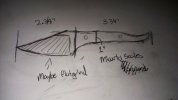
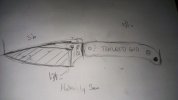
This is my first creation called Hades. My name is Sean Huang. My knife "company" is Pluto Bladeworks, please some constructive criticism, like where there would be hotspots etc, not like "Oh, you suck." I plan to make it out of D2 and G10. Any color g10 you like. with a Kydex sheath, optional paracord.
Blade length: 5"
Blade width: 1 7/8"
Handle length: 5 1/8"
Hollow ground.
IMAG0508.jpg
 
If you at just tarting out, I would probably do a flat grind rather than a hollow. What do you have for tools and what are you planning to achieve the hollow grind with?
 
Not for nothing, but try a model out of cardboard first. If you stick with what I am reading for measurements up there, that is gonna be a big knife. I wear a size 13 wedding band and find a 4"-4.5" grip is plenty big. If you keep those proportions it is gonna feel like a small hatchet (way forward weightwise) not a knife. Some people like that, but most do not. Great for chopping, but you wrestle the knife too much otherwise.
Also, take this for what its worth too... anybody can draw a knife on paper, making it functional out of real materials is where the craft comes in. For your first knife pick a design that is simple and classic, keep the materials simple as well, and take your time. I agree, a hollow grind is not a good idea without proper equipment and training. And if you are set on G10, wear a mask, cover your skin, all that stuff. Its basically fiberglass...
Welcome, cheers, good luck!
 
I will offer this: a blade width of 1 7/8" is very wide in a knife of this geometry. I believe it would be cumbersome in use. Keep in mind with a blade of this style the last 2 inches is the portion that is useful.

The edge will be hard to sharpen with the choil ground this way. Its hard for the entire edge to make contact with the abrasive without hitting the leg on the choil. This is one reason for the ABS style plunge line.
D2 is a good choice, they can be hollow ground very thin and hold up well.
If you are just starting out; grind a couple of blades that you might like to produce, add handles and sheaths and see what people think.

Regards, Fred
 
Sorry too if this feels like a flame, I don't mean it to be... But, make your first knife, and in reality all your knives, for you. Don't try to start it as a business, you will end up like all the toads on Fleabay hocking ground down spatulas and paint scrapers touting them as "custom knives." If YOU like it, and it feels right, chances are someone else will like it too. THEN start looking at the sales and commission side of it...
Cheers, again, just my $.02, take it or leave it as I am by no means a mastersmith or much of a business man, but I have been blessed by just enough requests to keep my hobby funded, and that keeps me happy...
 
I agree with the above post. I in no way mean to discourage you, but as many find out, drawing and naming a knife is the easy part. Creating a usable attractive knife from raw steel and materials can be a whole different ball game. I would make a few templates from wood, cardboard, or something similar and see how they fit your hand. When starting out I would focus on making the knives as perfect as possible, and not rushing steps. Once you have cranked out a decent number then you can evaluate where you are at and if your product is something you feel comfortable selling, or something someone would buy. For me I feel that sales should be an eventual end result, rather than the starting goal. The best advice I can give is to slow down and take your time on each step, making sure it is exactly how you want it before moving to the next step. Quite often people new to knife making end up rushing through the steps and end up with a crude looking shank that doesn't cut well at all, because they didn't take their time, or skipped important steps in the process. Also I would strongly suggest reading the stickies at the top as there is a pile of good info there .
 
The design looks pretty sweet. The shapes are manageable. I do agree with the others that you should start with a flat or scandi grind. Also, 4.5 inches is plenty size for the handle, especially with the blade only being 5 inches. How will you be heat treating? If you send it out then there's no problem with D2, but if you're doing it yourself then i would suggest some 1084 because it's cheaper and easy to heat treat. The most important thing though, is JUST GO FOR IT! That's how you'll learn. Grab a file, c clamp, and hacksaw and get to work. If you are seriously interested in selling, watch this video. http://www.youtube.com/watch?v=wO-y7MDY1M4. That's not my video but it has great info. I was in your shoes just a few months ago. I had all my designs, etc. Then I made my first knife haha. Don't get me wrong, I love knifemaking, and each blade I make gets better, and they're all usable, but there's a huge learning curve. Just have fun with it and good luck.
 
Not for nothing, but try a model out of cardboard first. If you stick with what I am reading for measurements up there, that is gonna be a big knife. I wear a size 13 wedding band and find a 4"-4.5" grip is plenty big. If you keep those proportions it is gonna feel like a small hatchet (way forward weightwise) not a knife. Some people like that, but most do not. Great for chopping, but you wrestle the knife too much otherwise.
Also, take this for what its worth too... anybody can draw a knife on paper, making it functional out of real materials is where the craft comes in. For your first knife pick a design that is simple and classic, keep the materials simple as well, and take your time. I agree, a hollow grind is not a good idea without proper equipment and training. And if you are set on G10, wear a mask, cover your skin, all that stuff. Its basically fiberglass...
Welcome, cheers, good luck!
I'm kinda thinking to go with Micarta instead. and well, if you guys don't think Hollow grind is good, then I'll change it to a flat grind.
 
stock thickness, handle thickness, any contouring of the handle, or will it be relatively flat slabs? (and as a person with large hands, i have no issues with the idea of a 5" long handle)
for a first knife, start with flat grind or even a convex -- hollow grinds take practice and a fine touch to keep them even.
also -- rather than starting with D2, which is not the cheapest of materials, you might try 1084 carbon steel -- relatively low cost, easy to grind and heat treat.
last -- what are you using to do the grinding? files, 1x30, 2x42, 2x72 belt grinder? if belt grinder, pick up some Norton Blaze belts -- not the cheapest, but they are pretty durable and last a lot longer than the standard aluminum oxide belts you find that are actually geared towards woodworking -- a good half or full face filter, and safety glasses..
 
stock thickness, handle thickness, any contouring of the handle, or will it be relatively flat slabs? (and as a person with large hands, i have no issues with the idea of a 5" long handle)
for a first knife, start with flat grind or even a convex -- hollow grinds take practice and a fine touch to keep them even.
also -- rather than starting with D2, which is not the cheapest of materials, you might try 1084 carbon steel -- relatively low cost, easy to grind and heat treat.
last -- what are you using to do the grinding? files, 1x30, 2x42, 2x72 belt grinder? if belt grinder, pick up some Norton Blaze belts -- not the cheapest, but they are pretty durable and last a lot longer than the standard aluminum oxide belts you find that are actually geared towards woodworking -- a good half or full face filter, and safety glasses..

I have 2x42 belt grinder
 
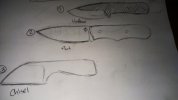
I like the looks of the bottom three. The top one still looks awkward to me. Maybe not, but never know till you try and finding out is the fun part. That #3 wharncliffe with a flat grind (chisel is good for sushi chefs, not a lot else IMHO) would be a very useable little knife.
Not to be overly repetitive but cardboard, play-doh, and thin wood strips like paint sticks are a cheap and easy way to feel one out. With thin wood on a belt sander you can cut and "grind" one to a reasonable facsimile in literally minutes... It will even give you a feel for the angles involved in the grind before trying it in steel...
 
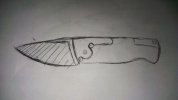
There isn't much of a blade on the folder. I mean it's short. Perhaps you might consider making it longer. Folders usually require a lot of care and extra time to make. Again, I will say make a pattern out of cardboard or wood and see how you like it. If YOU like it, then you are set to go! Folders are all I make and Styx, as a name , soundsgreat - I don't name mine - but the pattern doesn't look good to me. My best to you. My last remarks to you would be to just keep trying and your work will keep on improving. Relize often people starting make more than 50 (fifty) before they see anything that looks reasonable to others. Frank
 
I would make the spacer larger and bring around front more.In the pic of the 3 designs I like the basic #1.like the other guys have said get it cut out of some cardboard (I use cereal boxes) and get a good feel,especially for the friction folder to make sure your stop pin sets everything straight.
 
The chisel grind would probably be the easiest to grind as you do not have to match it up with the back side. Send it out for professional heat treatment. After that the drop point with a scandi grind.
 
Back
Top