
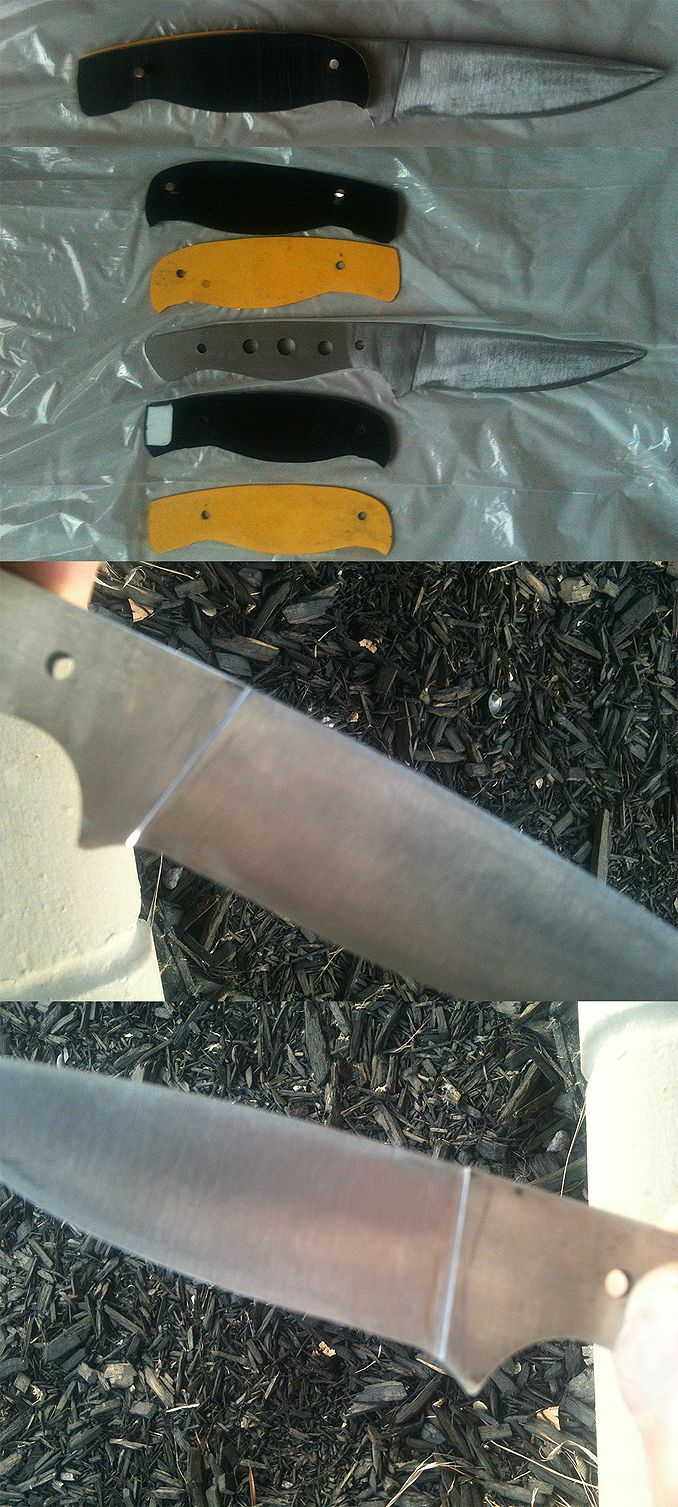
Help/Advice with this project?

Joined
Jul 19, 2014
Messages
92
ANfcIxj.jpg


So the relevant details I suppose, 1084, black micarta, yellow g10, nickel silver pins.

This is by far my cleanest job yet as far as bevels go. I tried to take a picture of my plunge's from the blade and spine but they didn't turn out, anyways they are exactly lined up.
I found a couple of pieces of 2 inch long stainless steel, with bolt holes at home depot a while back and grabbed them. I've tried using it to set my plunge before but I never really took the time to make sure it was right, this time it was.
I actually did most of the bevel by hand with a file with no jig (other then the stop guide for my plunge), I really wanted to be able to look at it from every way after each stroke and it paid off. I did touch it up with the sander briefly after for a minute or two however. I am concerned about the job I have ahead of me with filing once it is hardened, tough work.

A problem I encountered (and have a couple of times now) is that my pins don't line up when everything is drilled, not quite... Here I had to go one size larger then 1/8th inch after I drilled my original pin holes because they didn't fit with my scales.

Normally what I do is get my scales and liners all cut and sanded, the perfect rectangle, and then I electric tape them together so it's one solid, even slab. Then I take my knife, with the holes already in the tang, and I securely tape that to the front of my scale block so it can't move. Then I run the drill through the tang holes and cut through the scales/liners.
It's always lined up before, but the last 2 knives I made ran into this problem...

Any other general advice you guys can give me to making this the best knife I've done yet?

I was thinking of trying some "creeping vine" file work finally here, but other than that I don't know what else I can do to add style. Perhaps it doesn't need style?

How do I go about properly finishing this black canvas micarta? I figured since it's rather smooth already, I'd start sanding at 600, then jump to 1000 and then 2000, wet sanding I guess since it wont absorb the water.
 
Also, the handle will be rather thin. I only have the yellow liners and don't want to do 2 yellows I don't think. Is there another material I can use without having to wait for an order of G10?
 
Save all the style and flare for later. The main advice I can offer is to make the fit and finish as close to perfect as you can. Don't rush it. I remember a knife that i4marc posted a while back and it was pretty simple in the fact that it didn't have fancy scales or file work. What it did have was perfect fit and finish. All the file work and fancy materials won't make up for poor fit and finish. I thought it would when I first started not long ago. The first one I finished with no gaps or missed sanding marks and crisp plunge lines was beautiful because of these things and nothing else. I would stop your plunge short of the spine and then blend it when you sand it. You have a good start so all that's left is finish it to the best of your ability.
 
Save all the style and flare for later. The main advice I can offer is to make the fit and finish as close to perfect as you can. Don't rush it. I remember a knife that i4marc posted a while back and it was pretty simple in the fact that it didn't have fancy scales or file work. What it did have was perfect fit and finish. All the file work and fancy materials won't make up for poor fit and finish. I thought it would when I first started not long ago. The first one I finished with no gaps or missed sanding marks and crisp plunge lines was beautiful because of these things and nothing else. I would stop your plunge short of the spine and then blend it when you sand it. You have a good start so all that's left is finish it to the best of your ability.

Thank you, that is wise now that I think about it. I absolutely will keep this one simple, and clean.

When you say "blend it" as I sand, I'm not sure what you mean. I expect it will wash away to some degree as I am going, but I get the feeling you mean something different?
 
Good looking plunges but again, many would say stop short of breaking the spine. Your plunges appear to go all the way to the spine...

Sorry but you don't see that on a Bruce Bump or Nick Wheeler knife... Sorry but other than that they look nice.
 
Good looking plunges but again, many would say stop short of breaking the spine. Your plunges appear to go all the way to the spine...

Sorry but you don't see that on a Bruce Bump or Nick Wheeler knife... Sorry but other than that they look nice.

No need to apologize, I wouldn't have asked for advice if I didn't expect people to point out my "noobie" mistakes. Thanks.
Like I said in the OP, I did the bevel by hand more or less and I was just really focused of making sure that I first of all had a clear plunge, and second of all that it was lined up on both sides. Once I had cut into the spine significantly by accident, I saw no option but to go full in.
As it is, the entirety of the blade is thinned out. The spine has lost 25% of it's width where the plunge starts (and it's even on both sides! I'm so proud lol) I was under the impression this was, well I don't know the definitions but a "full flat grind", rather than a "flat grind". I mean, I've seen nice knives that have plunges at the spine and edge and the entire blade thins out, what do you call that?
Thinking about it though, I suppose thinning my spine like that with the whole blade, while giving me more slicing ability (no?) But it will weaken the knife itself, and considering the EDC type knife it is, that isn't good.
 
It's called distal taper. So you can keep from breaking the spine at the plunge and have a nice slicey blade.

Fine and even plunge though.

I also have to say that the inside curves on the handle portion of the blade is finished very well super smooth and flowing.
 
Last edited:
Back
Top