Help an idiot wire a etcher

Joined
Nov 17, 2014
Messages
254
First off I'll state that all of this is going into a box.
Second I'll state that I have searched this all and I'll admit it is a little out of my league.
Third I'll say that electronics are black magic voodoo that I will never understand and so that brings me here.
I've been following this
http://www.bladeforums.com/forums/showthread.php/888013-New-Electro-Etcher-design?highlight=arcade
I went to fry's this morning and picked up a bunch of crap that had similar numbers to numbers I have seen in parts lists.

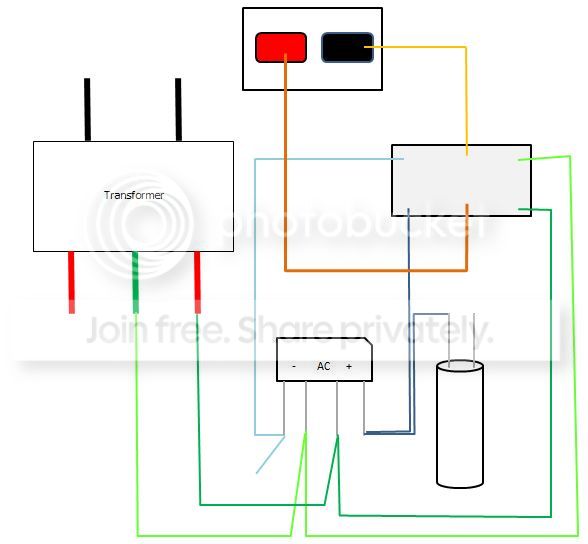
Start to end I have an old pc power cord with the blue and brown wires going to the black legs of the transformer.
The other side of the transformer has red green and red. I have one red taped off. one green goes to one AC leg and the red goes to the other AC leg of the bridge.
On the bridge the DC+ goes to the - side of the capacitor and to the toggle.
DC- of the bridge goes to the toggle and the other leg goes to ??????
In the guide I am following the capacitor is soldered to the arcade switch.
The arcade switch has NO, COM, and NC
FAFBE37A-3388-427C-96FD-EC8866E1A153_zps2ubiaxqh.jpg

FBAB4141-D5CE-48B2-AC23-9BC563496B5C_zpssecnuycw.jpg

What part of the arcade switch does the +leg of the Cap go.
What do I do with the other DC- leg from the bridge.
 
The center taps of the switch will go to the etcher pad and blade via the red button switch. The red push button turns it on and off. The DC positive from the button goes to the blade ground clip and the DC negative goes to the etcher pad. (In the AC mode it doesn't matter.)
Just wire the red button switch to pass the current when pushed. Use Zaph's instructions to wire the push button and capacitor.
 
OK to make this easier I am deleting the RED push switch. Does that mean I should delete the CAP too? Or should i connect the cap to the 2 wires going to the speaker terminal?
this is what I have
etherschematic_zps9620644f.jpg
 
Last edited:
OK to make this easier I am deleting the RED push switch. Does that mean I should delete the CAP too?

It should work without the cap. The push button would allow the cap to charge up when it was open. You wont be able to charge up the cap and get a pulse burst, but will still etch. Do you have a voltmeter?
 
ok so I hooked up my orange wires from the center of my momentary DPDT switch to the speaker teminals and to my volt meter. Plugged it in and when I throw the switch it reads 14.4V AC, switch the multimeter to DC flip the toggle the other direction and it reads 14.3. This is all with the cap disconnected and no red switch. If I flip the toggle while the multimeter is on AC to DC, it reads 25
 
It sounds like it is working. Now I would wire in the push button and the capacitor. Connect the cap across the dc output of the rectifier + to + and - to -. Use the pushbutton NO (normally open) to complete the circuit on the output when it is pushed closed.
 
ok so I hooked up my orange wires from the center of my momentary DPDT switch to the speaker teminals and to my volt meter. Plugged it in and when I throw the switch it reads 14.4V AC, switch the multimeter to DC flip the toggle the other direction and it reads 14.3. This is all with the cap disconnected and no red switch. If I flip the toggle while the multimeter is on AC to DC, it reads 25

Wait- I just read that last sentance....What. Are you measuring the DC out of the rectifier? If so use DC on the voltmeter. If measuring the out of the transformer it should be AC. The DPDT switch will switch between AC and DC to the speaker terms.
 
It sounds like it is working. Now I would wire in the push button and the capacitor. Connect the cap across the dc output of the rectifier + to + and - to -. Use the pushbutton NO (normally open) to complete the circuit on the output when it is pushed closed.

So wire the cap between the rectifier and switch? I couldn't mess with the wiring anymore as I had to go to the wife's company's Xmas party. But when we got back late last night I had to try it out. I slapped some nail polish and a O1 scrap and scratched a mark in it real quick. Connected a q-tip and did this.
97EDF197-97B2-4BEC-BB3C-5C9C671C5E52_zpspql064ie.jpg
 
A couple things, a capacitor should be connected to both the +/- output on the rectifier. It is used to smooth out the DC signal. I think you have it wired backwards in the above photo.

Second, when switched to DC your multimeter will read roughly double the AC voltage, so 25v isn't surprising at all. When you install the capacitor, the no-load voltage will change to match that of the capacitor. If you use a 16v cap, it will read 16v even though you really only have 13v.
 
I find it easiest to wrap the cap leads around the rectifier output. It keeps it out of the way and eliminates some messy wiring.
 
A couple things, a capacitor should be connected to both the +/- output on the rectifier. It is used to smooth out the DC signal. I think you have it wired backwards in the above photo.

Second, when switched to DC your multimeter will read roughly double the AC voltage, so 25v isn't surprising at all. When you install the capacitor, the no-load voltage will change to match that of the capacitor. If you use a 16v cap, it will read 16v even though you really only have 13v.

Ok got it, I'll get the capacitor connected. I accidentally bought a DPDT momentary toggle and I like it the way it is setup. Center off, up for AC, down for DC. I think I'll leave it that way. I just cut a quick logo out of masking tape to try out and it worked pretty good even with the cap disconnected.
627210B2-88EE-4DF4-A114-93BF0745042C_zpsvawaltie.jpg
 
Ok got it, I'll get the capacitor connected. I accidentally bought a DPDT momentary toggle and I like it the way it is setup. Center off, up for AC, down for DC. I think I'll leave it that way. I just cut a quick logo out of masking tape to try out and it worked pretty good even with the cap disconnected.
627210B2-88EE-4DF4-A114-93BF0745042C_zpsvawaltie.jpg

Yea with the 3 position switch and detent back to off you basically have the pushbutton switch capability. Again, not sure if the cap is totally necessary...
 
I worked electronics engineering for several years for NAVELEX. That cap really does nothing...since the knife blade or stencil does not care a rat's patootie about ripple, or the wave shape. You just want some sort of DC voltage to etch and an AC voltage to mark.
 
Back
Top