
Help identifying steel

Joined
May 23, 2016
Messages
115
Good day
I know the majority advocate the use of known steel. I'm all for that but I got my hands on 5 of these last week.
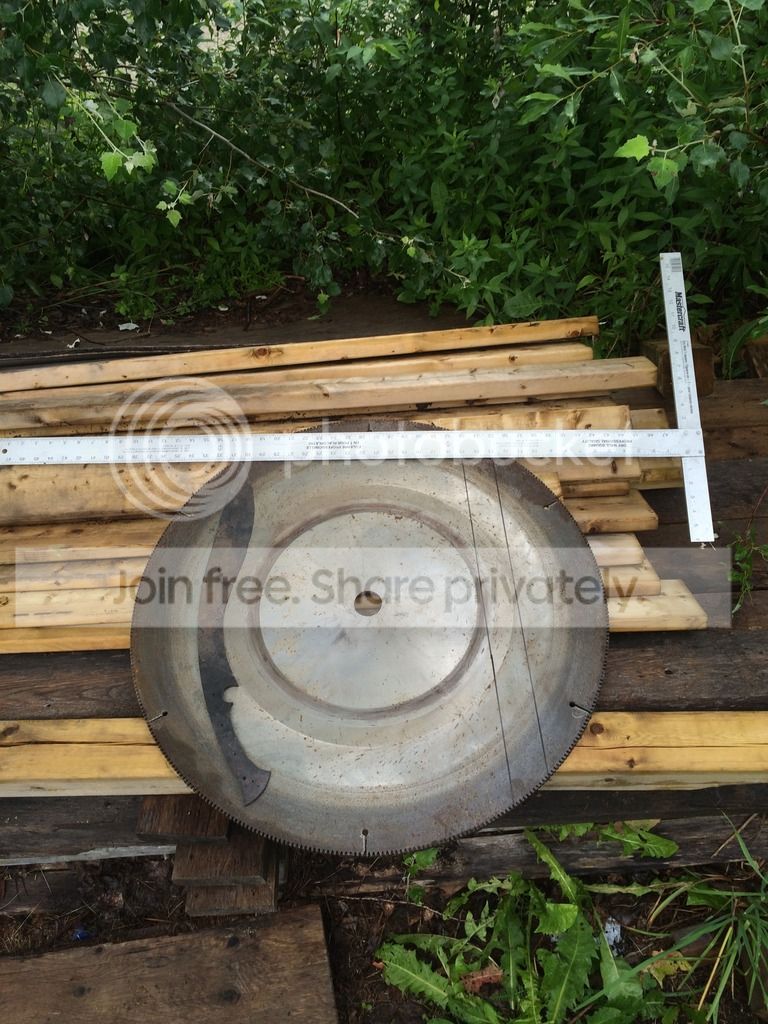
The blades come from a mill and are used to cut corrugated steel pipe.
They are stamped "disston USA". I can't seem to find any info on the steel type used to make them.
I'm gonna try to cut one with a grinder shortly and do some testing with forging and heat treat. They are 1/4" thick, and 30" in diameter so a lot of steel if I can deal with them.
They have been kept outside all week and it's been raining every couple days. The most rust forming is around the edge where they would have been in contact with the steel pipe.

I was thinking they might be 15n20, L6 or some hss like m2. I read m2 rusts pretty readily so mabey not that?

If you have any ideas on what it might be throw them out there. I will try to figure out a heat treat but if I can't these will go to the scrap yard.
Thanks in advance!

-Colin
 
If they are used to cut steel pipe, they are more likely to be made from high speed steel.

Hoss
 
I am very familiar with Disston. I'd say there is a 99% chance the steel is Bestar's 8670 (same Bestar that Aldo sells) hardened to the high 40s RC.

Definitely not 15N20, L6 or HSS.
 
If they are used to cut steel pipe, they are more likely to be made from high speed steel.

Hoss

Nope, if you look closely at the teeth, you'll see they are ground like gears. I did a factory tour of Disston and it was explained to me that these blades have a negative rake and cut in a high-RPM 'brute force' manner, unlike 'normal' metal cutting blades. They are homogenous 8670 steel with a homogenous heat-treat.
 
Beautiful, thanks P. Brewster. That's way more than I had before.
Anyone care to throw out a HT recipe for 8760?
Is this steel any good for knives? What's the toughness like? And what's it like for forging? The kukri like object on the left is broken and I'm thinking about making another from this stuff if I can

-Colin
 
Beautiful, thanks P. Brewster. That's way more than I had before.
Anyone care to throw out a HT recipe for 8760?
Is this steel any good for knives? What's the toughness like? And what's it like for forging? The kukri like object on the left is broken and I'm thinking about making another from this stuff if I can

-Colin

Think of it like this: Take 1075. Add a bit of nickel, chrome, and moly and you have 8670 (increased toughness, impact strength, and hardenability). Add some more nickel and you have L6. Here is a chart (not sure if link will work) http://www.zknives.com/knives/steels/steelgraph.php?nm=1075,8670,L6&ni=334,853,140

HT is pretty basic. I've used fast and medium speed oils with a soak in the mid/high 1500s F (as per spec sheet and Peter's). Here is a link to the spec sheet http://www.bestar-steel.com/site_files/files/material_data/BE86.pdf

Out of the quench, you have a hardness in the low 60s, so this steel is best for work/camp knives rather than slicers.
 
If these are 8760, then I guess we were made for each other. I like to make big choppers/ camp knives. With 5 of these and the ability to get more as they wear out, I'll have enough steel to last years.
Thanks for the info Patrick. At least I have a place to start. I won't be trying it out today. Getting ready to take the dogs swimming now. I'll give an update when I do.
Thanks again

-Colin
 
Colin, you may want to try a lower hardening temperature than is given by spec sheet (which is geared towards heat treating for a saw...much like "spec" heat treat for 52100 is geared towards bearings). I think (I do mean "think"....I have yet to try this steel...I have one piece given to me by Chuck at AKS) that your highest hardness will be achieved at 1500°F-1525°F, quenched in oil. 64-65HRC should be reachable as quenched. 1550-1625 is too hot, IMHO. That will give a larger carbide structure, along with some retained austenite. Aus grain coarsening should not occur till ~1750°F (Tool steels, 5th edition), so should be no worries there if you choose to use the higher austenitizing temp. If you look at a hardness chart for L6 (close to 8670), you can see that hardness will drop about 1 point for every 25° either side of the 1500-1525 area. And this holds true with most all of the carbon steels. Steels with higher carbon, like 1095 or 52100, hardness is maximum around 1475F. If you have access to a hardness tester, it would be easy to verify your target temp. Make a few coupons and harden them at differing temps. Also, as Mr Brewster mentioned, to put the alloying into solution, you will need to have the ability to soak the steel at temp for 10 minutes or so.
 
Ok samuraistuart, I'll keep that in mind. I don't have access to a hardness tester, I'll be aiming for mid to high 50's as a target hardness for most of my uses. As I will be forging, I suspect I'll be hitting temps in excess of 1750 f.
What's the process for normalizing to refine grain with this steel?

-Colin
 
When you say you'll be aiming for mid to high 50s, you still need to harden the steel as hard as you can get it, then temper it down to where you want it. Don't try to aim for 55HRC out of the quench. Aim for 64-65, then temper it back. After forging, normalize at 1650F, followed by an air cool. 1650F should be about right for normalizing 8670. To help refine aus grain after that, go just above critical a few times and air cool, maybe 1500F would be good. Or you could descend down, as in 1550, 1500, 1475, 1450. Your call. The idea is to refine grain by creating new ones and this happens during your thermal cycles. This alloy may harden to some extent by air cooling...not really sure. If that occurs, and you still need to machine it, you will need to anneal it first. Not to worry, this alloy can be annealed fairly simply. Heat the steel to around 1450-1475, and then stick it in a bucket of vermiculite overnight. Or heat it up in the forge to 1450-1475F and turn the forge off, letting it cool overnight. If the steel had a higher carbon content, like 52100 for example, the annealing process is different, and should be spheroidized.
 
Oh I will be trying for maximum hardness out of the quench. I was wondering if I should use a different tempering temprature because I will be using a lower austenizing temprature, and achieving a higher hardness. By looking at the graph in the link by Patrick, it looked like tempering around 300 f. That seems like a low temp to me.
Thanks for all the info so far. I cut a piece off of one of the blades today. Have a coupon ready to harden and a rough blade forged to test the effectiveness of the heat treat. This stuff seems pretty abrasion resistant, went through 3 thin cutting discs per cut

-Colin
 
So...
Tried hardening my rough knife and test coupon today. Brought them up to non-magnetic and a shade or so brighter. Could see the decalescence. Held for 10 min and quenched in canola oil. The oil was probably around 90 f by the time I quenched. A bit cold. The cupon is 1"X1/4"x3". Put in in the vice and hit it with a hammer to try to break it. Wouldn't happen. Thought I was going to beat my bench top off. Cut it about 1/16" and tried again. Nope. All the pounding and it barley even bent.
So I took my test blade and tried running a file over the edge to check for hardness and while it didn't bite right in, it didn't exactly skate off it either. I would say the piece is not significantly harder than it was when I started.
Any one have any thoughts on what I might have done wrong?
Should I have gotten the pieces hotter, or the quenchant hotter?
I think when I get a chance I will try it again with higher temps.
Until then, any input is greatly appreciated.
Thanks

-Colin
 
Make sure you account for you decarb layer when you do the file test. If you're not using anti-decarb stuff like ATP, you have a decarb layer to file/sand thru before you hit hardened steel. (not talking about the scale, but the layer of steel that has it's carbon robbed because of the heat treat) If your hardening temp was around 1500-1525, and you quenched in canola (90F is OK), and then removed the decarb layer, a file should skate.
 
I was well beyond the decarb layer. Out of the quench it is slightly softer than 5160 that has been hardened and tempered at 400 f. I'm going to try heating a little hotter before quench. I don't have any way of measuring temprature so I rely on magnetism, watching for decalescence and shades of colour. I emailed disston to see if they would verify the type of steel. We'll see how that goes.
Thanks for the help so far, I appreciate it!

-Colin
 
Disston emailed me back today and verified that these blades are indeed 8670! I have some hardness testing files ordered hopefully that will help confirm any issues I may have with heat treat. Looking forward to getting to know this steel, thanks for the help guys

-Colin
 
Cool. Since your quenchant (canola) should be fast enough for this steel, the only thing left to try is a longer and/or hotter soak.

Another thing I do when I'm trying to troubleshoot is go straight from the quenchant into water, to avoid any "autotemper" that might occur while the piece air cools. I quench for 20 seconds or so, then place the knife in water.
 
Hoss, the Germans used to use stuff like 115W8 for metal cutting saw blades until the bean counters convinced them that HSS would last longer. From what I was told by Achim Wirtz, the HSS blades did, in fact last longer, but only if you could keep the teeth from breaking off. It is fun to think about those Krazy Krauts making big industrial saw blades for years out of a steel that chemically is very close to Hitachi Blue #2. :D
Crazy, doesn't seem like it would work.

Hoss
 
Back
Top