Help me design a death trap

Mark Williams

Moderator
Joined
Nov 28, 2000
Messages
4,760
I am very fortunate to be able to own a nice chunk of riverfrontage. I am however unable to enjoy it very much due to having a hard time being able to get to the river (STEEP).

So I have this idea and thought it might be fun to design and have built a cable riding trolley to get to the river.

There is a large Cypress tree at the point I would like to land at bottom and sufficiently large trees at the top landing. Looking downward towards the river, the landscape is the inside curve of the river in a nice bowl shape.

I would estimate needing 500 feet of cable. The drop would be about 100-125 feet.

I'm thinking of using a basic cage with a 12 hp engine hooked to a hydrostatic drive from a lawn mower which would turn a hub with the cable wrapped around it a few turns. I could use brakes to get down and the engine to climb back up.

Does this sound feasible , or am I nuts ?

What size cable ?

What would be a safe minimum bending radius for the size cable I would need?

Thanks for any advise :)
 
Mark

I would bet you can find old mine equipment in your area. A couple of head frame sheaves and draw works to pull the car up and let it back down, just like on an inclined shaft.

It might be cheaper to use 4 wheeler ATVs, though. But not as much fun....
 
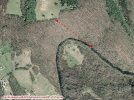
To steep for 4 wheeler Steve. Here's a view and its looks closer to 1000' run using web gis data.

attachment.php
 

Attachments

  • Property.jpg
    Property.jpg
    82.3 KB · Views: 416
There used to be a cable stretched across a river where I grew up with an trolley that hung on a couple of grooved wheels. It was level except for the slack . We pulled ourselves across by hand. It was under and inch if I remember right about 5/8 or 3/4. The escape line called a Geronimo line from the working platform on oil derricks used to be 5/8 and you rode it on a small t bar. I did it a couple times for youthful adventure. If I was to make a rig like you describe I would drive it by a driven hard rubber wheel on the bottom of the cable with 2 wheels above the cable on either side the drive wheel and have a clamping brake system that clamped the cable between grooved bronze pieces. (Geronimo line brakes)/

5/8 cable is rated for about 32,000. But you are loading it in such a way that it will drastically decrease the load ability. If the legs of a sling are at 45 each leg has about 70% of its load ability. The defection you put in the cable with your load will cause a greatly increased load on the run of the cable. More belly in the cable will lower this factor. A cable that is lifting a load by a center pick with the legs at 85 degrees (near flat) has a load capacity of just .4% of its vertical capacity. This is why suspension bridges have such a belly in their cables. You are also putting a tremendous load on the anchors. Please try to involve an engineer and be careful. If in doubt go heavier.
 
My 7 year old would be all over that. The other day he asked me to take him to the store where they sell jet packs as he thought he had enough to buy one now.
 
Last edited:
Maybe you could make a car that runs on tracks and the motor could pull it up the hill with the cable. I have seen these used for boat ramps at lakes with really steep sides. The tracks were what looked like 2"-3" steel pipes.
 
Cable should be easier than rails. I have seen railroads setup to move ships (cheaper than locks, but still government built $$$)

for outside use, inspect your cables and grease them lots...

keep it as low as possible to the ground for when it does fall down :)

I would skip the trees and anchor someother way


maybe combine the cable car and atv idea - use a cable to move a dedicated wheeled cart
 
I think you can do it with 5/8 or 3/4 cable. You just need some really good anchors and to allow for a good sag. Keeping close to the ground is a solid idea. You could also make a clear run and have wheels on the trolley and actually ride on the ground just be attached to the cable and be guided and driven by power to the cable, kind of like a old time river ferry. How many serious dips and humps between the top and the bottom?
 
Mark-

From an engineering standpoint, this has the makings of a nightmare.

It CAN be done... but holy crap there's a lot of stuff to factor into it.

I agree, don't use the trees. You need dedicated posts with foundations.

Don't get me wrong, the kid in me thinks it's cool as hell!

But if you don't really work out the details this could make for a really bad story on the evening news.
 
You need to watch reruns of "Axe Men" on the Discovery Channel and see the lines they used to skid logs. Might give you any idea. If it's good enough for logs should be safe enough for humans. :eek:
 
I like the ATV idea. Set up a switchback trail with a small dozer and you're set. They make some nice electric all terrain carts that would even be quiet. You would then also have the ability to take loads of material down to build a dock, go fishing, etc.
 
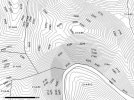
Depending on how perpendicular the path is compared to the slope's contour lines, any sort of wheeled trolley could require some significant grading. That being said, an inclined ("reclined" I suppose) elevator or one-car, counterweighted funicular railroad would be pretty cool.
 
I can't remembe the formula's from my Army days.. but wire/cable loads like what you're describing are a lot higher than the lifting capacity of the wire by several factors. Trees would probably serve for a few trips but think about how their load capacity changes due to weather conditions... wet soil=less load bearing.

Most people in your situation down here build switchback trails/stairs. Go to Home Depot or w/e you have up there and get a couple crews of undocumented labor and some shovels, have them dig in the trails, spike in the trail with railway ties and fill with gravel.
 
If there are any loggers around there you could ask them. Around here they set up all kind of rigs like this to get logs out of the woods. Some of them are huge and lift tremendous loads. Mostly they anchor to stumps and rock. I think when they use a natural anchor the use a series of them in line. What king of grade are you talking about here. I love stuff like this.
 
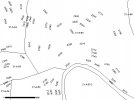
See if this helps with perspective
 

Attachments

  • elevation.jpg
    elevation.jpg
    30.5 KB · Views: 18
  • elevationlabel.jpg
    elevationlabel.jpg
    92.9 KB · Views: 24
It looks like about a 200+ ft drop too. How deep do Hemlock roots go. Can you run guy lines from the hemlocks back to other anchors. How much would the trolley weigh with load and motor. How high would your start point and end point have to be for a good belly in the cable. Is there a reason you can not go straight down the slope. That would make a wheeled cable guided/driven vehicle much easier. You would not need much of a bottom anchor and less of a top one if the weight road on wheels. Straight down looks like pretty steady slope. Do you have a source for cable? Oil drilling rigs have to cut and slip line all the time. When then get to the end of a spool they have up to 1200' of cable that is tossed in one piece. This does not happen often but does. Usually in the 1 1/8" to 1 1/4" diameter. Possibly a crane company may have some serviceable cable. A real big crane uses a lot of cable and anything at all can cause it to become un certifiable. A large crane with saw 250' of stick has some serious cable capacity. I have worked with a couple of the worlds largest mobile cranes. I had worked around the one that failed at Brewers stadium previous to that disaster. The cable for these weights tons.
 
Back
Top