- Joined
- Aug 12, 2006
- Messages
- 1,302
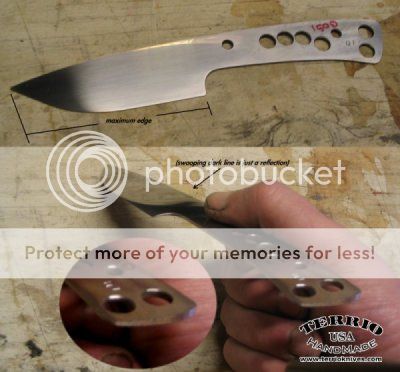
I am trying my first crack at some kitchen knives and came to a crossroads. I bought a 48" x 2" piece of stock so I figured I might as well make four of them to increase the odds of one coming out right  . As luck would have it I managed to eek out 4 12" knives and one ten inch because I was able to overlap the handles in layout.
They are all going to be FFG and full tang. I picked the small one to grind the bevel on hoping the nagging question I had would somehow resolve itself. It didn't. How do I lose the plunge? As the small knife lies right now there is no ricasso and the bevel is basically straight up from the heel. I was thinking to either leave the plunge there in front of the handle and have the scales start back from that about 1/4" or blend the plunge in. I think either would look like crap and I know there has to be a better way.
I remembered a thread some time back and knew it is done but I am not sure the best way to go. This is a quote from "LRB" in that thread and I think he explains it very well...
"I make early type knives with a gentle convex grind, and most often no plunge, and a blade that has a heel below the grip level. I never carry the grind above the grip level in that zone immediately forward of the grip, but grind it as a gentle blend in a 45° angle from the heel aimed forward into the spine. This ends up with a flat forward of the grip as a continuation of the flat tang, but is not noticable unless a straight edge is layed upon it, if done right. A tapered tang from the heel back takes a little more careful blending, but can be done."
Just wondering if this is the only option or if there are other ways to deal with an plungeless, FFG, full tang?
Thanks in advance!!
. As luck would have it I managed to eek out 4 12" knives and one ten inch because I was able to overlap the handles in layout. They are all going to be FFG and full tang. I picked the small one to grind the bevel on hoping the nagging question I had would somehow resolve itself. It didn't. How do I lose the plunge? As the small knife lies right now there is no ricasso and the bevel is basically straight up from the heel. I was thinking to either leave the plunge there in front of the handle and have the scales start back from that about 1/4" or blend the plunge in. I think either would look like crap and I know there has to be a better way.
I remembered a thread some time back and knew it is done but I am not sure the best way to go. This is a quote from "LRB" in that thread and I think he explains it very well...
"I make early type knives with a gentle convex grind, and most often no plunge, and a blade that has a heel below the grip level. I never carry the grind above the grip level in that zone immediately forward of the grip, but grind it as a gentle blend in a 45° angle from the heel aimed forward into the spine. This ends up with a flat forward of the grip as a continuation of the flat tang, but is not noticable unless a straight edge is layed upon it, if done right. A tapered tang from the heel back takes a little more careful blending, but can be done."
Just wondering if this is the only option or if there are other ways to deal with an plungeless, FFG, full tang?
Thanks in advance!!