Help me to make a beefy tactical knife.

Joined
Jun 5, 2012
Messages
29
I am wanting to make a beefy tactical style knife that will be useful for a wide variety of tasks and will hold up to some abuse. I want to be able to use it for anything from light chopping, fine work around the campsite, to field dressing a deer. I would like the edge to be a good cutter and resist chipping. I'm thinking of making something along the lines of the Crusader Forge TCFM XL or Oberland 2. I dont know much about the steel they use or if it is even something I should attempt to use for my first attempt....so Im thinking of using some 1084 with a design similar to their specs.

http://www.crusaderforge.com/TACTICALCUSTOMFIXEDBLADESCF.htm

What do you guys think of this idea? Are there any problems with my thinking? What sort of grind would you guys recommend? Would a flat grind work on such a thick blade?

Thanks for any help you guys can provide.
 
If it's really thick, I would go with a hollow grind as shown on the example knife that you linked.
 
Welcome to Shop Talk. Please fill out your profile, so we know where you are and a bit about you.

The style you picked is simple and basic. Making it with black canvas Micarta handles will be pretty simple.
Make some sketches and post them here for the folks to critique. Then make a wooden or cardboard cut-out to see if it feels right. After that, use the cut out as a template to make the knife.

I would stay with a full flat grind, as I am guessing you have limited equipment and experience.
We can discuss blade material in more detail later, but for a knife like you plan, CPM-154 will be a good choice. 1084 will be OK,too, but stainless will hold up better to camp and hunting use.

Fill out your profile and post your build plans, and lets get this going.
 
I know you want beefy, but if you are doing this by hand, I suggest knocking 1/4 back to 3/16

It's still stout and thinner cuts better.

Plus if you're hand filling, it's much less work.
 
Last edited:
Not sure what you skill level is or your equipment.. but all I can tell you being newer to knife making is that 3/16 is THICK for a new maker with little to no skill. 1/4 is way thicker. Now the thicker the more room for error in my book, but the thinner is easier if you are limited on a good belt grinder. I made my first 5 knives with 1084 and files (no belt grinder) and when I started my first 3/16 blade it was a 5" blade (10.5" overall). And let me tell you.. it took a LONG TIME to get that ground down with files and lots of patients. For a first knife, get some 1084 or cheap steel and practice making a few smaller knives first. Then when you feel up to it, start hoggin on that 1/4 material. You will mess up many, many, many times. And the mess up's are more so when you move to powered grinders from files. Go slow and you should be good. BTW.. the perfect knife does not exist for all those tasks.. it takes many. So maybe do a nice camp knife and a skinner and a neck knife.. that's 3 blades that do something very well, and not everything poorly.

Cheers.
 
Thanks for starting this thread. I am wanting to do something similar, except based on the Cold Steel SRK. It is 3/16" thick, and I think it is pretty popular among fans of "tactical" knives. I don't think 1/4" is necessary for the tasks you describe.

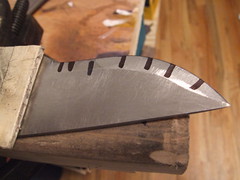
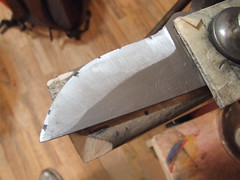
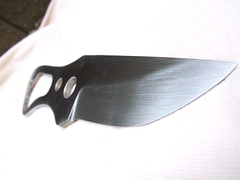
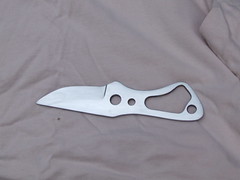
Regarding: "How to:" the stickies here have good information, and "bladsmith" has helped a lot of newbies with their projects. For my 4th knife, I read and reread the stickies, and followed bladsmith's directions. I am very happy with the results: a neck knife. (see pictures)

7001719537_fce7f32064_m.jpg


7001720671_a5f3f417b5_m.jpg


6978562014_464643d8c0_m.jpg


7124655405_f05c9788da_m.jpg


I have also read that Starrett O1 is easy to work with, relative to 1095, even though 1095 is more popular for larger knives.
 
Last edited:
Thanks for all the replies so far. I have zero skill as this will be my first attempt at making a knife. Thats why I think I'll go with 1084 to start with. I'd like to use the cpm154 but I think I'd be better off using the 1084 to start with. My first step will be to build a forge and get a good set of files. This first knife will be done completely by hand as will all my knives until I can get a belt grinder.

How difficult is the cpm154 to heat treat? My forge will be like the Freon tank forges.
 
As one who wants to learn everything about heat treat, there is no shame in sending your knife out to have a professional do it. My first plan was to do the freon tank forge as well, because I couldn't separate out the fantasy that a knifemaker needs a forge, but learned that the money spent on that could have been better spent towards a proper HT oven. Note, I'm NOT saying that you shouldn't build the forge, just recognize that some steels are not for beginners, or poor heat control.
 
I have a saying, "Its easier to build on small successes than grand failures." Another similar expression might be "Don't bite off more than you can chew." Every reply so far has been saying, in some fashion, to cut back on this project, and I echo those sentiments also.

Hawk45's advice sounds pretty good to me, i.e. make three different knives. I would suggest starting with the neck knife because it would give you more immediate gratification and teach you a LOT so that you can make the knife of your dreams. You COULD start by making the knife of your dreams, but it would likely drag on for a loooonnngg time, but you could do that.

I've discovered that heat treating knives is a LOT more complicated than heating it to red hot and sticking it some water or oil to cool it. You can do that to any steel you may use, and it will probably make it harder but you don't know what else it's doing to it. However, 1080/1084 steel is almost that simple and would be good introduction to the process.

OOO! I just had a brain storm! You want to ultimately make a mean, tactical, do-everything, knife. For know begin with a design ALMOST like what you want, but designed to be thinner and smaller and more simple than what you will eventually make. Rather than 1/4 inch use 1/8 inch steel. Rather than a six inch blade make a four inch blade. Rather than a super high performance (and cost) stainless steel, use 1080 steel. See how it turns out and then ramp it up for the second knife.

We WANT you to succeed. We don't sit around just waiting to dash someone's hopes on the rocks. Been there, done that, got the bruises to show for it. We're really telling you there are a bunch of rocks out there and suggesting ways of avoiding them. Good luck.

- Paul Meske
 
As one who wants to learn everything about heat treat, there is no shame in sending your knife out to have a professional do it. My first plan was to do the freon tank forge as well, because I couldn't separate out the fantasy that a knifemaker needs a forge, but learned that the money spent on that could have been better spent towards a proper HT oven. Note, I'm NOT saying that you shouldn't build the forge, just recognize that some steels are not for beginners, or poor heat control.

I agree. Check your local steel companies. I found one near me that deals with both commercial and personal orders. For small orders they charge a flat rate of $35 for up to 20lbs of steel to be heat treated. I am gonna make a few more knives out of files (just for fun since the HT will be free)
 
What steels would you say would be good for beginners? Would cpm154 be in that group that I could handle with a homemade forge?
 
I appreciate all of the words of wisdom and will back off my goals for this knife and use some 1084 to start with to gain experience. I'll also look into getting some better steel and send it out for heat treatment in the beginning.
 
The usual recommendation for beginning heat treating is 108/1084, of simple steel with less carbon such as 1075 or 1060. There are a couple specific things to read that might help.

Working the three steel types

This may give you some insight into heat treating simple steel such as 1080, and why 1080 is such a good steel for home heat treatment.


HT Regimen for High Alloy Stainless Steels


This should give you some insight into the complexities of heat treating something like CPM154.


At THIS SITE you will find specific information way at the bottom for heat treating a variety of non-stainless steels.

...And specific information for individual steel types is available at Alpha Knife Supply.


You will find all sorts of different information on the internet about heat treatment and some of it will be contradictory. This forum is blessed to have some top minds on the treatment of knife steel. The science behind the art is complicated but fascinating. I suspect an electric furnace/kiln might be easier to control than a gas fired forge.

Good luck,

- Paul Meske
 
Saluki2003

I just found some more info from Bladsmth (AKA Stacy Apelt). It is on the heat treatment of 440C stainless steel, but apparently the steps are similar for most stainless steels. The times and temperatures would be specific for each steel.

Quote:
"I'll explain the HT for 440 ( and stainless in general).

It must be prepared by having the blade sanded to 400 grit and nearly finished. The edge should be about .010".
Place in a sealed HT foil packet and put in a HT oven ( almost aways electric) at 1200F for 15 minutes. ramp to 1900-1950F.
Hold at 1900-1950F for 30 to 45 minutes.
Remove packet and quench between heavy aluminum plates. Alternate quench is in oil. Cool to room temperature.
Snap temper at 300F for 30 minutes. Cool to room temperature.
Place in sub-zero bath of dry ice (-100F) and acetone/kerosene and hold for 30 minutes, or do cryo in liquid nitrogen (-300F) and hold for 2-3 hours. ( note: sub-zero quench and cryo are different things. Either one will work)
Temper at 375-400F for two hours. Cool to room temperature. Repeat temper at 375-400F for two hours.
Sand blade to final finish. Rc should be around 57-58 if done with sub-zero quench, and 58-59 if done with cryo.

This whole procedure requires a controlled oven with a programmer, HT foil, quench plates, and either a dry ice bath or a dewar of liquid nitrogen.
As you can see, a forge and a pair of tongs won't work.

It takes about 8 hours to do a proper stainless HT, and $2000 to $10,000 in equipment. That is why even the pros often send their stainless out for HT. You can get a blade done with cryo for about $10-15, or twenty pounds of blades done for $70-100.

Attempting to do this at home with a forge won't be trial and error...it will be trial and failure
Sending the blade out is not cheating, it is good knifemaking. It is the same as buying Micarta for handles. Let the folks who do it for a profession do that step."


- Paul Meske
 
This site is really awesome! Before this thread I had that mindset that I had to do everything involved with making the knife but you have opened my eyes to what it takes to effectively HT the more complex steels. I'll stick with the 1084 until I get enough experience/knowledge/equipment to move up to 1095 and I'll probably stay there and use the advice here to send off my more complicated steels to be professionally HT. I'm still really looking forward to making some knives with the 1084 after we get a forge built.
 
A good steel to start on when the blades will be heat treated by someone else is CPM154. It is cheap, takes a good finish, works easily, and can be sanded to a near finish before HT. That amount of hand sanding after HT. It makes a first class stainless steel knife,too.
 
The 1080 or 1084 will be fine for a knife.. flat grind and about 3/16 thick would be sweet ... with the 1080 steel you'll have a tough blade, that'll hold an edge, and won't have to worry about much ... and besides, the price is right .... very affordable !
carbon steel is great stuff, you'll love it

Greg
 
Back
Top