
Help needed with grinding a file blade friction folder

Joined
Jan 12, 2010
Messages
99
Here’s an example of my wrong handling while shaping my blades; It’s a friction folder blade made from a swiss grobet file. I went down to 1mm thick on the edge. I think that 1mm is still ok to go, but there’s too much steel left on the bevel above the cutting edge, I think, and that is what is giving me trouble when trying to sharpen it.
The blade itself is 6mm thick.
I need to know: My contact wheel is 40mm (!) in diameter, what sanding angel shell I hold the blade in? Is there a way to calculate it? Or do I need to reduce the diameter of the contact wheel?
I would like to make me a wooden rig to hold the blade in that angle while grinding.
Thank you all in advance!
Michael
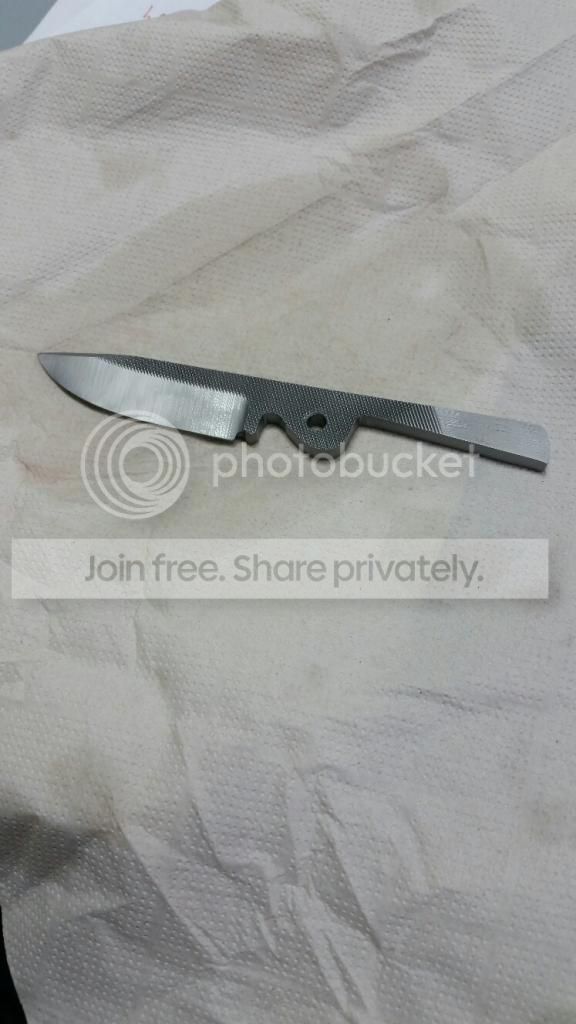
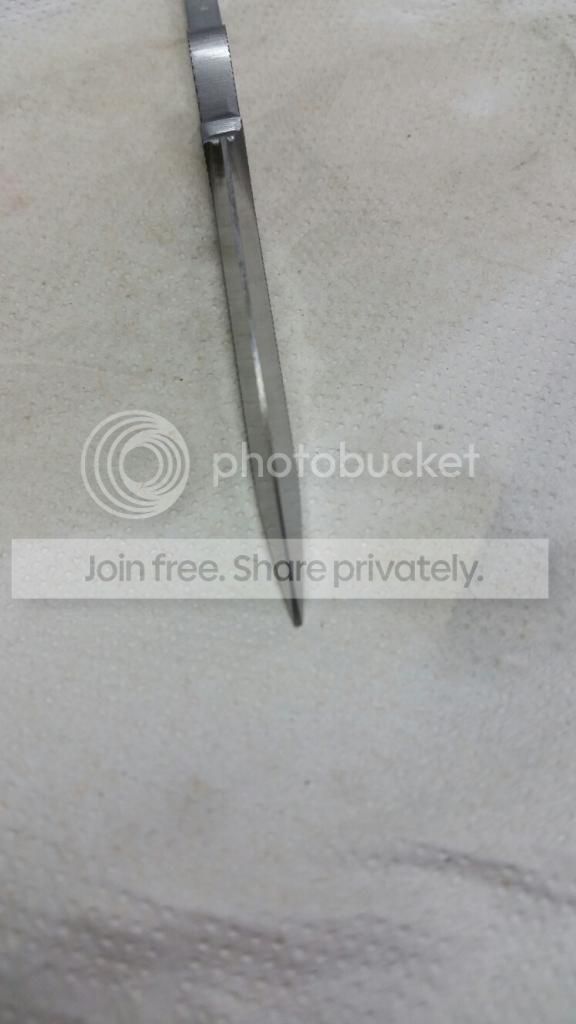
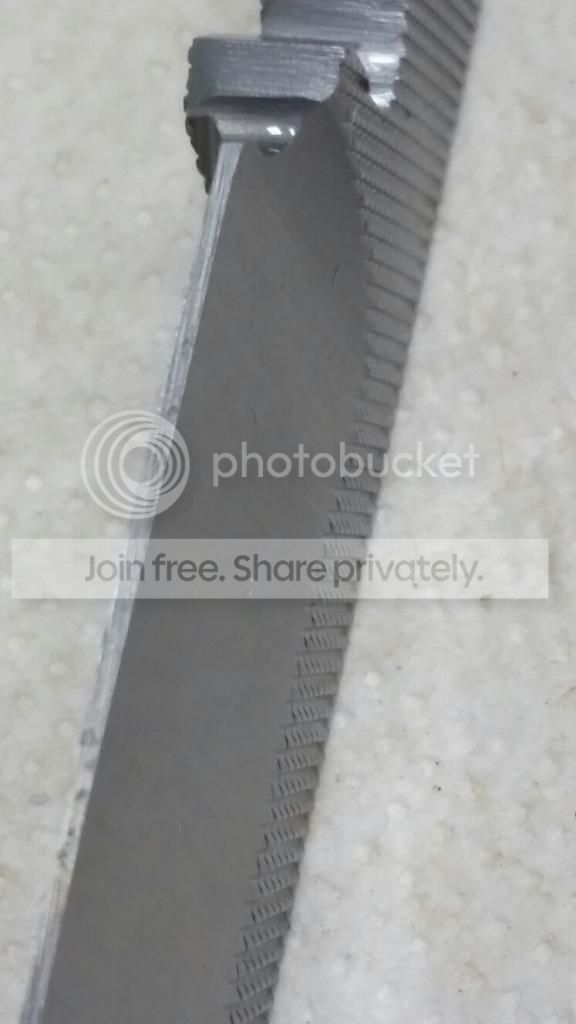


How did you get it to that point? If you can I'd keep on grinding until the edge is thinner and the shoulders are higher. I take my edges to about 1/4 of mm on folders, sometimes thinner. 1/2 mm would be great.

Nice looking work!
 
Last edited:
That is some awfully thick steel for such a small knife. If you want a grind like that on a knife that size, you may want to findbsome thinner stock like 1/8" or 3/16". I ddon't know the metric equivelant,sorry. At this point ( thepun intended!) I would make the grind go to the spine or somewhere close. You could also try to zero grind it and that may help? I have had good experiences with zero grinds.
Best of luck,
Tanner. S
 
You contact wheel is 40mm? That's pretty small - most folks like something on the order of 200mm to 300mm for a contact wheel.... OR - did you mean 40cm?
 
Keep on grinding as you have already been doing. The edge will get thinner and the grind will get higher at the same time.
 
Thanks guys.
Ken H - sorry for being a bit tired here... I meant 400mm of course (that’s in American language ;) – about 16”).
Daniel & S. Alexander – That’s what I did with the 1st blade I managed to destroy: I kept on grinding until the height of the blade was damaged and the blade was ruined; something with the angle is wrong, I think.
Backyardcrafter – because that’s the steel I had at the moment I tried it. I do not have thinner steel right now. BTW, what is “zero grinding”?

What will happen if I will reduce the contact wheels diameter?
I also would like to know if there is a way to calculate grinding angles and if you have any ideas of how a simple DIY grinding jig should look like best?
Have a nice weekend and warm wishes from rainy (and snowy!) Israel.
 
I understand, use what you got and try to make it work. Zero grinding is where you take the grind alllll the way to the edge without making a secondary bevel. They work great on convex grinds! Of course, uh you want to do this post heat treat.

I made a grinding jig where I made a small wood clamp with two bolts to tighten a wood plate around the tang. Then drill a hole in it and epoxy a steel rod to it parallel to the belt and perpendicular to the blade. Then set up two wood posts with holes drilled at varying lengths, yet make it so that when you put another steel rod through the holes, the rod is level.
Set this up so your lowest set of holes is about level with the place where the blade will contact the belt.

Not sure if this makes sense but I'll post a picture of my setup when I get home later today.
 
Last edited:
If I understand correctly you are using a grinding jig? You may just have to adjust your work rest angle or your jig angle until you get the right thickness at the edge. Once you have the correct edge thickness, decrease the jig angle to "climb" the grind line higher up towards the spine.

Here's an illustration I stole from another thread to show what I mean.

progressive%20angle%20grinding%20steps_zps8nr2ftfk.jpg


I have been free hand grinding (getting marginally better at it) so I can make fine adjustments with my hands. You dont have to worry about jig angles that way.
 
Last edited:
That's what I do on my jig. I just move the support rod up or down on the wooden tower to adjust the height of the grind.
 
Back
Top