Help please

Joined
Mar 31, 2009
Messages
153
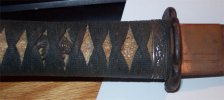
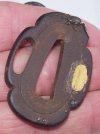
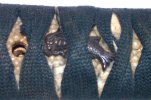
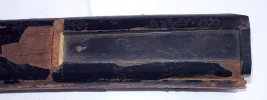
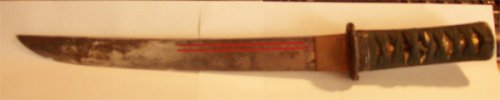
A Japanese style knife was donated to our living history museum and I wonder if any one can help with identification. It's 17" oal with a 12" blade which is .291 at the ricasso ares tapering to .125 juct behind the tip. The grip under the wrapping looks like some sort of stone and there are small figures of a fish and a dragon incorporated in the wrap. I believe the metal at the butt and the front of the handle is silver, and the guard appeats to be iron. Infront of the grard is a smaller flat oval of Copper? and the cover over the ricasso artea also seems to be copper. I can find no maker's mark.

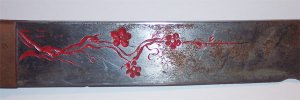
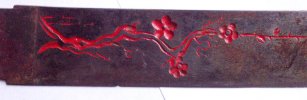
I am curious as to the probable age and origion of this knife. It has the weight and feel of a military weapon, but the red paint inlays make it look more like a tourist piece.

Any info will be much appreciated. Thanks

Dick
 

Attachments

  • right side.jpg
    right side.jpg
    8.3 KB · Views: 103
  • left side blade.jpg
    left side blade.jpg
    22.7 KB · Views: 93
  • left side handle.jpg
    left side handle.jpg
    27 KB · Views: 87
We have a sword forum here in the General form section.They will be more help.Also try SwordForums.com.They have many experts there that can help.The knife you have is called a Tanto.The handle wrap is silk.What you thought was stone under the wrap is rayskin.The little fish under the wrap are Menuki.The guard is called a Tsuba.The copper in front of the guard is a Habaki.The red paint was added by a previous owner.DO NOT CLEAN THIS KNIFE!!!! I am not an expert so I cant give much more information.It could hold little value or could be worth many many thousands of dollars.To be evaluated,your going to need better pictures.Also it needs to be disassembled.Dont worry,they are designed to be taken apart for routine cleaning.Under the handle wrap you will find a single wooden pin.Using a dowel of the same diameter push out the pin from the backside of the handle(edge down,tip facing towards your right).Once the pin is removed the handle,Saya,can be pulled off the blades tang,and all the other parts can be removed too.The reason you need to do this is to see if the tang of the knife has been signed,even if it hasnt it needs to be photographed to be evaluated.ONCE AGAIN,DO NOT CLEAN THE KNIFE!
 
Great advice, McAhron, though I'm sure you accidentally mistyped--the saya, is of course the "scabbard" and the handle assembly is the tsuka.
 
Thank you gentlemen. The knife came apart as you said, McAhron, and I see no mark under the handle. I will try to get some better pictures. Can a mod move this thread to the more appropriate area?

Dick
 
The material under the wrapping is same-gawa....stingray skin. The small figures under the wrap are called menuki.
The silver looking metal sounds like shakudo.
The blade style is o-tanto.
Carving is called horimono, and it is not supposed to be painted. The red is horrible.

The following are suppositions based on poor photos, so they may or may not be accurate.

The blade looks like WWII military, and is probably worth somewhere between $100 and $300.
I would soak the blade ( with the handle removed) in acetone and remove the red nail polish. It should come off easily.

Do not attempt to polish or clean the blade in any other way. After removing the red paint,oil it well and wipe it down with a soft cloth to remove any dirt and dried grime. Re-oil it and put the handle back on. Do not do any heavy cleanup or rust removal on the nakago ( tang). It should be left just as it is, with only oiling and light cleaning.

The blade can be re-polished and restored to new condition by a properly skilled togishi ( sword polisher). It may not be cost effective, though.

An expert in Japanese weapons could give a much better assessment. There are several in New England. Check with the New England Bladesmiths Guild. Dan or Kevin should be able to answer any questions.
http://www.ashokanknifeseminar.com/index.htm

If you get better photos, I would like to see them.
Email me with any other questions.

Stacy
 
The silver looking metal sounds like shakudo.

Stacy, I disagree with this. if the fittings look silverish or like tannished silver they are most likely either actual silver or shibuichi. most likely the latter.
Also the fittings are not what was generally seen on WWII Tanto. If it is a WWII piece then it was probably a hand made piece because the machine made pieces should not have had Horimono, also a military sword would generally had a serial number or a tang stamp. a twelve inch blade is basically one shaku in length so it is tanto not o tanto.
 
Last edited:
he i have always heard that if the rust is dark it is much older then wwii, i cold be wrong, if im also not mistaken, mny japanese soldiers took there familys sword to battle with them in place of the standard issue sword. again im no expert, but that is some dark looking rust on his blade.
 
Bill, thanks for the input.

I thought shakudo, because the owner said it looked like silver ( but he thought the same' was stone,too). The photo isn't clear enough to decide if it is shakudo or shibuichi. I have seen shakudo patinated to a dead black color.

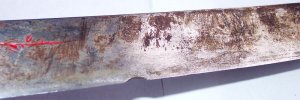
My first thoughts was that it was a tourist piece. When I was a lad, post WWII, these were commonly called hari-kari knives ( usually incorrectly), and every serviceman who went to Japan seemed to have one.Most were sold as having been surplus military or antique, both of which usually were not true. I probably should have said, " At best, it is a military piece worth $100-$300." The blade looks funny in the photos. Probably because someone took sandpaper to it at some point in time. Most of the tourist knives I have seen had poorly made blades with no markings. Many were not even hardened. The carving going so close to the edge may indicate this situation.

My description of the blade as being o-tanto was based on the fact that it was the max length for a tanto, again, perhaps misleading to some folks.I consider o-tanto to be form 1 shaku to 1 shaku 2-3 sun. Beyond that I call it shoto-wakizashi.

Since my terminology is mostly descriptive, I may use terms that are different from those used by others who are classical trained.

Stacy
 
Gentlemen - Thanks again for your observations. I apologize for the poor photos - close-ups are a skill I have yet to master. Here are a few more...

I found the critter cast into the lower edge of the guard interesting - scorpion?, stingray, crab with a barbed tail? - I can't tell.

Again, thanks for your input. I wasn't expecting an iron clad evaluation, and based on the circumstances of our acqusition of the knife I sure it probably did retrun from the pacific in WWII.

Dick
 

Attachments

  • 1.jpg
    1.jpg
    44.5 KB · Views: 23
  • 2.jpg
    2.jpg
    70.4 KB · Views: 24
  • 3.jpg
    3.jpg
    36.7 KB · Views: 21
  • 4.jpg
    4.jpg
    34.4 KB · Views: 23
  • 5.jpg
    5.jpg
    49.1 KB · Views: 26
Back
Top