Help with lapidary for folders

Joined
Dec 5, 2013
Messages
1,180
I'm thinking about shifting into some more artistic folders and am considering doing some stone inserts (Ron Lake/Warren Osborne type inserts). As a kid I would sit for hours and watch my neighbor make silver and turquoise jewelry. I polished a few pieces but, more often just tumbled stones and then flattened the backs...and that was 40+ years ago. Basically, I know very little. If anybody is willing to share experience on this I would really appreciate it. I have lots of questions.

What is the best way to match the stone profile to the window in the frame? Can a hardened steel template be bonded to the stone as a template?

Do I need a large multi-wheel grinder if I currently do all my contouring on a 9" disc? Can an 8" lapidary disc machine fill my needs?

Are there any books/videos out there that cover how to do this type of work? Needn't be specifically for knifemaking.

More questions to follow, I'm sure.

Bob
 
I'm thinking about shifting into some more artistic folders and am considering doing some stone inserts (Ron Lake/Warren Osborne type inserts). As a kid I would sit for hours and watch my neighbor make silver and turquoise jewelry. I polished a few pieces but, more often just tumbled stones and then flattened the backs...and that was 40+ years ago. Basically, I know very little. If anybody is willing to share experience on this I would really appreciate it. I have lots of questions.

What is the best way to match the stone profile to the window in the frame? Can a hardened steel template be bonded to the stone as a template?

Do I need a large multi-wheel grinder if I currently do all my contouring on a 9" disc? Can an 8" lapidary disc machine fill my needs?

Are there any books/videos out there that cover how to do this type of work? Needn't be specifically for knifemaking.

More questions to follow, I'm sure.

Bob
9494136c5baf02a7eb13b4dd0f706c58.jpg


I believe that most of the folks dong that style inlay are using a deckel pantograph or similar.

Or they setup a little handheld tooling plate that works like a router flush trim bit.

shear.jpg


Stone would make it more complicated, but then I think diamond grinding pins would replace end mills.

If you create the inlay and the pocket each with a taper, they would press fit tightly, then work the top surface after.
That way, exact fit is less tricky.


I'd avoid sharp corners and pick smooth radi that you can make with a tool.
 
I recommend MOP for starting on inlay work.

The inlay I do is usually done with a saw and sheet stock. I saw the cut-out with a 3-0 saw blade, and file it cleanly to exact shape with fine cut needle files. Save the cut-out for marking the inlay piece. I often glue it to the back of the inlay material as an approximate guide when shaping.
Next, you cut a backing piece of sheet metal to make the solid backing of the scale. Sometimes they are soldered together, and other times they are just pinned together in assembly. The inlay material can be anything that you have the equipment to shape. Some things, like mother of pearl, are very easy to shape, sand, and polish. You can use files, sandpaper and belt sanders, and regular buffers with white polish. A flex shaft and some basic jewelers tools will also be needed. It can be sawed with a jewelers saw (it will eat the blades pretty fast). A diamond wire saw in a jewelers saw frame works very well, too.
Before anyone chimes in with, "MOP dust will kill you", that is just an old wives tale. MOP powder is just about as dangerous as baking/washing soda ( sodium carbonate vs calcium carbonate).

Ivories are also easy to inlay, but have certain legal issues today. Other soft items are rare woods, bone, and other organic things.

Some stones, like turquoise, malachite, and coral are not too hard to work, and normal knife making abrasives will sand and polish them. Using diamond bits and wheels makes this easier, though. Harder stones like jade, agate, petrified wood, etc, need diamond cutting/grinding/polishing equipment ... and some skill.

Opal isn't too hard to cut and polish, but requires skill and proper diamond equipment.


If you develop the equipment and skills over time, the ultimate inlay project is a Gold Field Dagger handle with a geometric inlay of "Gold in Quartz", high grade opal, or a mix of the two. This should be in a metal mix of gold and silver .... and engraved heavily,of course.
 
I used to do lapidary and sell rough for a living, it was a lot of fun.

There are many ways to go but I'd consider sticking to softer stones like Stacy mentioned at first. You can get away with a simpler setup and they take a lot less time to cut.

A disc grinder will be great, that is what I started with and still use for many projects. The key is to find something safe with a gfci as you are mixing lots of water with electricity.

You can also use a single wheel to rough with then go to carbide belts on an expando wheel.

In my opinion the nicest setup is something like a Diamond Genie but you really don't need to spend that much. I eventually moved to one but my Inland flat lap cut many stones.

You can even make a disc machine that uses diamond slurry on a plywood wheel for cheap. They use a gear motor.

Look out for used equipment, there is lots around.

I actually got into knifemaking to make stone handled knives and got carried away with the knife part. :D
 
Good stuff guys! I should mention that I do have the book "How To Make Folding Knives" with the chapter by Ron Lake. He does cover some useful techniques on how he makes the pockets in the interframes and his tooling and such. I've used some of these techniques but now looking to move into more serious pieces. In the book, he demonstrates with stag so you don't really get any info on how he fits stone.

I am thinking stuff like lapis and jade to get started. I've used Mammoth tooth which I imagine is similar to soft stone in some respects.

I managed to find one how-to DVD for stone inlay and it was sold out through it's exclusive vendor. I think I have a lot of research ahead of me.

Bob
 
Lapis is great stuff to work with, you can usually finish it in about 4 stages which is nice. Just about all of the stones used in Native American jewelry can be cut easily or with a hand setup on a small scale. Zam is often a great polish for these stones along with sapphire powder.

Jade can take a lot of steps and orange peels easily. I like to stick to all diamond and do most of my work on harder wheels. Black Jade is pretty nice to work with and can be had for a good price.
 
Lapis is great stuff to work with, you can usually finish it in about 4 stages which is nice. Just about all of the stones used in Native American jewelry can be cut easily or with a hand setup on a small scale. Zam is often a great polish for these stones along with sapphire powder.

Jade can take a lot of steps and orange peels easily. I like to stick to all diamond and do most of my work on harder wheels. Black Jade is pretty nice to work with and can be had for a good price.

Daniel, if I'm sticking with softer stone, what grit diamond plates would I want? I'm looking at the Covington 8" Maxi Flat Lap because I like that it has no center hole. Any idea about their quality?

Bob
 
That's a really nice machine, I was looking for an old one like it for years. My friends that production cut turquoise like to set one up just for roughing.

The lack of center hole is nice, you won't use the center very much {just like a knife disc sander} but you also won't clack stones against the nut.

You could probably get away with just 180-220, 320 and 600 then go to a buffing setup like leather or canvas setup with Zam. I know a guy who probably cuts 50 stones a day with this setup, he pretty much only cuts Turquoise. His son cuts the same stuff with the Diamond Genie over seven stages so a lot of it depends on style.

For harder stones you will need to add 80-120 and at least 1200 grit.


I use 80, 220 hard diamond wheels then go to 280, 600, 1200 and 3000 nova wheels. After that I finish with Zam, Cerium Oxide or {usually} diamond paste up to 50,000 depending on the stone.


Covington makes great solid, old school style equipment. I've never used that particular machine but it looks good. Consider ergonomics and how you want to cut also. I like to do my cutting on a wheel machine but you always need a flat lap to keep things flat...
 
Cool, sounds like that will cover a lot of what I'm wanting to do. Now I need to find some cylindrical diamond burrs with consistent shank and cutting diameters for profiling. Anyone got any idea? Will carbide work at all on softer stone?

Bob
 
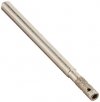
Last night I found some diamond core drills made by Dremel that I think might work for profiling with a pattern. They are 1/8" drills with an 1/8" shank. The LOC looks to be about 1/4" so they have potential. I think running them in a tray with a water bath could work. I'm going to order a couple for testing.

Bob

51UL7b4mCHL._SY355_.jpg
 
Back
Top