Help with saber grind

Joined
Mar 13, 2018
Messages
55
New knife maker here. This is the 4th one I’ve ground. I’ve tried to do saber grinds on all of them but with the first 3, I kept trying to get the line straight and I kept working up the blade until I ran off the spine so now they’re flat grinds. One is garbage (messed up the plunge) and two others are ok.
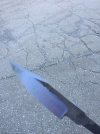
This is something I made out of one of the scraps (I actually really like the shape), and it’s the straightest I’ve been able to get with the grind line. I like it, but it’s obviously far from perfect.

[https://flic.kr/p/24mpcMY]

My question is: Is this something that just takes practice? I’m working in good light, on a HF 1x30, 80 grit fresh belt, elbows locked, steel is 1080 if that matters.
Is this something I will be able to straighten out when I hand sand after the HT? I plan on making a sanding bar with a metal bar a la Nick Wheeler and taking it up to 400 grit.
 
24mpcMY
 
do it pre HT
practice and don't be afraid to to clean up with files after grinding before hand sanding
look up draw filing, it is slow but gives good control. You should be able to get straight lines
 
Grinding does take a lot of practice. A 2x72 grinder with a nice flat platen also helps, but you should be able to get decent grinds with your grinder. Before you start you should always scribe a center line where your edge will be, it is a very helpful reference. I also mark on the blade how high I want the grind to be, so I have a reference there as well.

When doing a saber grind, even high saber grinds, you somehow have to follow the curve of the blade as you drag it across the belt. This way you get a nice curved grind line. You don't have to do this with a full flat grind as far as my understanding goes, at least not as much.

There are many different ways to do this I imagine, but I know two:

When you hold the knife in your hands, one hand on the spine of the blade and one hand on the handle (blade facing upwards into the belt): As you drag the knife across the belt you can pull the handle towards you slightly to accomodate for the curve towards the tip of the blade. The more curved your blade shape is, the more you have to pull the handle towards you.

The second option you have is to, as you come towards the tip when dragging your blade across the belt, rotate the blade upwards slightly to accomodate for the curve on your blade.

How much you pull the handle towards yourself, or rotate the blade upwards, depends on your blade shape. Both methods should give you the same geometry if done correctly.

Also as a gernal tip, if you drag your blade across the belt, try to apply even pressure.

You can correct this and and improve yourself by going slow and taking time scribing your reference lines correctly. If you get uneven grindlines within your reference scribe lines you can still adjust and try to apply more even pressure. The learning experience with this is, that when you go very slow and pay attention, you can see what you are doing. You can see if you have removed too much or not enough material on a certain spot and you can adjust your pressure accordingly.

If you need a visual reference, there are a lot of youtube videos that show and explain this maybe a lot better than I can.

As for plunges: they need a lot of practice. A file guide helps a lot.

Also regarding hand sanding: you can correct very much with hand sanding if you put enough time and elbow grease into it, but I would not focus primarily on correcting grave mistakes via hand sanding, because it will take a lot of time. Time you could invest in practicing your grinding technique.

Hope I could help
 
Last edited:
That helps a ton. A bigger grinder would be sweet but this is a brand new hobby and my wife would probably kill me. I’ll work on all those techniques though. I think that keeping the pressure steady as i work across the blade while swinging the handle up or out is where I’m going wrong.
 
This is my first "saber grind" ever after over 10 years of making knives. It is a very tall saber grind as this was the first time that i wanted to leave a little bit of forge scale on a blade. I used one of Nathan's 36 inch convex platens and it not only seemed to make grinding the main bevels easier but I also used it lengthwise to cut in the swedges for the false edge. My plan is to finish grind with 80 grit and clean everything up with Gator and maybe do the final clean up with Scotchbright or cork belts. The blade is Cru Forge V and will be HT'ed to 60-61 Rc, so it will be a tad abrasion resistant.
IMG_0722.jpg
 
Last edited:
Picture looks not very focused, but for what I can see, that blade looks very good.

I just want to know out of curiosity, why did you make your first saber grind after all this time? I'm not saying that is something bad or anything, just curious.

Were most of your previous knives full flats or hollow grinds? Did you choose not to do saber grinds because in your experience a full flat grind with good distal taper cuts better?
 
Very out of focus. :D That blade was ground freehand with no jig or work rest. The curved spine was actually the trickiest part. Not enough curve to use my 72 inch radius platen. I plan to use it on the back of the yanagiba that I am making.
As for why no saber grinds, the answer is the same as for why no hollow grinds. I learned to do FFG with a convex edge and am equipped to do them. I have subsequently learned to do shallow convex grinds and some weird compound grinds like the S grind. The primary reason that I bought the curved platens was for setting clip points and the swedges. This is only like the second or third blade that I have done in this very shallow hollow grind. I also have never used a saber grind because I don't feel that I have ever made a blade that required that type of reinforcement.
 
Back
Top