Help with two-tone wood scales

Joined
Jun 5, 2012
Messages
1,071
I'm trying to use up a lot of the scrap exotics/premiums that I have laying around, and I had a couple small pieces of stabilized birdseye that would do nicely for bolsters. I also have a million little pieces of macassar ebony. I want to do a two-tone set of wood scales for a small full tang utility/hunter that I just left at the HT place.

I've seen this done a few different ways, sometimes a straight butt joint, sometimes where the pieces are mated on a curve.

Basically I'm wondering if I do a clean, well mated butt-joint and then join those pieces to the G10 liner I'm using, is any other reinforcement necessary besides at least one standard pin in each piece? I will be doing a good prep on each piece to ensure adhesion and tight fit, and the finished assembly will also be bonded to the knife in the same way as "normal" scales usually are.

edit: Another question... G10 and unstabilized wood are generally compatible with epoxy, but I have had personal experience as well as being warned by others that some stabilized woods work poorly with epoxy, and CA should be used instead.

Here's my little mockup. I have a few larger scraps of the same ebony, a bit thicker and longer if those end up being too small.

A9mU9mm.jpg
 
Last edited:
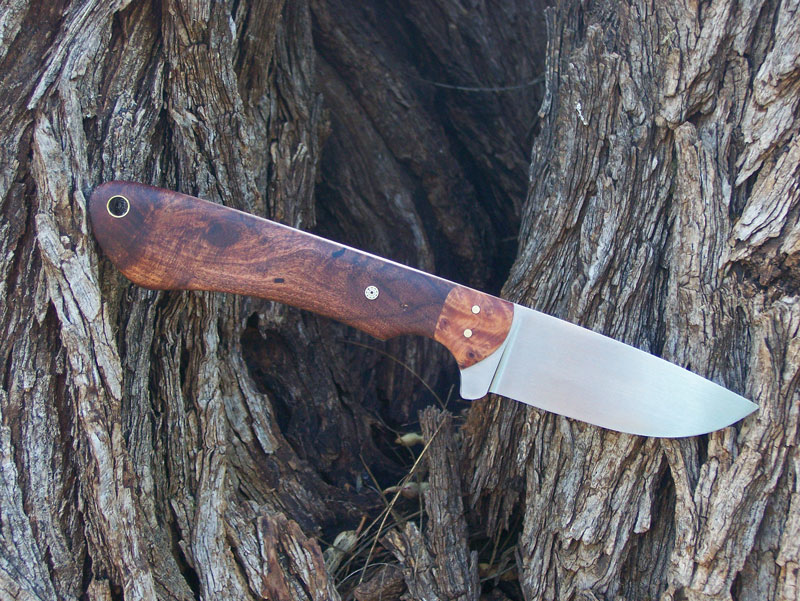
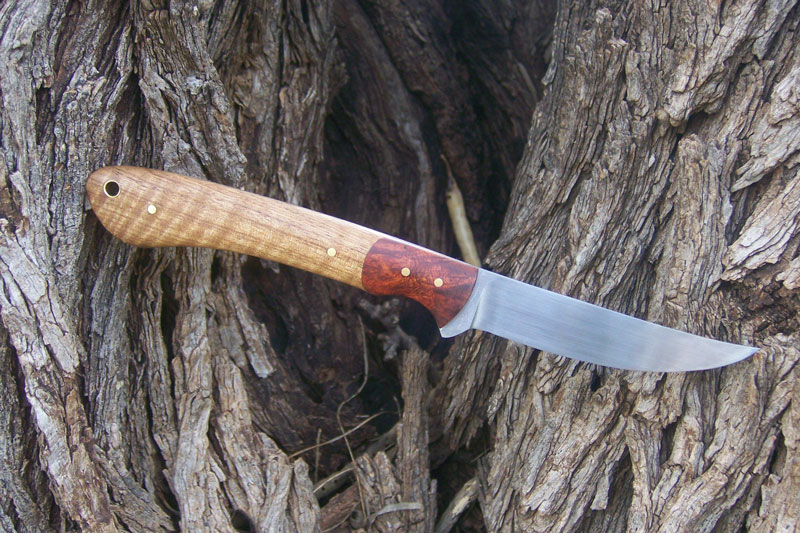
I do that kind of handle all the time. Often I'll just use epoxy and dovetail the joint. I usually put two pins per piece, but that's just me. As far as the glue, clean everything up good with acetone and use epoxy. I wouldn't trust CA for attaching handles to a knife.

100_5902.jpg

100_5216.jpg
 
Your mockup looks fine. Use the strongest epoxy you have available. G-flex or T-88 is the glue for such tasks.
As Jason said, dovetail angling the joint makes it stronger and better looking. About 20-30° works well. One advantage of this is that when the handle is rounded, it makes the joint appear as a curve ( see Jason's second photo)
In some cases, placing the joint at a diagonal (as opposed to perpendicular) to the line of the handle also looks good.

Tastes vary, buy I think that a darker wood as the bolster looks better than putting lighter wood there. Ebony bolsters with a light wood handle is very common in Japanese handles.
 
True, most factories use darker bolsters, but there is probably a reason for that. Ebony is a lot more expensive than most other woods.

Another question I'd like to add, if I may; Why don't you guys advise liner material between the wood?

It should make for a better bond, and it looks sooooo much better, IMHO.
 
I don't use liners that often, maybe 10% of the time I make a handle with that construction. For me, it's mostly because of my assembly procedure. I build the bolsters and attach them first, then attach the handle. If I do liners, I put the liner material on the handle piece. There are times a liner really adds to the look. There are other times that a super tight clean dovetail joint is better, IMO. It's the difference between "that looks cool" and "how the heck did he get that joint so tight."

If you were to use a piece of liner material and glue up both bolster and handle pieces onto the liner, then put all that on the knife, that would work too. I personally find it easier to keep everything lined up doing it my way.
 
I dovetail these joints as well. Without dovetailing, it helps to mix a bit of the sanding dust from the darker wood with the epoxy which hides the glue line. If the wood is natural, rather than I stabilized, good old carpenters glue is what I use. It is less likely to show the glue line.
 
I've used that technique as well. But what I do is to go down to the hardware store and get a small sheet of copper or brass and cut a small piece and use as a spacer. I think a real thin contrasting spacer rocks.
 
Vintagefan,
I am quite happy using G-flex epoxy and at least one pin or Loveless bolt in each part of the handle.
I also dovetail the bolsters at 30 degrees. It hides the epoxy line and gives you more surface area to bond.

The most important thing that makes epoxies work is how well they are prepared. I use a 220 grit finish at the max for the areas to be epoxied so there is lots of surface area to bond.

Liners are larger cosmetic in my opinion, some make the case that you have a common material for two different materials to bond to, I haven't seen a difference.

Its nice to mix it up for different looks so I am all for using different colors for bolsters and handles. Your mock up's look quite attractive.

Laurence
 
Thank you for the responses everyone, I read all of your replies thoroughly.

I definitely will dovetail the joint as advised, it makes me feel a lot more comfortable and the added bonus of a nice curve doesn't hurt. Unfortunately, those little pieces of birdseye are the only ones I have, and they're really only big enough for bolsters. I was a little worried about going dark on the "handle" and light on the bolster, but I think this particular combo might just work.

I'll be documenting my progess in my WIP thread, but I'll try and post a pic or two back to this thread for future reference.
 
Just an idea: you can use the maple in the middle of a handle.
If you have the patience to make two oval connections on each side of the maple and connect them to the ebony you can get a spectacular handle.
(ebony-maple-ebony)
But it is a LOT of work, you have to be precise and all the extra time is just for the looks it doesn't add strenght or so.
 
Thank you for the responses everyone, I read all of your replies thoroughly.

I definitely will dovetail the joint as advised, it makes me feel a lot more comfortable and the added bonus of a nice curve doesn't hurt. Unfortunately, those little pieces of birdseye are the only ones I have, and they're really only big enough for bolsters. I was a little worried about going dark on the "handle" and light on the bolster, but I think this particular combo might just work.

I'll be documenting my progess in my WIP thread, but I'll try and post a pic or two back to this thread for future reference.

Vintagefan,
I am in Santa Monica and you are welcome to come by the knife shop if you would like to share knife making tips?
PM me if you like.

Laurence
 
Vintagefan,
I am in Santa Monica and you are welcome to come by the knife shop if you would like to share knife making tips?
PM me if you like.

Laurence

Hi,

I plan on being down in that area next week, in fact I was already going to perhaps meet up with another BF member for lunch. I was actually planning on making it down this week, but things haven't quite gone as planned (as usual).

I actually saw your website somehow a couple weeks ago. I can't remember how I ended up there though. Very cool stuff.


So, I promised I would post pics once I had these scales finished. I'm pretty darn happy with the results, I forgot how sparkly the birdseye was. It was a couple of sad looking little scraps too, never would have guessed. I sold the guitar this wood was on a few years ago.

I did a bit of rework after these pics, removed a couple small scratches, fixed the finish on the heel of the handle, and worked on the crown of the handle a bit in relation to the blade. I didn't peen one side of the pin quite enough so I ended up with a small shadow. :(

qr0SeoP.jpg


Tf9YobB.jpg


3N1Br9v.jpg
 
That is a very nice looking knife!

I see quite a few handles like this, and a couple things I don't understand.

Why do you call a miter joint a dovetail?

Why do you put so much effort into the miter, but leave the front a square butt?

It leaves such a sharp, possibly uncomfortable edge, that is much more fragile and liable to catch on things. Seems like it would slip into a sheath much more easily if it were contoured.

Wouldn't a little chamfer or radius match the miter better?

To a finish carpenter, it looks out of place and unfinished.
 
Thanks!

Grizzled, that is indeed a miter joint. I'm not really sure why we're calling a dovetail :)

The front is actually not a square butt, it has a gentle crown to it. There are quite a few different ways to treat that area. Sometimes I've seen people do heavy rounding, or a large chamfer, or a "pinch", which is a concave taper.

After I read your comment, I looked at my photos and it does look a bit abrupt. I took a couple more photos showing how it looks from a better angle:

Exk7q4W.jpg


xMGUQRq.jpg
 
Good looking.

Seems like the joint is a half dovetail but when things are labelled as something they stick. By. Allying it a miter joint then there would likely have to be more descriptors to explain in what plane the miter lives. By using dovetail I kind of paints an accurate picture in your mind's eye right away.q
 
Thanks for the comments :)

If you wanted to get really ornery, you could add a third contender into the mix and call it a beveled lap joint. I'm not sure that wouldn't be an appropriate term as well. :D
 
No disrespect intended, but that only holds for those who don't know the difference.

They are not even close to similar.

Seems like with all the technically minded people here, that would be something pretty blatant.

Could just be me...
 
Back
Top