Helpful Hints Thread

Joined
Mar 17, 2006
Messages
1,363
Here is the first.
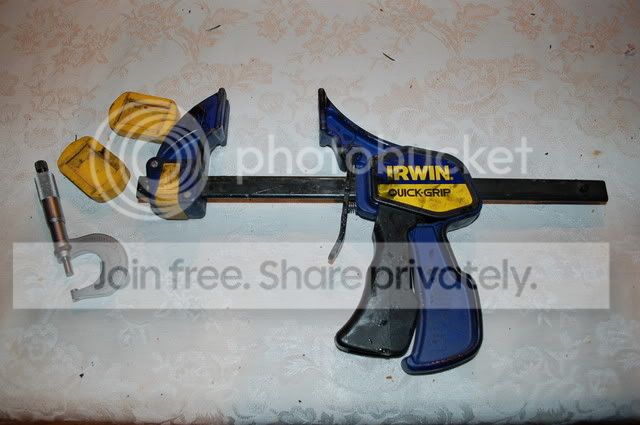
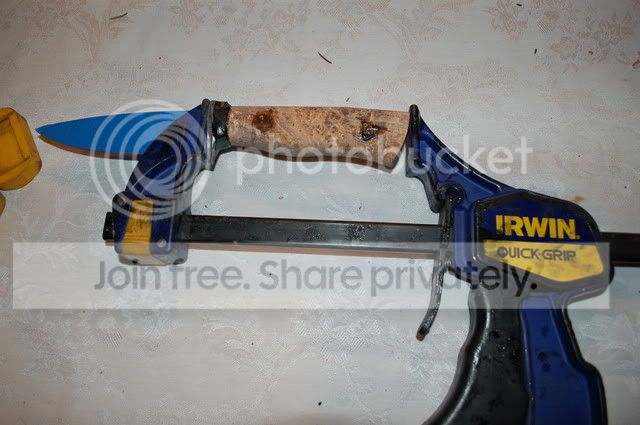
I saw this Idea some where and I really like the way it works in clamping hidden tang knives when gluing or drilling. I have used it at least 50 Times this way.

1
Standard Quick Clamp


DSC_0005-23.jpg


2
remove protective pads


DSC_0006-21.jpg


3
Slot end


DSC_0007-16.jpg


4
Install to work on/ glue/ drill knife


DSC_0008-14.jpg
 
The only tip I have really is for leather sheaths. Use a cheap food dehydrator to wet form your leather or harden it. It gets the perfect temp without getting too hot and can get one for 30$ new at wal-mart. Im sure cheaper else where if you looked.
 
When mixing Satanite, I use denatured alcohol. This makes it dry much faster than when you mix it with water.
 
Good tips, guys. Here's a couple you may already know:

When filing a epoxy-fit guard to fit the tang shoulder just right, you can improve an already good fit by peening the face of the guard lightly all around the guard slot, then driving the guard on cold. Grind the guard face flat again.

When hand sanding a blade, sand one side entirely to your desired finish grit. Make sure it's dry and clean. Lay down a strip of blue or green masking tape over the polished side. Burnish the edges down, and trim off with an xacto. Flip the knife and sand the other side to finished grit. This way the blade only needs to be flipped once, and the blade finish is well protected on the first side.

After etching and de-oxidizing a hamon blade, or when first going into the etch, scrub the blade down hard with detergent and a sponge, rinse and repeat, then rinse and go directly into the etch with the blade still wet. The best way I know to avoid a streaky etch.

X-fine knife edge Cratex wheels are very good for cleaning and shining solder joints, held by hand or in a pair of needle nose pliers. They also clean up epoxy joints nicely at the front of scales.

A stiff wire brush works very well to de-glaze and sharpen Gator belts. Just wire brush the belt a little while it's running, the belt will grind like new. Can be done MANY times to the same belt.
 
This tip kind of sucks!:)
I needed a spark/dust collection system for my new grinder. This is what I came up with:


The whole schmeel is suspended on a slide that can move in and out depending on the grinder attachment. The entire mouth has been reinforced with steel banding then connected to the bucket using that "alumiflex"(?) tubing. I've also connected my Shop Vac to the bucket and half-filled it with water and a couple drops of soap.

I did this on a small budget and in very tight space hoping I would get some active collection. The damn thing bends a flame at six inches! I'm really quite surprised how well this works.
 
When filling a hidden tang handle block with epoxy, first slip a thin coffee stir in the hole. Then the epoxy will run down without creating a vapor lock. When full , pull out the stir.
Also, warming the epoxy a bit will make it flow much faster.
 
1) When drilling and broaching the hole for a hidden tang, save some of the sawdust and drill shavings from the piece and keep them clean. Should you accidentally pierce the exterior while trying to fit the tang or shape the handle, the shavings/dust can be used in conjunction with super glue to patch the hole sufficiently such that when the epoxy is used to fill the channel you have a solid handle once more. This will save you from having to throw out an expensive piece of handle material just because you broached just a bit too hard.

2) When using hand tools to grind the bevels, use a scribe to mark off ALL of the lines for the bevel before setting the file to the steel for the first time. Draw out EXACTLY where you want the plunge, the transition from bevel to flats (or the center line on a blade with opposing bevels, such as a dagger), and the edge center line. Start the grind by carefully cutting in the plung line. Use a file guide, if you can, to keep your lines straight. Begin by using a severe angle on the file (say, 45 degrees) to knock the corner off the edge of the billet), and with each stroke decrease that angle a little, until you have clearly marked the plunge. Once you have a plunge line deep enough to act as a stop for the file, change the file strokes so that instead of moving perpendicular to the blade they start moving in the direction of the blade, so that each stroke of the file moves down the entire blade edge. This will help keep the edge consistent and avoid having hills and valleys that need to be flattened. I also find it useful to turn the blade over after a certain number of strokes (say, 50 strokes per side) as a means of helping to insure that I am working toward a well centered edge line.

3) Always wear gloves when hand filing. I find thin gloves with rubberized palms (available at Harbor Freight for about $1.99) to be best for hand filing, as they allow you to feel the file through the gloves.

 
When polishing a blade i use a piece of G10, Micarta, or Corian about 6-8" long and 1.5" wide. I put a piece of double stick tape (as wide as the block or wider) along the length of the block and trim it if neccesary. Then I stick it on my pants to get some lint on it to dull the stickiness, allowing the paper to come off cleanly later. I cut a sheet of sand paper in half length-wise so i have two 4.25"x11" pieces. Then i stick it on the block lining up the edge and cutting it off along the other edge so i have a piece of paper 4.25" x 1.5." As soon as the paper stops cutting i peel it off and cut a new piece off the sheet. cutting the paper after sticking the sheet to the block keeps you from having 100 loose 4.25X1.5 pieces floating around. I can usually get 10-15 repetitions before the double stick tape needs to be replaced.

I do this for several reasons. It lessens hand fatigue trying to hold the paper around a block, keeps the paper completely flat on the block so it wont round crisp lines, and it allows me to use a sheet of paper as efficiently as possible while allowing for minimal set-up.
 
When mixing glues, use an old phone book and when thru, just tear off and throw away.
 
Additional sanding tips:

I use a steel bar for a backer, and spray glue. Works well. My favorite part though is chopping up sandpaper for it. I use a paper shear/cutting table, I cut the paper in half lengthwise, stack the two pieces and cut strips, moving the paper over an inch each time. Allows me to turn a sheet of any grit into strips an about 4 seconds.
 
Another sanding tip: For a sanding bar, I use a piece of angle iron. I have one bar with a piece of firm leather epoxied to it for a softer finish, and another bar with the center portion ground flat. The angle iron makes for a very stiff sanding block, and it also gives a place for a simple spring clamp to hold the paper. I cut the bar long enough so that I have a nice "handle" on either side of the blade. I use a sharper-edged micarta when working the plunge.

IMG_6490.jpg


IMG_6492.jpg


--nathan
 
Don't wear flip flops while grinding with a fresh 36 grit belt.

If you peen, peen using the flat side of the hammer, not the ball side. Seriously, nobody ever told me that for the first 3 years I made knives. Works a heck of a lot better if you do it correctly.
 
Last edited:
In cold weather when finishing wood, allow the wood and the finish to reach a temperature over 70f before applying the finish.
Best to do indoors in a dry heated area. Keep it indoors in a heated area for at least a few days to allow it to cure.
If wood or finish is cold it can turn gummy and/or blush (fogged).

Don't rub your eyes when your face is covered with sawdust. :eek:
 
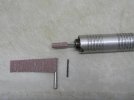
You can get roll pins in different sizes, I use auto motive sticky backer sand paper in different grits.
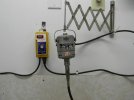
I got tired of the variable spd. pedal on my fordom so got a router spd. control instead.
The fordom is mounted on an old makeup mirror bracket.
 

Attachments

  • PT 140 Holster, Roll pin saders 012.jpg
    PT 140 Holster, Roll pin saders 012.jpg
    47 KB · Views: 122
  • PT 140 Holster, Roll pin saders 011.jpg
    PT 140 Holster, Roll pin saders 011.jpg
    55.6 KB · Views: 130
Organizing knifemaking projects is easy using breadmaking loaf pans. They are available at the Dollar Tree (for $1 ea.). $20 worth is a lot of pans.

A lathe bit makes a great square scraper for cleaning up the joint between handle and ricasso.

Carbide tipped scribes are not center punches.

The more heated the discussion, the less the issue matters to me.

A blade grinding clamp makes plunges WAY better and easier.

It isn't all that hard to grind a hardened blade, and is much easier than trying to fix a blade that warped in heat treatment. And, it is MUCH easier than making another one because you broke one trying to bend the warp out of a too-cold blade.

it is possible to learn something from almost anyone. Including myself.

Good drill bits are a LOT better than cheap ones.

It's better to try and fail than to not try because I'm worried about failing.

Trying to fit a whole shop into a small(ish) space is a good thing - it helps focus priorities.
 
When hand sanding make sure you don't have an edge on the knife, wait until the knife is done.
Don't forget to drill tang holes on SS pre-heat treat
 
Tait's post reminded me of something else.

When dealing with warp, I first try Rick Marchand's method of tempering with clamps and shims. If that doesn't work, I heat the blade back up and straighten it hot, then re-quench. I NEVER go with the 3-point cold anymore on a hardened blade, too many epic failures. It's much easier to re-quench than to make a new blade.

Oh, and don't breathe in when you are taking a bite of a powdered donut on your break.
 
This is turning out Great. I will try markb's tip on the pin and sticky sand paper.

Another tip,
Try using packaging tape if you run out of blue masking tape. I use both interchangeably.
 
I use Porter-Cable rolls of sticky sandpaper. It seems expensive, but a roll will last a Lot longer than it appears, and the abrasive is excellent. You can use it several ways- It's about 4" wide, and I cut it from the sticky side with a hacksaw in a vise.

You can fold it in half, sticking it together. It is pretty heavy paper, so this forms a very grip-able piece of stiff paper.

You can stick it on a piece of wood, and it stays.

I always take a piece of wood about 1/2" x 1", and wrap it very tightly around the piece several times. You have to make sure the end of the paper is cut very squarely, so that it wraps around squarely. When you have all four sides used, you unroll a layer and you instantly have a brand new block.

Thanks for making this thread, guys. Awesome tips!
 
DanGraves's tip gave me a use for those stupid "one sheet each day" little desk calenders.

Mixing the epoxy on the spine edge should leave a perfect sheet for the next batch.

That should work perfectly...? I'm trying it today. I've always used a piece of ductape on the anvil of a vice. No slippage is nice.
 
Back
Top