Here is that Puukko I always wanted

Joined
Sep 18, 2010
Messages
215
The 1084 I got from Page and donated cherry wood and 1/4 brass I had to buy, This knife Is fast becoming my favorite knife , its so good its silly, slices like nobody's business, carves and anything else you ask it to do. I think that this type of blade might be best all around and its pretty easy to do. Here are few photos of how I done it. Just wanted to say Braising is 10x easier than silver solder, the bolt was brass braised to the knife and the nut was silver braised with 45% silver to the brass for pommel, JB weld for bolster and handle was filled with JB prior to assembly. I think Its not coming apart any time soon


Uploaded with ImageShack.us

 
Last edited:
They are simple , graceful, efficient .Very good .On mine I extend the 'guard' a bit on the bottom as a bit of a safety .
 
Yeah I might extend the guard a bit next time, I think Im in love with it cause I'much a function over form person and these things just work so darn good, ty mete
 
Nice work!
I'm glad the steel worked so well for you. there's a reason I recommend 1084 to most people, it really is the best thing to work with simple setups

-Page
 
Now that you are hooked, find a copy of Bo Bergman's book, "Knifemaking". It is a step-by-step book on making about six types of puuko. It is pricey, due to rarity and quality. Here is an Amazon link that says it has some starting at $45. It is usually hard to find for less than $100. Don't let the price stop you - it is worth every penny of that.
http://www.amazon.com/Knifemaking-Complete-Crafting-Handles-Sheaths/dp/188737437X
 
TY all, everyone has been of great help here, Ill see if that book is still available, hehe correction I just did order one , look forward to reading it
 
Last edited:
Bergman's book is great, I keep going over it for ideas. However you should be aware that it assumes you have a blade (probably purchased) and want to put a handle and sheath on it. It's very good for what it covers.
 
Yeah tha'ts where I need help is hoe to put handle on, I figured out how to make 4-5 inch blade from 1084 and am pretty confident on that, now drilling out a straight hole in a block of wood is another matter altogether.
 
The one thing that concerns me about this knife is that there seems to be nothing to stop the hand from sliding down the handle and onto the blade. I understand you're a function over form guy, but sometimes form IS part of the function. In this case the curve of the handle may have an undesired function. The fattest part of the handle is the part being gripped by the smallest and weakest finger, and the skinniest part of the handle is the part being gripped by the longest and strongest fingers.

I guess the underlying message is you shouldn't disregard form altogether. It serves a purpose, and often reveals elements of function that aren't immediately apparent otherwise.

- Greg

P.S. You may have guessed I run the other direction... I'm a form focused guy. So take anything I say with a grain of salt.
 
The design of the puuko has been vetted for several hundred years as the primary working tool of several Scandinavian cultures. The handle design works because the knife is primarily used in a slicing manner rather than a stabbing manner. It is not designed for penetrating thrusts, rather pulling cuts.

-Page
 
I agree,will make next one with some kind of a guard, but then is it a true puukko, now why does it appear that 1084 is stiffer than 1095, my previous two knives made of 1095 flexed more then his one, they are both same thickness? and really what do you do to get that straight hole through wood, what kind of auger?
 
When you get Bergman's book, you will see that there is often a slight flare to the handle at the bolster. This keeps fingers where they should be.
 
I agree,will make next one with some kind of a guard, but then is it a true puukko, now why does it appear that 1084 is stiffer than 1095, my previous two knives made of 1095 flexed more then his one, they are both same thickness? and really what do you do to get that straight hole through wood, what kind of auger?

There should be no difference between the flexibility of an equivalent cross section of any steel until you get to the point where deformation occurs, Young's Modulus allows engineers to predict any elastic deformation (where it returns to its original shape). What heat treating does is to move the point of plastic deformation (permanent change) way way up the curve. If you are noticing a major difference in stiffness between equivalent cross sections that would indicate that the 1095 didn't harden and at some level is taking a "set" when you bend it.

-Page
 
In Scandinavia a man is supposed to be able to work with a Puukko (without a guard)
knives with guards are considered knives for boys. Moving from a guarded knife to a real puukko is sometimes seen as a transition from boyhood to manhood.

Bo Bergman's book is hard/expensive to come by in English.
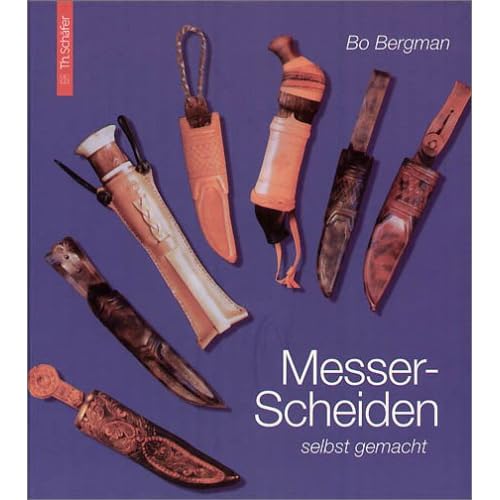
He made a 2nd book dealing with Scandinavian sheeths.
51R8Z4Z0TQL._SS500_.jpg

(the books are still readely avaliable in German, but that''s likely no use to you)
 
Ty page make sense, on the German my partner in business was born in Germany but I don't entertain the idea of him reading a book to me at night ,so I ordered one used in English,hehe, I'm making another puukko soon, I can't part from one I made
 
Puukkos are excellent. Brendan (barberphobic) has done several with blades I made him.

When I do a leuku I alos break tradition and use metal fore and aft. What I do i press fit, epoxy, just like you are, but I peen the tang over the metal buttcap (I use steel cut from my blade blanks fore and aft). If you do a peened tang, make sure ypu soften the last half inch or so of tang up good first!

A lot of puukkos just end the tang in the handle, no pins, bolts, or peening. I'll eventually do one that way, but I like the peened tangs a lot. Especially on the "leukuchete" and snow knives.

I like the looks of the one you've done quite well.
 
Ty , I appreciate that much, I wanted to do hidden tang just stuck in the wood but chickened out and braised that bolt to make it through tang, without pommel I could do more with the handle
 
Did some test carving and found out that its a monster carver, only on oak did it show some micro chipping, I rolfed it and now it stands up to it much better, By the way bo bergmans book is awsome
 
Last edited:
Back
Top