Hey Guys, Like to Share a Great Knife Storage Solution

Would you go into more detail on this? Will this affect only uncoated blades, or is there more to it?

I'm curious, as well. In the lab, we have ribbed polyethylene drawer/shelf liner, and AFAIK, the stuff in essentially inert.
 
here is a thought guys......a tool chest is indeed much more cost effective that a safe however look at it this way. If you were to be the victim of a robbery think how much easier it would be to pick up a tool chest filled with very valuable knives and walk out the door. Unless you secure it is a great carrier and you are putting all you eggs in a perfect little basket for thieves. Also, thieves see a tool chest and think sweet.....tools....easy to fence or sell at pawn.....get it open it up and its PAY DAY!!!
 
... think how much easier it would be to pick up a tool chest filled with very valuable knives and walk out the door.

I suppose it's a matter of how many knives you have. I've thought of getting a small tool chest, but I think I'd rather keep my small collection spread out in different places around the apt. If I get robbed, I may keep a couple.
 
here is a thought guys......a tool chest is indeed much more cost effective that a safe however look at it this way. If you were to be the victim of a robbery think how much easier it would be to pick up a tool chest filled with very valuable knives and walk out the door. Unless you secure it is a great carrier and you are putting all you eggs in a perfect little basket for thieves. Also, thieves see a tool chest and think sweet.....tools....easy to fence or sell at pawn.....get it open it up and its PAY DAY!!!
Yeah, that's why I said it depends on people's security needs. If you need a safe to be safe, then use a safe. But thins thing ain't small or light, either. It takes two big dudes to pick it up and carry it. It would be easy to bolt down to something, and the lock on it is pretty sturdy too. Still, it's no safe, but it's alot more versatile than a safe. You can have it upstairs, on a table or something. Not a good solution for valuable knives, depending on your home security set-up, but great for knives of lesser value.
 
In response to: ""Most non-stick liners off-gas, negating the advantage of a metal cabinet."

Would you go into more detail on this? Will this affect only uncoated blades, or is there more to it?

Off-gassing causes a few problems for the storage of collectibles. Foremost is the chemical reaction that occurs between the off-gassing vapor and the stored material, potentially leading to degradation of the collectible. Second, off-gassing often imparts an odor to the stored material that may then be unattractive to the current or future owners. Third, an off-gassing product is unstable, and can react physically to materials touching it as well as coming into contact with the off-gassing vapor. Many factors decide how critical those concerns are, including the length of time the collectible is stored, the material being stored, and the regulation of light, temperature, and humidity in the micro-environment. It's not just non-stick liners you've got to worry about. The main culprit of off-gassing is strong adhesives, often used in wooden chests to assemble everything, as well as chemically treated wood and cheaper finishes. A metal cabinet has advantages over a wood cabinet in that you don't need to use much glue in its construction (adhesives are among the most powerful off-gassing cuplrits), you don't need to finish it (with urethane or other finishes that will also off-gas for a while) and it's much more inert than raw wood, which attracts moisture and bugs. It is also more stable in fluctuating temperatures and humidities. Keep in mind, none of this really matters unless you are storing valuable collectible knives for many years.

Let's take the example of a brand new non-stick liner, though. Many of these are made of petroleum byproducts, including the synthetic rubber ones. They smell like petro-chemicals and will off-gas for weeks, if not longer. Furthermore, they are often cheaply made, and the dyes may be volatile, especially until the material is more stable (has aired out for a while). If you put a collectible knife on that liner and close the drawer, 1) the knife will likely absorb the odor, 2) there will be a chemical reaction, although it may be slight, and 3) you may see some dye transfer from the liner to the knife. This is more likely to happen if your knife has a natural material handle, and if humidity in the micro-environment is high.

Now, to answer your question, if you take the knife in and out of the drawer alot, and the knife is mostly made of metal, you should be fine, even in an off-gassing environment. It probably wouldn't affect a metal blade as much as it might affect natural handle materials. But even an all-metal product can be affected if stored in an off-gassing environment for enough time.
 
I'm curious, as well. In the lab, we have ribbed polyethylene drawer/shelf liner, and AFAIK, the stuff in essentially inert.
Yep, polyethylene is basically inert, although there are many types of polyethylene. Mylar is one kind, and it's used for the inert archival storage of coins and paper money. Your typical grocery plastic bag is also polyethylene, however, and I wouldn't store any collectible in one of those.

The little clear plastic bags that typically wrap a knife when it is new in the box are bad for storage. Over time, they will degrade, yellow, and off-gas, reacting with your knife and sometimes leaving an uneven patina or even residue stuck on the knife. For that reason, if you're going to store a collectible knife long-term, always remove it from its plastic sleeve and store it on something more stable.

But if you know you're buying a truly inert archival-grade polyethylene liner, then it's probably fine to store things on. Except when you get into the whole air-flow thing and the development of patinas, which is a whole other subject concerning storage. Basically, plastic prevents air flow, so if you didn't rotate the knife often and the liner has a pattern to it, the metal patina may form around the pattern rather than evenly across the knife. That's why I prefer breathable liners for metal storage.

For this particular tool chest, since it comes with synthetic "rubber" liners, here's what I would do: Remove the liners, clean the drawers to remove any residue, dry, and lay down pure cotton liners, like an old sheet folded over, or a pillowcase.
 
hi you guys
i put all the busse "knives" in my computer's HD
very safe !:D:D:D

f74606cd.jpg
 
Last edited:
Eh, I just give mine a good throw and wherever they stick (floor, ceiling, wall, neighbor's cat. . .) is where they are stored.
 
Thanks for the good explanation, and advice.


Yep, polyethylene is basically inert, although there are many types of polyethylene. Mylar is one kind, and it's used for the inert archival storage of coins and paper money.

Mylar is actually polyethylene terephthalate, the same plastic as soda bottles. As you indicate, when properly formulated, it will be inert.
 
You know the best way to deal with a slightly uneven patina or marks from asymmetrical air flow?


Take that thing out of the stinkin' safe and smash it through a few logs :rolleyes: sheesh... these are knives, not ancient artifacts from a long dead civilization.
 
You know the best way to deal with a slightly uneven patina or marks from asymmetrical air flow?


Take that thing out of the stinkin' safe and smash it through a few logs :rolleyes: sheesh... these are knives, not ancient artifacts from a long dead civilization.

I agree, no reason to baby your users. But some folks like to know how to preserve their safe queens and collector-grade knives. Not too many Busses fall into that category, we seem to be more of a user crowd, but some might. It's a topic I like to rant on, because many folks don't know how to properly store collectibles, but it's a topic probably seems out of place on this forum, where folks mostly beat their knives (in a good way, of course). For storing users, the non-stick liners that come with that tool chest work really well. Storage is a really interesting science. For example, I was visiting the storage campus of a major university paleontological collection, and they asked for my help because they were going through too much desiccant trying to keep certain specimens in certain cabinets from deteriorating so fast due to reacting with the moisture in the air. They weren't aware that desiccants can actually attract humidity into a cabinet, and regulating the macro-climate is often more cost-effective. They had alot of cool gizmos through, like little sensors that give you real time stats on temp/humidity and the presence of chemicals and feeds that info straight into a computer to keep track of the data. For their best stuff they had these archival-grade airtight metal cabinets that cost about $3000.
 
Last edited:
All mine are buried in sealed PVC in undisclosed locations.

I like it. I thought about that as well Guyon. However, I chose to drop them into the Mariana Trench. I know they will not get stolen down there, and may even make a surprise appearance on the next IMAX movie on Oceans.
 
it's a topic probably seems out of place on this forum, where folks mostly beat their knives (in a good way, of course).

Oh no it doesn't - there are plenty of collectors here who have lots and lots of safe queens.


I just like to harass them about how they should use their knives instead of babying them - nothing but a little friendly harassment between hogs ;) :D
 
This topic comes up every now and then. But, it looks like it has been almost 2 years now.


Last I saw: http://www.bladeforums.com/forums/showthread.php?t=537702


I have been using Craftsman "Intermediate" chests for a few years now and can't imagine a much better arrangement. :thumbup:


The following is old pics and doesn't show my INFI drawers, but I just copied the following from an old post:

I looked for some variety of furniture type chest for a LONG time and finally discovered that Craftsmen type tool chests work very well if you get the right sized drawers.

I LOVE the full extension ball bearing drawers.

I use Intermediate chests because they can be locked and don't have a top lid. Some might like a top lid, but I put mine under a credenza that fit perfectly.
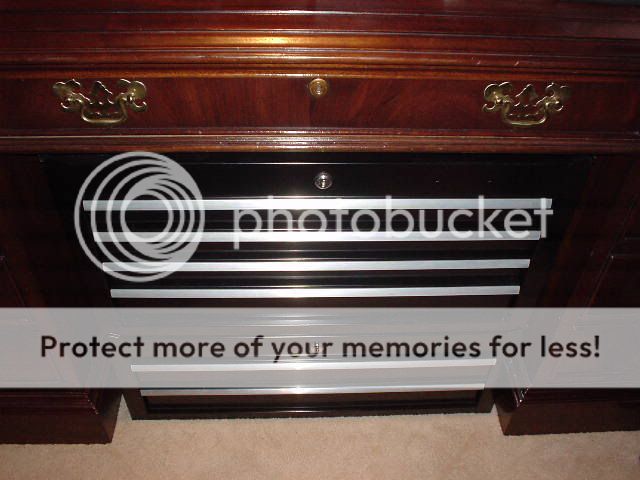
KnifeStorage-Craftsmanintermediatec.jpg


2" - 3" drawers work best. I can even stand up the little knives in little wood spacer racks like shown in the following picture:
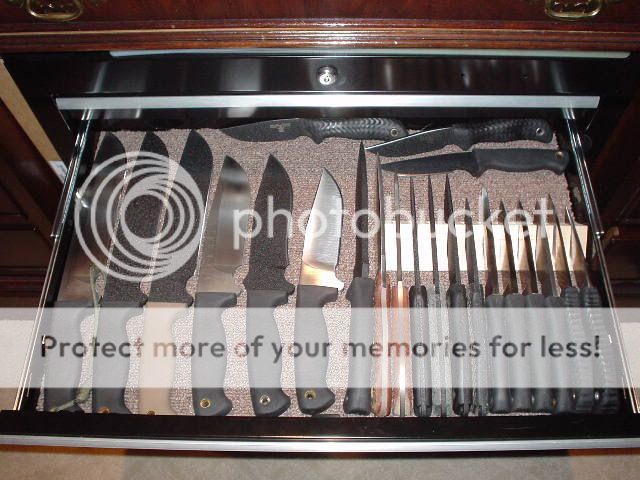
RatScrapDrawerworganizer.jpg


Small knives will stand up in the 2" drawers.

Medium knives or knives with a double guard usually require a 3" drawer for standing up.


My Battle Rat sized blades just barely fit front to back.

Anything longer like a FFBM or DogFather needs to go side to side in the drawers I have.

My cabinet size is 26" wide x 16" deep. The drawers are about 22.25" wide x 14.25".

They have worked well for me.

Originally, I had considered putting a wood veneer on the front (I could do side and top if I needed), but I have decided it works fine for me as it is for now. :thumbup:

.


I purchased a big cheap thin carpet remnant from Walmart for about $12 and cut it to fit as drawer liners.

My drawer heights are 3 @ 2" tall and 3 @ 3" tall.

The 2" tall drawers are a bit more versatile. I can lay down ANY knife in a 2" drawer AND I built wooden racks to stand up my smaller knives. Most small knives will stand vertical in the racks even in the 2" drawers.

I wish my two intermediate chests were combined into one single unit with one more drawer..... But, I have been having to slim down the collection lately due to finances anyway. :( :grumpy:

Larger knives with larger guards will mostly stand upright in the 3" drawers.

Large Double-Quillion knives tend to have to lay flat.


Sears has Craftsman, Lowe's has Kobalt, Home Depot has Husky - they are all worth considering depending on price and preferences.

But, the "ball-bearing" glides are WAY are worth the extra cost IMO. :thumbup:

I searched and considered storage ideas for Months before deciding on the intermediate tool chests.

Everybody has their own needs, so to each their own. But, for me, the advantages of the tool chests were:

1st) Right sized drawers - low profile drawers with lots of drawers that fit common knife sizes are HARD to come by (As mentioned by Balislinger, I also considered various flat file storage options - But, those are actually more expensive than tool boxes, deeper front to back than I need and take up a lot of space. I use the 26" wide tool chests which are plenty wide for my largest knives (short of Waki's and Rucks) to lay side-ways

I specifically chose the Intermediate chest options for a few different reasons:

- The Intermediate chests are stackable

- Lockable

- They don't have a lift top like most top chests - For me, the lift top just doesn't offer the storage function I wanted and need - Partly because I wanted all of the drawers under a credenza behind my desk (easy access AND a good place for me to add storage that wasn't being used) - Others might like the lift top for various reasons, display, etc. - Depends on your needs. :thumbup:

*** One notable downside to the lift-top chests IMO and for my application was needing to have the top lid up to open the lower drawers and/or lock the lower drawers. - That didn't work well for my needs.

- The Lower chests tend to have larger drawers often 5" - 8" deep - which work great for storing sheaths. But, not so great for knives IMO.
For storing sheaths, boxes and such, I actually have an old chest of drawers I keep seperate. I am not worried about needing to lock that stuff up and prefer to have somewhere else.

The intermediate chests = Just right. ;)


I wouldn't say my Intermediate chests are as safe as a gun safe. I have 3 gun safes. But, I personally don't like storing my knives in my gun safes and consider the tool chests WAY more "convenient" and "safe enough" IMO.

The intermediate chests are pretty heavy and cumbersome to carry. I would guess my top intermediate chests weighs about comparable to a fully loaded two drawer file cabinet = Not easy to move and carry. So, I am not terribly worried about somebody seeing them as an easy grab, carry and run option. My intermediate chests would generally require 2 people to carry and still heavy and cumbersome. :thumbup:
My two are not bolted together, but I think bolting them together to make them even heavier and harder to move would be plenty easy.

I don't know much about all of that "off-gas" stuff. But, from what I can tell, whatever fumes "might" come from whatever pale in comparison to just simple humidity in a house in regards to potential damage to knives.

I live near Houston with disgustingly high humidity. With the A/C running most of the year, it helps cut in house moisture. But, there are some days when the moisture in the house is VERY present. That said, most of my knives are fine in the drawers.

Certain HIGHLY prone to rust knives just need protection if you want to avoid rust - O1, 1095, 1085, and ESPECIALLY INFI with a decarb layer and similar steels prone to rust.

SR-101 is not "quite" as bad as those above, but outside of decarb, SR-101 is pretty easily the most prone to rust Busse steel. So, I keep my SR-101 coated with Ren-Wax and anything similarly prone to rust coated as well.

I recommend getting rid of the decarb layers on those knives that have them.

SR-77 will rust and A2 will patina easily, but those steels and similar are what I would call "moderately" prone to rust and seem to do fine in my house and those drawers without extra protection...

INFI will rust, but it is VERY high on the list of steels that are hard to rust short of being a stainless steel. So, INFI "WITHOUT" the decarb layer should NOT have many problems.

.
 
Funny, just starting to get to the point where I actually need storage and was thinking of a tool drawer just the other day.

If you're AD Military, Lowes and HD will give you a 10% discount if you show your ID. Not sure if that's everywhere but they do it in Florida, as recently as last weekend.

T
 
I like the Craftsman line, I was thinking of getting a small one for users since it was on sale at Sears. But I wouldn't use the Craftsman line to store collectible knives long term because they have a gap at top of each drawer that allows dust to flow into the closed drawer and onto the knives. What I like in particular about the Husky is that the drawers have no such gap, meaning knives stored long-term will not develop a coating of dust from circulated air.
 
Back
Top