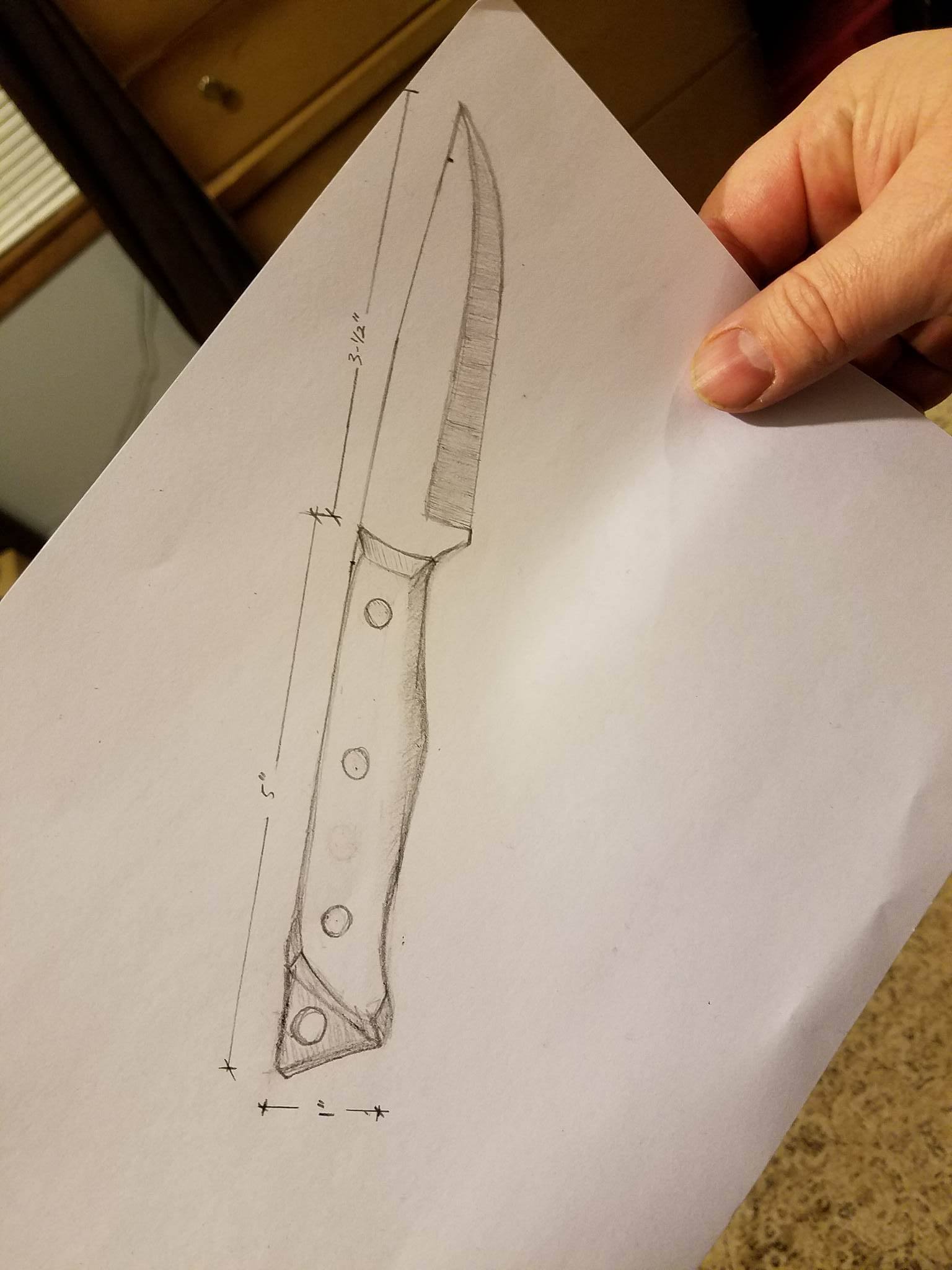
Hi, I'm the new guy :)

Joined
Feb 22, 2017
Messages
89
Hi all,

I have recently sparked an interest in making a knife. Just one, to start. I have been watching a ton of youtube videos by Walter Sorrels and a few others and reading the sticky posts in this forum, and feel like I dont need an elaborate shop to create the one I have sketched out.

I am thinking of using 1084 for this paring knife, due to its relative ease of HT and the fact that I wont have a proper forge or tempering specialized ovens to work with.

So far I have cut it out and glued it to a pc of cardboard, and will have to buy some steel and tools, and wood.

Very anxious to start it, and would welcome any tips for HT and normalizing without advanced equipment.

Thanks for looking :)


This is the sketch I mentioned.
1Rj4SJm.jpg


EDIT: I am not sure why that image is so huge, so I apologize! IDK how to make it smaller.

P.S. I originally posted this in the General Knife Discussion but it was mentioned that I might have been posting in the wrong place so I am putting it here as recommended by another member so thanks PWNJimbo :D.
 
Hi new guy, welcome to the forum! The sketch looks not bad, although IDK if the lanyard hole at the end is necessary in a paring knife- your design though, musta put it there on purpose... the planned bevel will be easier to pull off, as well as cut better, if you go with a full flat grind.
You are wise to start with 1084. You'll need a forge, and since I see you don't have one, in a pinch an oxy-acetylene torch will work to heat treat with.
Grind away everything that does not look like a knife, leaving the edge about as thick as a dime, and drill your handle holes. Then carefully heat the blade up evenly and slowly to a non-magnetic temperature, then quickly quench into pre-heated canola or vegetable oil (130f is best). Have your kitchen oven already pre-heated to 400 (should be 59-ish for 1084 in oil) and temp verified in the oven with an additional thermometer inside. Temper right after quench, 2 hrs., then water quench, then temper again for 2 hrs., then water quench. Then finish it up, carefully thinning the edge down to .020" or less without overheating it.

There is of course a whole lot more to it than that, but that'll get you through this one, and a whole lot of reading will get you through more knives.

Good luck!

P.S. I did not include normalizing, because you're not forging it... it should be in a reasonable state to harden from the supplier. There will be a little stress imparted from the grinding process, but since you have no forge, you may do more harm than good trying to refine grain or reduce stresses that are already likely fairly small.
 
Thanks for the tips, Salem!

The hole at the end I put there to be able to hang it instead of sticking it in the drawer, but I suppose I could lose it and just stick it on the mag strip with the rest of the knives.
As for the grind, I just thought it looked cool so I guess it was more aesthetic than functional. I may have to rethink that based on your suggestions.
What thickness steel would you recommend starting with? I was thinking of 1/8" but concerned that it might be too thin once grinded down and HT that it make crack etc.
Also, for this kind of application is there anything else I should do to the steel like a sealer or anything like that?
 
1/8" should be a good place to start. i often start with thinner steel than that, for kitchen knives.
No sealer or anything, it's carbon steel so it'll rust if you let it... Just a hand-rubbed finish at 400 or 600 grit should be fine, and is easy to touch up in case of corrosion. It will gain a patina over time. Or you can force a patina with things, mustard being the most popular option. Google "mustard patina knife" and see what you think. The idea being to force some corrosion in an attractive pattern, so that additional corrosion is less likely to occur.
As for cool looking grinds, I agree that a saber type grind (partial height) is more visually interesting... but a boring old full flat grind or very mild convex or blend of the two work better on thin blades. Also, new guys always wanna have a grind line like that, and almost always struggle with it- often just ending up with FFG anyway!
 
Thanks again Salem! I actually like the forced patina. Googling it and youtubing things lead me down an Opinel modding stream of videos so I got a bonus side project out of it too :eagerness:
I guess I'll decide on the final grind as I get to that point. thanks again for the help :)
 
Welcome.
The sketch loks basically OK. I would make that knife in .100" steel. I would suggest you remove the glass breaker end and thong hole. The other thing I would change is the dip in the spine at the bolster. It will serve no function and make the knife less comfortable to use. Make the blade spine come straight back into the handle like the line you drew to start with.
 
Back
Top