High end knives and keeping up with new steels

I fall squarely into Blackhills camp here. Of course, I am another one of those tool-steel loving fixed blade W&SS's. What a custom knife brings is innovation in design elements, F&F, trust in the maker's reputation and warranty (most makers warrant their knife for the life of the maker and they are directly and personally accountable to the customer either in private or on the forums).

I think that even though most consumers who buy customs also have several productions, that customs buyers actually can be considered two consumer types in the sense that they have a completely different mindset when considering the purchase of a custom versus a production. For myself it is a very conscious decision. My next knife will be a production and I will think of these qualities....My next knife will be a custom and I will consider these makers. For me personally that is how I make these kinds of decisions. I almost never mix the two, i.e. getting a production when I originally set out to get a custom knife.

But ask me to trade them with an exact model except that the other models have ATS-34 (not considering collector value), and I'll call you crazy. Nothing against ATS-34 but if I have a choice, I will go with the steels I already have.

This statement makes perfect sense when you are talking about a production knife. The attributes that set apart production models are their specs. In your quote above, you already made a value choice on the knives you have and steel choice. For sure you wouldn't trade your knives for the ATS-34 model because you already perceive that the one you have is better quality and that is probably why you paid more money for the model you already have rather than the lower cost one in ATS-34.

Now try to apply that same statement to a true custom knife and it just doesn't jive. Custom makers make individualistic knives and while some will over choices of steel type for a given model it is pretty rare. Among the makers I deal with regularly they usually indicate to me that O1 and 1095 are their most requested steels. I've even talked to a few that tried to offer knives in 154CPM and their customer base doesn't want them. The reason is that the customer base wants the style of knife made by the maker, but doesn't want to pay more for one type of steel. This seems very common. Talk to Scott Gossman and I believe he mad similar statements in W&SS.

So in essence - steel type is a marketing technique that works for production companies. I think this is in a result of high competition between major production companies that sell to the masses and the steel mystique is a powerful attribute to that particular audience. Custom makers make their own niche do to the style of blade, design for specific function, ability for customers to tweak or alter designs, production of unique one of a kind knives etc. Steel type could be a factor, but I hardly ever see it as a main selling point of why a custom maker appears to be popular.

To answer you original question - No, I don't think production companies offering higher end steels at lower prices has any impact on the custom market.
 
When I look at custom knives (and I'm not saying I buy custom knives), the steel isn't the main factor. No custom maker is going to use bad steel. I usually just take it as a given that they are using 1095, S30V, or D2, and even when they're not it's some other quality steel. However, even if a custom maker were using what some would consider low quality, like AUS8, I would be more worried with the overall design, build quality, and fit and finish. However, I don't think I would buy ANY knife, let alone a custom knife, that used something like 440A.

But if we look at steel performance objectively, AUS-8, ATS-34 and even a properly heat treated 440A are not "bad" steels. Randall knives uses 440B IIRC. A $35 440A Kershaw Leek and can what most knives do regardless of price, assuming the task is reasonable of a pocket knife. It may take a bit more sharpening, but getting it to a hair whittling sharpness level is insanely easy, especially when compared to premium steels.
 
But if we look at steel performance objectively, AUS-8, ATS-34 and even a properly heat treated 440A are not "bad" steels. Randall knives uses 440B IIRC. A $35 440A Kershaw Leek and can what most knives do regardless of price, assuming the task is reasonable of a pocket knife. It may take a bit more sharpening, but getting it to a hair whittling sharpness level is insanely easy, especially when compared to premium steels.

No Kershaw uses 440A anymore, they've moved all of their current lineup to 13C26. And while you may not consider it bad steel, I do. Time is valuable, and the less sharpening I have to do the better. In my experience, 440A dulls excessively fast, and therefore is a bad steel in my opinion. Also, when did I say AUS-8, let alone ATS-34, were bad steels? I said some would consider AUS-8 as low quality, and that is completely true. That does not include me. Also, I rate "low quality" above "bad," but that's kind of a ridiculous distinction to make.
 
This statement makes perfect sense when you are talking about a production knife. The attributes that set apart production models are their specs. In your quote above, you already made a value choice on the knives you have and steel choice. For sure you wouldn't trade your knives for the ATS-34 model because you already perceive that the one you have is better quality and that is probably why you paid more money for the model you already have rather than the lower cost one in ATS-34.

Now try to apply that same statement to a true custom knife and it just doesn't jive.

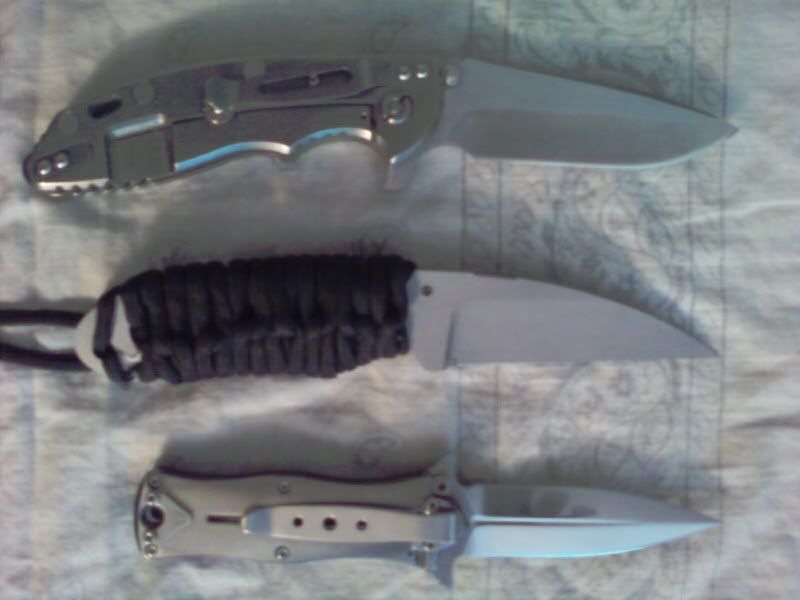
Actually, I was specifically referring to my custom knives:

1247063787.jpg


Custom makers make individualistic knives and while some will over choices of steel type for a given model it is pretty rare. Among the makers I deal with regularly they usually indicate to me that O1 and 1095 are their most requested steels. I've even talked to a few that tried to offer knives in 154CPM and their customer base doesn't want them. The reason is that the customer base wants the style of knife made by the maker, but doesn't want to pay more for one type of steel. This seems very common. Talk to Scott Gossman and I believe he mad similar statements in W&SS.

So in essence - steel type is a marketing technique that works for production companies. I think this is in a result of high competition between major production companies that sell to the masses and the steel mystique is a powerful attribute to that particular audience. Custom makers make their own niche do to the style of blade, design for specific function, ability for customers to tweak or alter designs, production of unique one of a kind knives etc. Steel type could be a factor, but I hardly ever see it as a main selling point of why a custom maker appears to be popular.

To answer you original question - No, I don't think production companies offering higher end steels at lower prices has any impact on the custom market.

In general, I don't disagree that the "good old" steels are important for makers to continue with. And let's keep in mind that I'm talking about higher priced knives in general (custom and production), but we have certainly seen S30V make this type of impact on the custom and high end production markets in the last half decade or so. Prior to S30V, the steels that dominated the market were perfectly fine to do what they were designed to do. There was no need ]to make better performing steels. And yet we see that continuing on, in most price ranges, custom and production.
 
No Kershaw uses 440A anymore, they've moved all of their current lineup to 13C26. And while you may not consider it bad steel, I do. Time is valuable, and the less sharpening I have to do the better. In my experience, 440A dulls excessively fast, and therefore is a bad steel in my opinion. Also, when did I say AUS-8, let alone ATS-34, were bad steels? I said some would consider AUS-8 as low quality, and that is completely true. That does not include me. Also, I rate "low quality" above "bad," but that's kind of a ridiculous distinction to make.

The thing about time saving is that longer edge retention generally = longer time sharpening. I do realize that that can be remedied with diamond stones,but diamond stones would also shorten the time frame to sharpen 440A.
 
The thing about time saving is that longer edge retention generally = longer time sharpening. I do realize that that can be remedied with diamond stones,but diamond stones would also shorten the time frame to sharpen 440A.

Which is going to be more time, though? A few extra minutes to sharpen a higher quality steel blade, or a few extra days of not needing to sharpen a blade?
 
Ok, I have to make one more point that no one has brought up yet (I think) The newer higher performance steels often require very specific heat treat regimes that add time, labor and/or equipment costs and are often financially or technologically infeasible for smaller companies and custom makers. For a great many of these makers and companies, if Peter's or Bos can't or won't do it... it is out of the question. Peter's and Bos aren't going to invest in a heat treat regime or technology unless there is a huge call for it..... yadda, yadda, yadda, therefore, if the HT is hard to do or expensive for either in house HT, or, a major HT provider the steel is not going to catch on with too many folks outside of the big boys.

Just thought I'd throw that wrench into the works ;):D
 
Which is going to be more time, though? A few extra minutes to sharpen a higher quality steel blade, or a few extra days of not needing to sharpen a blade?

It my depend on how one uses their knives. I used to own a moving company and I used the 440A Leek for heavy cutting and never found that getting it back to a working edge was a burdensome task. I would rotate between the Leek, an AUS-8 Camillus Heat, a 440C BM Griptilian and an S30V Ritter Grip and didn't notice much of a difference if at all. It might have to do with my obsessive-compulsive need to keep all of my knives at least shaving sharp so I touched all of them up fairly equally. The Ritter grip didn't need it as much but it took slightly longer to touch it up. Overall, I didn't notice that much of a difference.
 
Ok, I have to make one more point that no one has brought up yet (I think) The newer higher performance steels often require very specific heat treat regimes that add time, labor and/or equipment costs and are often financially or technologically infeasible for smaller companies and custom makers. For a great many of these makers and companies, if Peter's or Bos can't or won't do it... it is out of the question. Peter's and Bos aren't going to invest in a heat treat regime or technology unless there is a huge call for it..... yadda, yadda, yadda, therefore, if the HT is hard to do or expensive for either in house HT, or, a major HT provider the steel is not going to catch on with too many folks outside of the big boys.

Just thought I'd throw that wrench into the works ;):D

Great point. And I think it means that the new steels haven't reached the point where the major heat treaters have considered adapting to them. But I would remind you that Bos eventually took on S30V when all of the older steels were performing fine and still do.
 
PS I hope all of the readers are enjoying this discussion. I sure am:D. Great points brought up by everyone so far:thumbup:
 
PS I hope all of the readers are enjoying this discussion. I sure am:D. Great points brought up by everyone so far:thumbup:

It is nice to have a reasoned discussion every now and again.... it seems like so many threads here go downhill quickly b/c the original poster stirs something up then buggers off. You have done a very nice job of moderating this thread. People tend to forget that moderating is a skill needed in daily life and conversation among groups, not just something that gets done by folks with red screen names on internet forums :).

So to you Kaizen1.... :thumbup:
 
I can see that a properly heat treated 440C blade can hold its own, but to say that it can blow away supersteels seems to push it too far. And the key with new steels is that they seem to bring greater potential for performance. If we can get so much out of 440C, I would guess that we can get that much more out of the newer steels. But because we are using ambiguity in our descriptions right now, it will depend on what specifically we are referring to.

This was the very point M Black (KI) made when comparing 440C to some newer exotics - he found that in his tests some 440C blades outperformed the exotics. From memory, Vassili? posted some unexpected results in BF from his tests as well. It all depends on blade profile and heat treat. I don't know enough about steel properties to know how much performance can be wringed out of the new super steels but I suspect that they are less forgiving to heat treating errors. I would take a properly made and heat treated in 420, 440 or AUS over an improperly made or heat treated blade in any of the latest super steels - trouble is we won't know what's well made unless we test for ourselves or get reviews from other owners - for which I thank BF
 
This was the very point M Black (KI) made when comparing 440C to some newer exotics - he found that in his tests some 440C blades outperformed the exotics. From memory, Vassili? posted some unexpected results in BF from his tests as well. It all depends on blade profile and heat treat. I don't know enough about steel properties to know how much performance can be wringed out of the new super steels but I suspect that they are less forgiving to heat treating errors. I would take a properly made and heat treated in 420, 440 or AUS over an improperly made or heat treated blade in any of the latest super steels - trouble is we won't know what's well made unless we test for ourselves or get reviews from other owners - for which I thank BF

I think the better question would be "Would you rather have a properly heat treated old steel like 440C or a properly heat treated super steel like S90V?" It wouldn't be fair to compare a poorly heat treated blade to a properly heat treated blade. In consideration of whether we should go with one steel over another, we need to assume that all other factors are equal (heat treat, grind, etc).
 
It is nice to have a reasoned discussion every now and again.... it seems like so many threads here go downhill quickly b/c the original poster stirs something up then buggers off. You have done a very nice job of moderating this thread. People tend to forget that moderating is a skill needed in daily life and conversation among groups, not just something that gets done by folks with red screen names on internet forums :).

So to you Kaizen1.... :thumbup:

Thanks spiralarchitect:).
 
Back
Top