Hollow grind and wheel size question

Joined
Jan 30, 2008
Messages
129
My question is when does a hollow grind become a flat or tapered grind and what do you look for when making a hollow grind as related to the depth of the grind. I have a wilton grinder and if I use the 8" wheel to make a 1" deep grind there is some dip with a grind line but not near to the extent as if I would use the 3" wheel on the platen to make the same grind. There is a lot more edge to the blade before it starts to make the transition to the flat. Question one is: Does the depth of the hollow grind make it more sought after considering all other things equal as far as what I should be trying to acheive as I develope my skills. Should the blade have that deep sharp look to be better knife, worth more money with all other things being equal. Question two: is there a rule of thumb you use when choosing the wheel size you grind on related to the width of steel you are grinding.
Thanks for the help.
 
Someone on this forum has a calculator as to which size wheel to width of steel all figured out.
 
Cloyde,

A very knowledgeable knifemaker “Bill Herndon” came up with a device that looks like a slide rule with different radiuses shown on the rule. And it considers in the formulae of the height and thickness of your blade. K&G Supply still sells them. This slide rule allowed me to visualize the hollow grind hands on with the pattern. And made me think about tip strength..
I have a knife maker friend who uses large grinding wheels in the 16” to 20” range. Those blades are still considered a hollow grinded blade, even if its hollow could be less than 1/.100th of an inch. You may see some older knives made in the 70’s and 80’s which are hollow ground, but the hollow grind was stretched upwards towards the spine. With the lack of large wheels this method gave a larger area that was thinner and a better cutting tool with a very strong thick spine.
Flat ground blade is produced on a flat platen.
You must work with your blade geometry to find the right spine to edge thickness. The use of the knife is a must consideration. Your finished edge geometry will make or break your cutting tool. Will it be a filet knife or a Bowie? Looks don’t count if the knife is a user and the edge chips or it need to be sharpened daily like an axe.
 
There are various ways to hollow grind a blade. Using the wheel diameter to set the radius for you is probably the easiest, but you may move the grinding surface up the blade height as the grind developes, to get a hollow ground blade with a grind larger than the wheel diameter. It's difficult, but it really can be done.
What makes or destroys the value of your knife is not the grind, but the final finish and the heat treatment. A good blade shouls have a pleasant, regular finish suited to the task it must perform, (and such a finish is not necessarily mirror-like) and it must be tough and flexible to a degree while keeping a very sharp edge for a long time, which are actually two opposite requisites.
In the end, a knowledgeable user will much prefer a not-so-beautiful, well heat treated blade to a fancy blade that won't hold an edge or that chips or, worst, breaks.
So, in my opinion, proper edge geometry and heat treating are paramount, then it comes finish, which is an evident demonstration of the skill of the maker, after all, and then come fancy materials and such, which in some cases, depending upon why you want the knife, may even be an issue and not an asset at all.
It's like a cake: the heat treatment and blade geometry is the cake, finish is the frosting, valuable materials for grip and guard is the cherry.
You can have a perfect glazing, with lots of cherry on top, and it surely add value to the cake and make it sell easier, but if the cake is not well baked, or is disgusting, it will be useless.
Same with the knife: if blade and edge geometry is wrong, and if the heat treatment is crappy, the knife is, at best, a knife shaped object.
 
I've seen it said on a hollow grinding tape by Stout that an 8" wheel will grind up to a 3/4 depth of blade and a10" wheel will grind an inch of depth not a hard and fast rule but in the ballpark and pretty close. As said earlier in this thread the bottom line is heat treat and geometry.
 
There are various ways to hollow grind a blade. Using the wheel diameter to set the radius for you is probably the easiest, but you may move the grinding surface up the blade height as the grind developes, to get a hollow ground blade with a grind larger than the wheel diameter. It's difficult, but it really can be done.

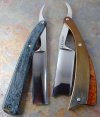
case in point i grind razors on a 2 inch wheel and im using 3/16 -1/4 stock but can make a blade
in this pic the blades are 15/16 tall edge to spine and 6/8
if i needed to i could make a 1/2 out of the 3/16 stock i started with
 

Attachments

  • DSC05295sm.jpg
    DSC05295sm.jpg
    57.9 KB · Views: 84
Cool razors! I like free hand razors a lot. I just never even thought about buying one because I'd like to get old and, clumsy as I am (I always manage to cut myself at least twice each time I shave with safety razors) I'd surely cut my own throat. :rolleyes:
 
hi this is rich castelluccio again did any one find out were I can get the grip it fright hollow grinder attement
 
Rich- I appreciate you trying to search for info, but this is something that you'd be better off starting a new thread for.

This thread hasn't been active since 2008. Many of the guys that replied back then, haven't even been around here for years.
 
Back
Top