
-
The BladeForums.com 2024 Traditional Knife is available! Price is $250 ea (shipped within CONUS).
Order here: https://www.bladeforums.com/help/2024-traditional/
You are using an out of date browser. It may not display this or other websites correctly.
You should upgrade or use an alternative browser.
You should upgrade or use an alternative browser.
How Big A Knife Really Need To Be
- Thread starter Blood_Grooves
- Start date
Machete and pocketknife for me. They just work, and aren't too precious to worry about.
x2.
Large bladed knives aren't ideal IMO, they aren't very effective choppers, and besides chopping they don't excel at anything.
I'd sooner carry a small fixed blade/folder and a machete/hatchet. (Depending on the environment I'm in)
I may try a cheaper Kukri soon and see how I like it.
Why are you guys chopping up the forest every time you go camping? Can't you camp without destroying natural resources?
Last time I checked, fires and shelters didn't build themselves.
i want a seven to nine inch blade.an axe would chop better but a large knife is more diverse.it isnt the best at any one thing but it does all things well.
i can cut the tree with large knife or axe buy i can cut meat or cord best wit only the knife.
i think the location and vegetation involved would really determine what would be needed most
i can cut the tree with large knife or axe buy i can cut meat or cord best wit only the knife.
i think the location and vegetation involved would really determine what would be needed most

- Joined
- Dec 29, 2007
- Messages
- 1,990
Why are you guys chopping up the forest every time you go camping? Can't you camp without destroying natural resources?
That's exactly what they are, our resources, and I use my resources wisely when in the bush. It's not like we are building Wal-marts and Waffle Houses at every 3 miles on the trails.

- Joined
- Jan 28, 2006
- Messages
- 7,035
Sorry, but I don't see cutting up deadfall as wasting natural resources. There's so much of it it's not funny. I just don't feel like dragging a 4-60 foot long log back top camp, even if it is only 6" in diameter.
I do cut and burn thorn bushes with wild abandon. They grow like weeds, and make good tinder.
I do cut and burn thorn bushes with wild abandon. They grow like weeds, and make good tinder.

- Joined
- Dec 15, 2007
- Messages
- 1,435
Based on photos here, much if not most of the wood is not deadfall. I have no problem with using down wood but knocking down living trees and branches is a waste unless it's necessary for your survival. Then again, depends on where you are as to how much down wood there is. We see areas here that look like locusts went through and removed everything.
Brush is also different.
Just keep in mind, we share that planet with each other and the wildlife we have dominion over. Everything works together in nature and small changes can cause big problems to a local ecosystem.
Again, I'm speaking as someone who is not a bleeding heart or treehugger (I'm right of Atilla the Hun) but rather as someone who knows a little about forestry and hate to see evidence of fellow users ruining the landscape.
Brush is also different.
Just keep in mind, we share that planet with each other and the wildlife we have dominion over. Everything works together in nature and small changes can cause big problems to a local ecosystem.
Again, I'm speaking as someone who is not a bleeding heart or treehugger (I'm right of Atilla the Hun) but rather as someone who knows a little about forestry and hate to see evidence of fellow users ruining the landscape.
When I speak of chopping, or read a post on it, I always assume that it's dead wood unless otherwise specified. Unless I'm in a true survival situation, I wouldn't touch live wood, to me that's a given. Except for a small aspen branch for roasting marshmellows... But they're pretty much weeds anyway, and don't scream too loud when you cut them... 

Codger_64
Moderator
- Joined
- Oct 8, 2004
- Messages
- 62,324
I think that as reasoning adults (most of us here are), we can agree that it makes sense to do what we can to conserve/preserve our recreational environments. Through experience we learn how our actions affect the environment. Where I grew up, we could hack, chop cut, build shelters with whatever materials we wanted in the "woods". The woods there were small tracts bordering our fields and like the fields, belonged to us. What trees there were were scrub varieties... quick growing and of no real commercial or esthetic value. They were in fact odd corners of land left over when the fields were cleared by my grandfather in the depression years. There was no real downside to doing as our hearts desired there and they made for great learning labs. Cane, willow and hackberry, a few pin oaks and pecans, most of which regrew in a single season and overcame our "improvements".
Living in an upland hardwood forest was a whole different ballgame. Growth was different, and management was different. Then came coastal planes pine land. DIfferent again. Now I am on hardwood/pine mix and cedar is the scrub. I can do whatever I want with the cedar on my farm. MY FARM. I treat other people's land and public land differently. It would also be different if I lived in the tropics where lush growth continues year round. Or if I were in the frozen North like some of you are. It does bother me no end to go to a public area and see where Nimrod Jr. has hacked on the trees just because he was bored, or felt like destroying something.
All that said, practicing brush shelter building in the city isn't hard. Go to a construction site and cut branches from the bulldozed piles of trees and take them home. Or take them to a park. Or talk to a landowner or mill operator who is doing clearcutting or select cutting on a parcel and get permissin to carry off a trunk full of slash.
As bad as clearcutting looks, it is actually much more benificial to wildlife and the health of the forest than "preserving". Yeah we all like to see old growth forests, but to wildlife they are deserts devoid of forbs, grasses and other edibles. Not to mention fire hazards. The key is moderation and selective harvest.
Codger
Living in an upland hardwood forest was a whole different ballgame. Growth was different, and management was different. Then came coastal planes pine land. DIfferent again. Now I am on hardwood/pine mix and cedar is the scrub. I can do whatever I want with the cedar on my farm. MY FARM. I treat other people's land and public land differently. It would also be different if I lived in the tropics where lush growth continues year round. Or if I were in the frozen North like some of you are. It does bother me no end to go to a public area and see where Nimrod Jr. has hacked on the trees just because he was bored, or felt like destroying something.
All that said, practicing brush shelter building in the city isn't hard. Go to a construction site and cut branches from the bulldozed piles of trees and take them home. Or take them to a park. Or talk to a landowner or mill operator who is doing clearcutting or select cutting on a parcel and get permissin to carry off a trunk full of slash.
As bad as clearcutting looks, it is actually much more benificial to wildlife and the health of the forest than "preserving". Yeah we all like to see old growth forests, but to wildlife they are deserts devoid of forbs, grasses and other edibles. Not to mention fire hazards. The key is moderation and selective harvest.
Codger
It does bother me no end to go to a public area and see where Nimrod Jr. has hacked on the trees just because he was bored, or felt like destroying something.
I hear that. Usually the same clods that leave all their trash.
s bad as clearcutting looks, it is actually much more benificial to wildlife and the health of the forest than "preserving". Yeah we all like to see old growth forests, but to wildlife they are deserts devoid of forbs, grasses and other edibles. Not to mention fire hazards. The key is moderation and selective harvest.
With respect Codger (and I don't just say that idly) I find selective cutting much more beneficial.
One thing I would say is that I doubt that there are many here on this forum that are wanton vandals (if any). Just careful learners who want to learn the old skills.
All you need is a good folder (or fixed-blade) with 3"-5" blade-length and you will be just fine in woods.
I've never been anywhere that required chopping to build a good shelter.
Truthfully, I hate to see folks carrying a big chopper knife (or an axe or a machete) on a camping trip.
My experience has taught me that the chances of them using their choppers on living healthy trees is nearly 99%.
Especially young guys (which are usually the ones who carry choppers while camping...I honestly can't recall the last time I saw an older more experienced man carrying a chopper while camping).
Give a 15 year old boy an ax, machete, or large fixed-blade, and I guarantee that sooner or later he's going to start hacking on a tree.
I've never been anywhere that required chopping to build a good shelter.
Truthfully, I hate to see folks carrying a big chopper knife (or an axe or a machete) on a camping trip.
My experience has taught me that the chances of them using their choppers on living healthy trees is nearly 99%.
Especially young guys (which are usually the ones who carry choppers while camping...I honestly can't recall the last time I saw an older more experienced man carrying a chopper while camping).
Give a 15 year old boy an ax, machete, or large fixed-blade, and I guarantee that sooner or later he's going to start hacking on a tree.

- Joined
- Mar 22, 2006
- Messages
- 5,944
As I said earlier I only cut dead fall wood when in a camping /recreational setting. and have built countless small fires and shelters without everneeding to chop a living branch....if my life was at stake I might make an exception....recently I carry a stockman pattern pocket knife on my person and it does most everything I need...I also carry an opinel folding saw, and a kabar heavy bowie stays in my bag...should my pocket knife break or be lost I have something I could cut decently with if my saw should break or be lost I have something I can still get wood with....living in the city I do take a lot of "unexperienced" people in the woods some bring no knife other's bring swords...it is true that there is a tendency for inexperienced people to try and chop trees but once informed they seem to understand at least in my experience..

- Joined
- Feb 3, 2006
- Messages
- 8,250
Depends on what else you want to carry. I personally can see the plus and minuses of all the combos out there. A 7.5" blade with a Leatherman is a stellar combo IMO. But then so is a hatchet and a Leatherman, SAK and a hatchet and a mora, or a 3.5-6" knife with a SAK and a saw. They all get the job done it just that different combos do some things faster/better than others.
- Joined
- Feb 11, 2005
- Messages
- 582
While I don't even always carry a combo in the woods. The truth is that with my 8.75" Gerber pack ax, my Wave, and my Frosts Clipper, I can do what I need with little or no trouble, and all for less than 2 lbs.
Plus my ax handle gives me a cool place to store a BSA Hotspark and a couple of PJ cotton balls for firemaking.
Plus my ax handle gives me a cool place to store a BSA Hotspark and a couple of PJ cotton balls for firemaking.

- Joined
- Oct 19, 2005
- Messages
- 20,029
23" min.........

Jeepnut22
Gold Member
- Joined
- Jan 17, 2007
- Messages
- 5,600
I like the 5-7" size, but there are definitely times a big knife or hatchet is helpful and quick. If chopping fire wood is needed, a tool that will help you use as little energy as possible is going to take you further, even if you have to carry the extra weight (which usually isn't that much).
Busse Badger chopping 6-7" deadfall (about 4 chops in each direction got me about 1/3 of the way):
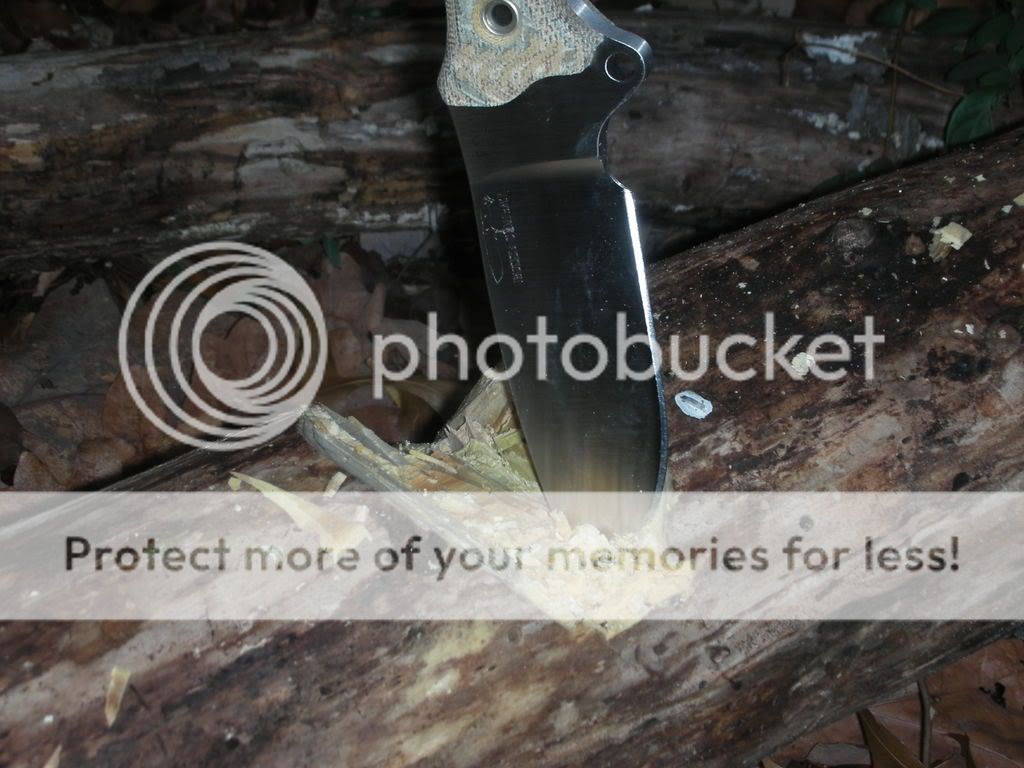
Reality is there should be plenty of deadfall that size that a chopper, or 5-7" blade could handle easily to help obtain firewood. All a matter of what survival needs you have I guess. I haven't done much for experimenting with what I can get by with. Kinda new to this particular forum and I am learning much. I hope to get more practice/experimental time in this year...
Busse Badger chopping 6-7" deadfall (about 4 chops in each direction got me about 1/3 of the way):
Reality is there should be plenty of deadfall that size that a chopper, or 5-7" blade could handle easily to help obtain firewood. All a matter of what survival needs you have I guess. I haven't done much for experimenting with what I can get by with. Kinda new to this particular forum and I am learning much. I hope to get more practice/experimental time in this year...
Oh f**k! I am about to trade for a RAT-7 and I started reading this thread... now I am so messed up that I feel the urge to get an F1 myself right now as well. You guys are evil...
I like the idea of a simple SAK, a folding SAW and fixed blade the size of an F1 or TAK. BTW... a question for those who own an F1... which sheath did you buy it with? and... anyone here got a nice Kidex one for it? (think upside down carry in the left shoulder strap of the backpack).
Mikel
I like the idea of a simple SAK, a folding SAW and fixed blade the size of an F1 or TAK. BTW... a question for those who own an F1... which sheath did you buy it with? and... anyone here got a nice Kidex one for it? (think upside down carry in the left shoulder strap of the backpack).
Mikel