How big is a Texas Jack?

It's just the fact that the TJ and the stockman are otherwise identical made me forget that for a moment and wonder "why?"

I don't have the Medium Stockman, but the Texas Jack has a narrower spring for the pen blade. Is the Stockman that way too? or do they have two "thicker" springs?
Maybe Zuchus can give us a spine shot comparison.

Oh, and I know the logic is not exactly the same, just having some fun. :p
 
What he said :D
I am also very interested if there's a history behind the name.
Blues or Jackknife, got something for us?

Many companies over the years have produced a knife which they called a "Texas Jack" according to catalog images in several guidebooks I own.
Some of these knives were based upon patterns as diverse as sowbelly, double-end premium jack, premium jack and stockman frames to name what comes immediately to mind.

So right off you can see that there is quite a bit of latitude taken by the manufacturers. Generally the "Texas" in "Texas Jack" implied that the knife was a larger knife (relatively speaking).

Now, according to Levine's Guide, a "Texas Jack" is essentially equivalent to a "Moose" which is a large (usually 3.75" or above) knife based upon the premium stockman frame with a wide clip master and either an equally long spear or spey blade on the other end.

Steve Dick, in his book on pocketknives narrows the "Texas Jack" moniker to only those with those sporting the spear blade while those with a spey are referred to as a "Moose".

Hope this helps somewhat in terms of definitions...(though it certainly doesn't cut down on the license taken by the manufacturers).


To elaborate with a few illustrations, each of the knives below has been labeled a "Texas Jack" in guidebooks or catalogs:

The original "John Primble" version of this Moore Maker was called a "Texas Jack":

orig.jpg


This original "Winchester" was referred to as a "Texas Jack":

orig.jpg


This "47" Pattern "Case" was sometimes referred to as a "Texas Jack" in guidebooks:

orig.jpg


And finally, this "75" pattern "Case Classic" can be referred to as either a "Moose" or "Texas Jack" (according to Levine's Guide):

orig.jpg


So there you have it. Murky as ever. ;)
 
Last edited:
I don't have the Medium Stockman, but the Texas Jack has a narrower spring for the pen blade. Is the Stockman that way too? or do they have two "thicker" springs?
Maybe Zuchus can give us a spine shot comparison.
I don't have a 63032, but on my 6344 (same blade selection, just smaller) the spring for the 2 short blades is indeed thinner (very slightly so).

On the stockman the pen blade has a taper, while the blade of the sheepsfoot is slightly thinner and krinked to the side to allow it to be bent and fit beside the pen. It's possible the pen on the TJ isn't as tapered since it doesn't need to be. It could also have a thicker spine - the blade is obviously broader, which means it could have a thicker spine, yet have the same cutting geometry as the pen on the stockman. I'd like to see a top shot of the blades as well.
 
Many companies over the years have produced a knife which they called a "Texas Jack" according to catalog images in several guidebooks I own.
Some of these knives were based upon patterns as diverse as sowbelly, double-end premium jack, premium jack and stockman frames to name what comes immediately to mind.

So right off you can see that there is quite a bit of latitude taken by the manufacturers. Generally the "Texas" in "Texas Jack" implied that the knife was a larger knife (relatively speaking).

Now, according to Levine's Guide, a "Texas Jack" is essentially equivalent to a "Moose" which is a large (usually 3.75" or above) knife based upon the premium stockman frame with a wide clip master and either an equally long spear or spey blade on the other end.

Steve Dick, in his book on pocketknives narrows the "Texas Jack" moniker to only those with those sporting the spear blade while those with a spey are referred to as a "Moose".

Hope this helps somewhat in terms of definitions...(though it certainly doesn't cut down on the license taken by the manufacturers).


To elaborate with a few illustrations, each of the knives below has been labeled a "Texas Jack" in guidebooks or catalogs:

The original "John Primble" version of this Moore Maker was called a "Texas Jack":

orig.jpg


This original "Winchester" was referred to as a "Texas Jack":

orig.jpg


This "47" Pattern "Case" was sometimes referred to as a "Texas Jack" in guidebooks:

orig.jpg


And finally, this "75" pattern "Case Classic" can be referred to as either a "Moose" or "Texas Jack" (according to Levine's Guide):

orig.jpg


So there you have it. Murky as ever. ;)

Murky indeed! :confused:

The one common trait I see, based upon these examples, is they're all 2-bladed knives, as opposed to the basic, ordinary single-bladed 'jack knife'. Maybe that's got something to do with it being 'Texas'. Or, maybe not. Who knows(?).

Thanks, Elliot. Excellent pics, BTW. :)
 
Murky indeed! :confused:

The one common trait I see, based upon these examples, is they're all 2-bladed knives, as opposed to the basic, ordinary single-bladed 'jack knife'. Maybe that's got something to do with it being 'Texas'. Or, maybe not. Who knows(?).

Thanks, Elliot. Excellent pics, BTW. :)

You're very welcome.

Dave, as a pattern (as opposed to manufacturer's "name") I'd rely on the definition as supplied by BRL... The commonality is the stockman (or sowbelly stockman) frame, two large blades (wide clip master, spear or spey secondary), double-ended and 3.75" or larger.
 
You're very welcome.

Dave, as a pattern (as opposed to manufacturer's "name") I'd rely on the definition as supplied by BRL... The commonality is the stockman (or sowbelly stockman) frame, two large blades (clip master, spear or spey secondary), double-ended and 3.75" or larger.

I have no reason to doubt BRL's definition (or any, for that matter, as I'm 100% ignorant on this). The 'double-ended' aspect surprises me. I'd always assumed any 'jack knife' as being single-ended (whether one or more blades).

That being said, it's a good-looking pattern. I'm already a big fan of the large '75 pattern stockman, so the (similar) '92 pattern large Texas Jack really speaks to me. Don't have one yet, but I'm forever tempted... :p
 
Well, not quite. My point is, in my eyes, the 63032 stockman and 62032 TG are exactly the same length and thickness and thus take up the same amount of pocket space, so why not fit as many blades as you can in there? But for me, that's always been the appeal of multi-blade knives - fitting as many different blades as possible into as small a package as possible. It bugs me to see open spaces where blade could fit. I guess the trade-off for that is comfort (sheepsfoot blades always stick out) and bent blades sticking out at weird angles. That stuff certainly bugs me too, but that's the sacrifice I'm happy to make if it adds an extra blade or 2.

I guess the Texas Jack is hardly all that different than countless other jack knives with a large clip/spear and a pen. Those aren't really "my thing" either, but to each is own. It's just the fact that the TJ and the stockman are otherwise identical made me forget that for a moment and wonder "why?"


Double post
 
Last edited:
Well, not quite. My point is, in my eyes, the 63032 stockman and 62032 TG are exactly the same length and thickness and thus take up the same amount of pocket space, so why not fit as many blades as you can in there? But for me, that's always been the appeal of multi-blade knives - fitting as many different blades as possible into as small a package as possible. It bugs me to see open spaces where blade could fit. I guess the trade-off for that is comfort (sheepsfoot blades always stick out) and bent blades sticking out at weird angles. That stuff certainly bugs me too, but that's the sacrifice I'm happy to make if it adds an extra blade or 2.

I guess the Texas Jack is hardly all that different than countless other jack knives with a large clip/spear and a pen. Those aren't really "my thing" either, but to each is own. It's just the fact that the TJ and the stockman are otherwise identical made me forget that for a moment and wonder "why?"


See my earlier post. It's not just a comfy thing. The two bladed jack knife is normally stronger/tougher. That is why some don't want three. Some prefer a stronger knife than a third blade.
 
About stronger etc.

This prompted me to get my digital scales out and stage a weigh-in:

Stainless CASE TJ 64 g
CV Amber Bone TJ 66 g
Chestnut Bone Stockman cv 64 g

Maybe stainless is not as heavy as cv? It still has the same full spacer between the blades as its cv equivalent but weighs the same as the Stockman which does not but sports a 3rd blade. The scales of both knives are bone and look the same thickness. Odd.
 
Last edited:
I don't have the Medium Stockman, but the Texas Jack has a narrower spring for the pen blade. Is the Stockman that way too? or do they have two "thicker" springs?
Maybe Zuchus can give us a spine shot comparison.

I don't have any spine shots handy (those other pics I already had uploaded to photobucket) but just looking at them in hand they look identical to me. Two springs, both about the same thickness. If there is any difference it is subtle.
 
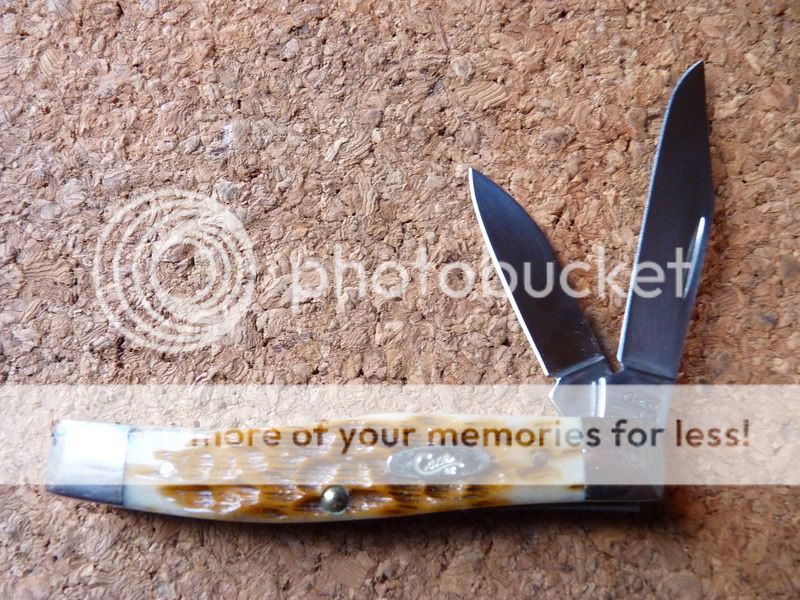
This may not help the OP much but here's my Texas Jack. I haven't carried it much, but it's sentimental to me because it's the first Case knife I ever bought for myself.

P1020191.jpg
 
Give all the opaque clarity of the name. I guess I can go with "I live in Texas and this is my jackknife. That makes it a Texas Jack." :D

Time period, locale, and the ever interesting marketing, all seem to often be part of a pattern name, or other terms for that matter.

Saw two guys having a minor conflict over the term "house gun" on another forum. One guy was in an area of the country where everyone calls the home defense gun the "house" gun. The other guy was in a different part of the country and the general term in use was "nightstand gun." Having not heard the term house gun, he was making cracks about shooting in the house with it. It was resolved quickly without shots fired, btw.

Same thing with some knife patterns. If you showed me some of the double-ended versions of a Texas Jack and asked me what it was I'd say, "That's a Moose. Handle looks funny though." Or others I just call a double ended Jack. Then again, I've seen what I call a Moose also labeled as a Muskrat, when to me a Muskrat has two equal, slender clip blades.

That's just part of the fun I guess.

Btw, here is and interesting page that you can bookmark. One of many and none will ever fully agree.

http://www.knifecollector.net/PocketKnifePatterns.html (Sarasota Knife Collectors page, to give credit.)
(Psst. Off topic, but go to the home page and find the link for the Randall Knife song)

Btw, some knice knives there! I hadn't really given much thought to the 6032 Amber Texas Jack, but looking at the comparisons, that has some appeal. I like the usefulness of the Stockman, carried one years ago, but it just carries a little to heavy/bulky in my pocket. That Jack just might work. Miss the old rounded edges of a lot of the pocket knives of years back.
 
Back
Top