Wowbagger
Gold Member
- Joined
- Sep 20, 2015
- Messages
- 8,084
Surprising results.
I didn’t do this to prove you wrong I did it to simply see the effect on the A2.
There was basically no effect. There may be, perhaps the subtlest blue area but it is in the area to the left where I did not wash the blade. That makes no sense. In the photos the mustard patina effect , MPE, shows up much better. I can't really see this with the naked eye (no camera) but with magnification. Weird.
However I CAN easily see the rust dots on the A2 naked eye with or without magnification (see photos near the end of this post).
Lets back up . . .
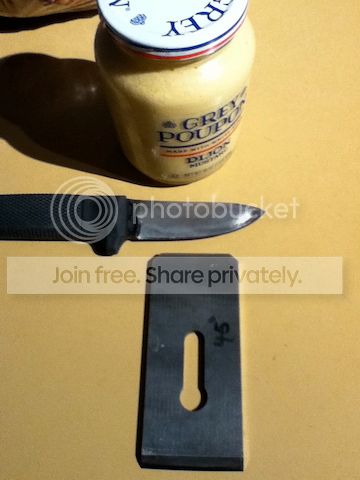
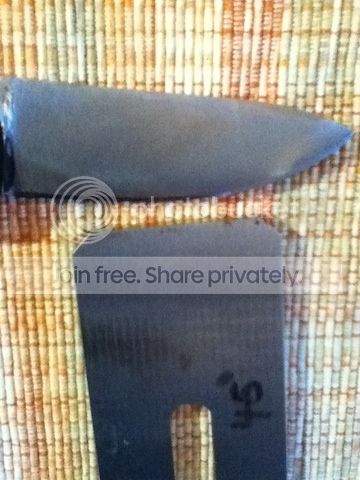
To find out how much effect prewashing the steel has verses a surface with a film from months of sitting around and handling I did the following. I washed the half of the blade on the right with dish soap and rubbed and rinsed very thoroughly. Left the half of the blade to the left unwashed. I put mustard on the right half and most of the left half but saved the left most area from any mustard for comparison sake.
This is how the A-2 woodworking hand plane blade company describes the blade :
"Our A-2 Tool Steel is cryogenically treated, hardened to Rockwell 60-62 and double tempered."
here
The before photos :

Suited up :
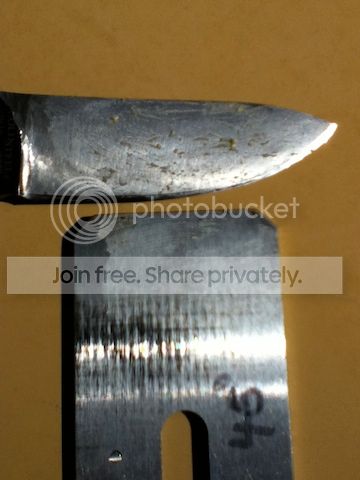
The after photos :
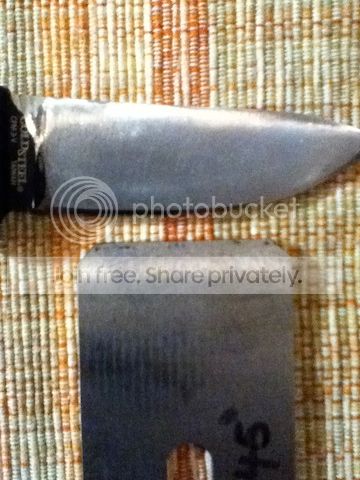

Here is a control that I added after the above confounding results. The blade is obviously an Opinel
“Carbone” . . . basically plain carbon steel. We should see patina like crazy.
thirty minutes and counting . . . tick, tock, tick, tock etc., etc., etc. . . .
annnnnnd we’re back . . . let see how it tastes . . . er . . . I mean looks :

Funny . . . in the above photo I can see browning / patina. In fact just looking at it with the naked eye I can’t hardly tell this is there.
OK I changed tac. I scrubbed the surface of the blades with the end of a Norton 220 very soft stone that makes tons of mud. This took off the other finish / patina and freshened the steel to a raw state so that I could do my test I spoke of early in this thread. I ran the blade under hot, hot tap water and then held it and watched as the water evaporated off the steel. The A 2 did just what I spoke of and expected; once the water evaporated little fine pin prick dots of rust formed. The areas where the point of the knife is shows concentration of these dots / rust. When I have done this with plane carbon steel I get much more rust and a more even coverage as apposed to dots.


So
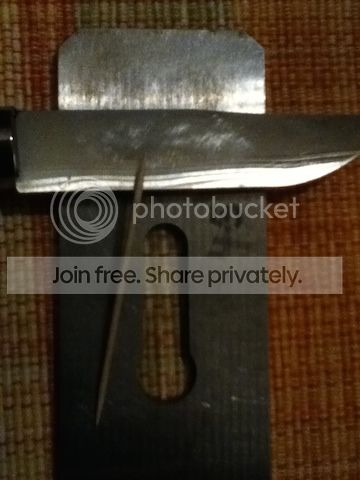
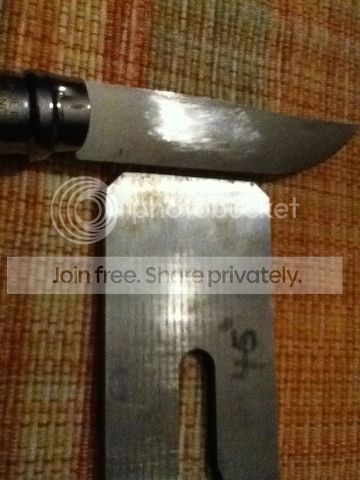
I took the Opinel “Carbon” and rubbed it well with the Norton 220 and wet it with hot water and let it dry. Did not react like the carbon plane blades I am used to. I’m not sure what those are without researching it, I only have one or two. I think they are O1 or W1 or such.
aaaaaanyway
the tooth pick points to the scrubbed and wetted zone and I am trying to show both as clearly as possible in the photos where they are overlapped here :
Finally here is the 3V scrubbed with the Norton 220 and wet with hot, hot water and watched until it dried. No rust . . . dots or finer.
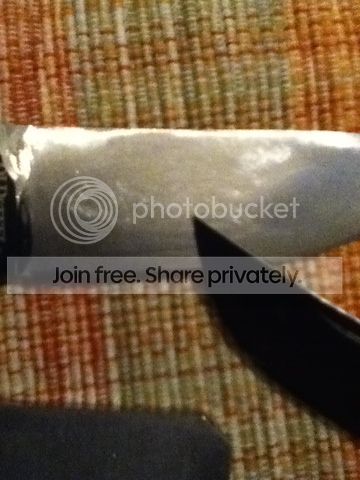
I didn’t do this to prove you wrong I did it to simply see the effect on the A2.
There was basically no effect. There may be, perhaps the subtlest blue area but it is in the area to the left where I did not wash the blade. That makes no sense. In the photos the mustard patina effect , MPE, shows up much better. I can't really see this with the naked eye (no camera) but with magnification. Weird.
However I CAN easily see the rust dots on the A2 naked eye with or without magnification (see photos near the end of this post).
Lets back up . . .
To find out how much effect prewashing the steel has verses a surface with a film from months of sitting around and handling I did the following. I washed the half of the blade on the right with dish soap and rubbed and rinsed very thoroughly. Left the half of the blade to the left unwashed. I put mustard on the right half and most of the left half but saved the left most area from any mustard for comparison sake.
This is how the A-2 woodworking hand plane blade company describes the blade :
"Our A-2 Tool Steel is cryogenically treated, hardened to Rockwell 60-62 and double tempered."
here
The before photos :


Suited up :

The after photos :


Here is a control that I added after the above confounding results. The blade is obviously an Opinel
“Carbone” . . . basically plain carbon steel. We should see patina like crazy.
thirty minutes and counting . . . tick, tock, tick, tock etc., etc., etc. . . .
annnnnnd we’re back . . . let see how it tastes . . . er . . . I mean looks :

Funny . . . in the above photo I can see browning / patina. In fact just looking at it with the naked eye I can’t hardly tell this is there.
OK I changed tac. I scrubbed the surface of the blades with the end of a Norton 220 very soft stone that makes tons of mud. This took off the other finish / patina and freshened the steel to a raw state so that I could do my test I spoke of early in this thread. I ran the blade under hot, hot tap water and then held it and watched as the water evaporated off the steel. The A 2 did just what I spoke of and expected; once the water evaporated little fine pin prick dots of rust formed. The areas where the point of the knife is shows concentration of these dots / rust. When I have done this with plane carbon steel I get much more rust and a more even coverage as apposed to dots.


So
I took the Opinel “Carbon” and rubbed it well with the Norton 220 and wet it with hot water and let it dry. Did not react like the carbon plane blades I am used to. I’m not sure what those are without researching it, I only have one or two. I think they are O1 or W1 or such.
aaaaaanyway
the tooth pick points to the scrubbed and wetted zone and I am trying to show both as clearly as possible in the photos where they are overlapped here :


Finally here is the 3V scrubbed with the Norton 220 and wet with hot, hot water and watched until it dried. No rust . . . dots or finer.

Last edited: