I would like to know the best way to get a large hole, say 1" in 3/16 stainless. I don't think a 1/2" bandsaw blade can contour that well, so a large hole for the choil might make sense(?). Also, if I wanted to reduce tang weight, large holes would be nice. So what is the best way to do it? Since I don't have a mill, boring is our for me, but I do have a drill press. No clue what kind of drill would be best for that. Suggestions? suppliers?

-
The BladeForums.com 2024 Traditional Knife is available! Price is $250 ea (shipped within CONUS).
Order here: https://www.bladeforums.com/help/2024-traditional/
You are using an out of date browser. It may not display this or other websites correctly.
You should upgrade or use an alternative browser.
You should upgrade or use an alternative browser.
How do drill a large hole (1") in 3/16 stainless?
- Thread starter CrisPal
- Start date


james terrio
Sharpest Knife in the Light Socket
- Joined
- Apr 15, 2010
- Messages
- 22,618
Cutting a 1" hole for a choil or similar profile contour would require a workpiece much wider than the blade/tang, and entail grinding off a lot of waste (drilling over the edge of a bar is not going to work well, if at all). I usually make such contours by drilling two or three smaller holes (say 1/4") just inside the layout of where the choil will be, and removing the web/cleaning it up with a rotary tool or files. Many makers have small 1" accessory contact wheels for their grinders, specifically for grinding tight radii like that... that's probably the best way.
I routinely drill lightening holes in tangs, up to 1/2" diameter in some cases. For holes over 5/16" or so, it's not a bad idea to start with a smaller pilot hole. Search for Nathan the Machinst's thread on drilling holes here in ST for more details on feed/speed, types of drills to use, etc.
Never drill into steel that isn't clamped down or vised, and prevented from spinning if the bit catches.
I routinely drill lightening holes in tangs, up to 1/2" diameter in some cases. For holes over 5/16" or so, it's not a bad idea to start with a smaller pilot hole. Search for Nathan the Machinst's thread on drilling holes here in ST for more details on feed/speed, types of drills to use, etc.
Never drill into steel that isn't clamped down or vised, and prevented from spinning if the bit catches.

- Joined
- Apr 6, 2001
- Messages
- 2,632
It might be best for you to shop around for someone who can rough out the work with a water jet.
I've sent stuff out before to had it done, and it was pretty incredible.
If I had a large volume shop, that's how I'd do it. Then again shipping might kill me.
I've sent stuff out before to had it done, and it was pretty incredible.
If I had a large volume shop, that's how I'd do it. Then again shipping might kill me.
- Joined
- Dec 7, 2011
- Messages
- 369
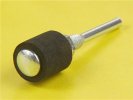
These are what I use to make choils

- Joined
- Jul 13, 2009
- Messages
- 21,855
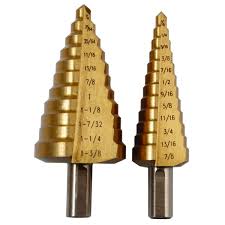
You can make large diameter holes in thin material with a step drill
Large round and half round files are also useful.
You won't find these in Home Depot
http://www.use-enco.com/1/1/59398-05059n-nicholson-half-round-american-pattern-files.html
Large round and half round files are also useful.
You won't find these in Home Depot
http://www.use-enco.com/1/1/59398-05059n-nicholson-half-round-american-pattern-files.html

- Joined
- Feb 16, 2010
- Messages
- 3,668
+1 to numbers advice. Step drills are awesome. Stepping up through all your bits one at a time will destroy a lot of bits, but step drills take the abuse and ask for more.
- Joined
- Apr 1, 2009
- Messages
- 572
You can often do the job with a holesaw. I usually use Starrett, bur Lenox are my favourite when I can get them.
If you have a "whole hole" to make, the normal setup is to use a pilot drill and do it as the designer intended.
If you only have part of a hole, or don't have anything to pilot on at the center of your intended hole, you can run the holesaw through a piece of scrap material, clamp the scrap to the workpiece, take the pilot drill out of the holesaw arbor, and cut the hole using the scrap as an external pilot.
I can't claim it's precision engineering, but it works better than most people expect it to.
I have used this method to cut blanks from plate to turn in the lathe. I have also used it to cut reasonably good curves out of flat for welding to tube or pipe. I've used it on mild steel to 3/4" thick, unhardened O1 tool steel, 304, 316 and 310 stainless steels. I've not tried it on a stainless blade steel though.
It's usually best to use a slow speed in a pillar drill, with plenty of suitable lubricant. Where I need a turning blank from something I can't get to a pillar drill, I tend to use an SDS masonry drill with the hammer action turned off to give a lower speed and more torque than my normal handheld drills.
If you have a "whole hole" to make, the normal setup is to use a pilot drill and do it as the designer intended.
If you only have part of a hole, or don't have anything to pilot on at the center of your intended hole, you can run the holesaw through a piece of scrap material, clamp the scrap to the workpiece, take the pilot drill out of the holesaw arbor, and cut the hole using the scrap as an external pilot.
I can't claim it's precision engineering, but it works better than most people expect it to.
I have used this method to cut blanks from plate to turn in the lathe. I have also used it to cut reasonably good curves out of flat for welding to tube or pipe. I've used it on mild steel to 3/4" thick, unhardened O1 tool steel, 304, 316 and 310 stainless steels. I've not tried it on a stainless blade steel though.
It's usually best to use a slow speed in a pillar drill, with plenty of suitable lubricant. Where I need a turning blank from something I can't get to a pillar drill, I tend to use an SDS masonry drill with the hammer action turned off to give a lower speed and more torque than my normal handheld drills.

- Joined
- Aug 17, 2010
- Messages
- 883
I agree. I recently drilled a 3/4" hole in 1.5" bar with a step drill. (pre-drill a pilot hole) The highest step was 3/4", so the thickness of the material was not an issue (lots of cutting fluid). I decided to "upgrade" and bought a 3/4" bit for some other holes in the same material. The step drill hole was cleaner and more true. They can also countersink your drilled holes nicely in preparation for HT.
You can make large diameter holes in thin material with a step drill
Large round and half round files are also useful.
You won't find these in Home Depot
http://www.use-enco.com/1/1/59398-05059n-nicholson-half-round-american-pattern-files.html
I was told by an old machinist to use a single flute countersink when drilling big holes in comparatively thin material. It works well, is less likely to grab on break through than a brill bit, and gives a nice round hole. Hole saws can work well too, but you do get what you pay for when buying one and the mandrel to mount it. If you are going to do this a lot, google "annular cutter"