How do I do this!?

Joined
Aug 9, 2013
Messages
78
OjMoHaO.jpg


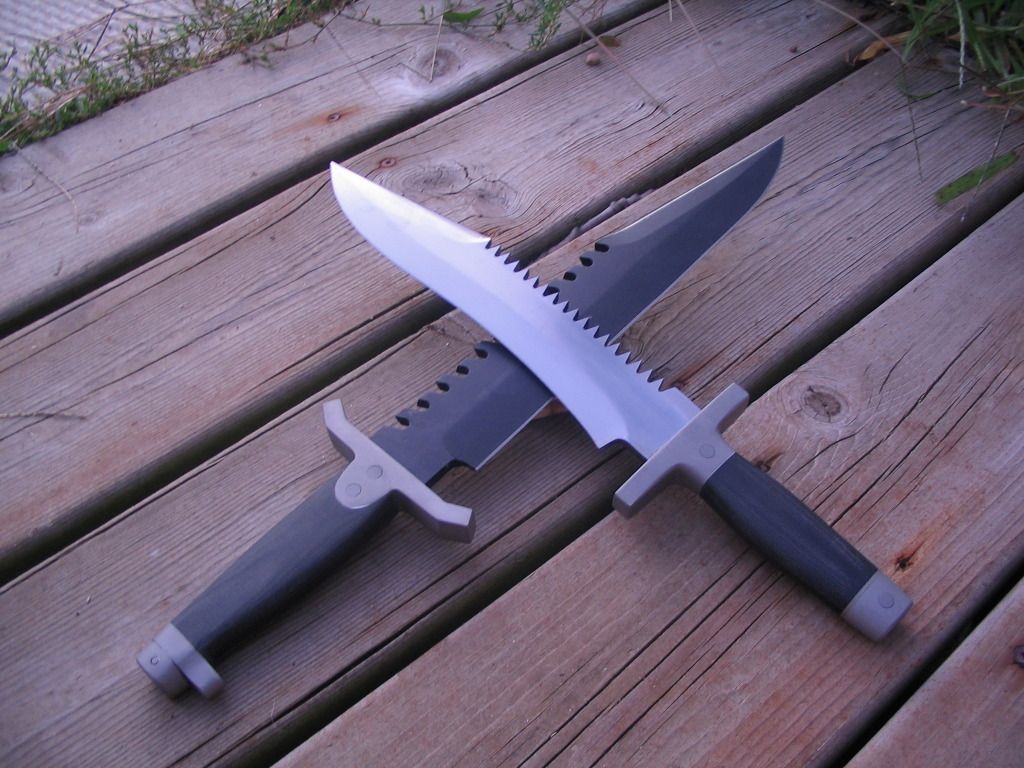
I met with a guy tonight that asked me to reproduce something like this in a cpm steel. I'm mainly nervous about the two different grinds on the blade edge and am clueless on how to get serrations on the top? A file?!

Please help.
 
I had a long reply which got lost in my inability to work on the internet, but I believe this knife design has some merit. The hollow ground edge belly is good for a hunting skinner, the straight hollow ground edge should cut well too.

The curve and serrations on the spine don't appear to serve any purpose beyond cosmetic.

With that said, this would be a fairly difficult endeavor to blend the two different hollow ground cutting edges properly.

There are many people here who can do this, but I cannot.
 
I dont know...If you were Indiana Jones and you needed to scrape off some 500 year old calcified, mossy, crusty, cob web, stuff to reveal the hidden map to the gold thing-a-ma-bob those teeth on the top of that knife just might come in real handy

It looks like a normal skinner with a deeper double plunge line
 
It's a ridiculous design to begin with!

I wouldn't carry it, but... Money talks.

Step One: Quote HIGH and hope the client balks. That's gonna take a ton of work to build by hand, so charge accordingly, keeping in mind the many other, simpler knives you could make and sell in the same amount of time with less headaches. Also remember, if you get it right... someone else will want another one sooner or later.

Sometimes they will be willing to pay exorbitantly for something completely off the wall. Now it's on, baby!

Step Two: You do NOT want to be filing out those teeth. The slots that form the teeth should ideally be cut out by waterjet or on a mill. Barring that, careful layout will allow you to drill the holes that form the bottoms and cut out the slots with whatever you have available. After that, it's a simple matter to bevel the tops of each "tooth" by hand in alternating directions.

Bear in mind, teeth like that won't cut or "saw" worth a damn. Again... that may not matter to the client.

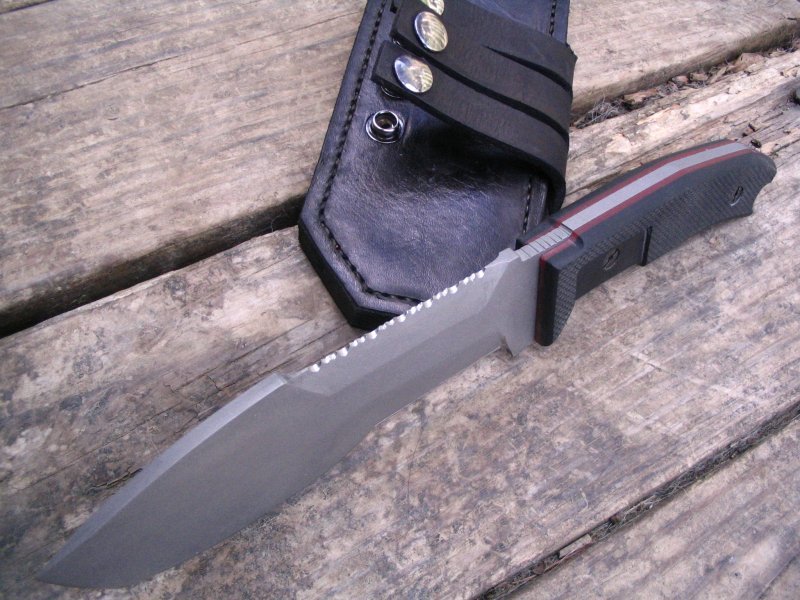
Step Three: The compound grinds are not as hard as they look, but there are a few tricks. First make sure the lower "draw knife" part is at least a little wider than your belt/platen/contact wheel. I'd try to employ a flat or sabre grind, it will be much easier to blend in the dual plunges. If the client specifies a hollow grind there, it's going to extremely difficult to blend that grind smoothly into the front chopping portion. That may not matter to the client. The front grind is easy, whether you do it flat, hollow or convex.


Anyway, that's how I did it on similar custom projects.

IMG_1003.jpg


attachment.php


tumblr_n0gwaqeYKr1t96crwo1_1280.jpg


Easy-peasy! :D
 
Last edited:
I agree those serrations on top will be pretty useless but the person ordering it didn't seem to be phased by that. Thanks so much James for the great input! Drilling the holes first is definitely something I had not thought of and will save me a great deal of time I'm sure. I definitely do not have access to a waterjet or a milling machine, so how do you suggest I remove the material from the spine once the holes are drilled?
 
Regardless, careful layout will be the key. After that it's just a matter of staying focused and taking your time.

Whatcha got? A hacksaw or well-tuned bandsaw would work. If using a hacksaw, I'd use a file guide to keep the blade straight and perpendicular to the sides of the blade blank. Try to cut just inside the lines and clean the slots up with small files later.

Cut them after basic profiling but before grinding any bevels. You'll want the workpiece nice and flat when you're cutting those out, especially if you use a bandsaw. I've edited my post above to reflect that.
 
Back
Top