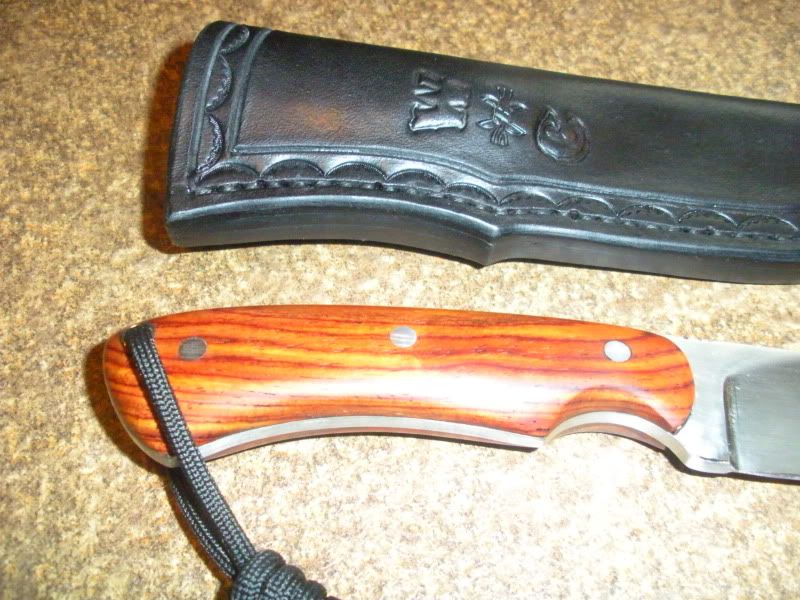
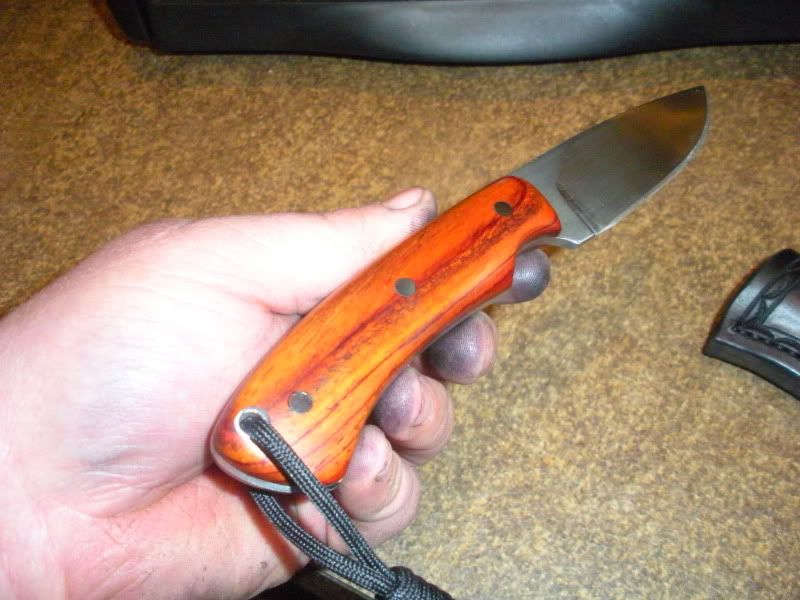
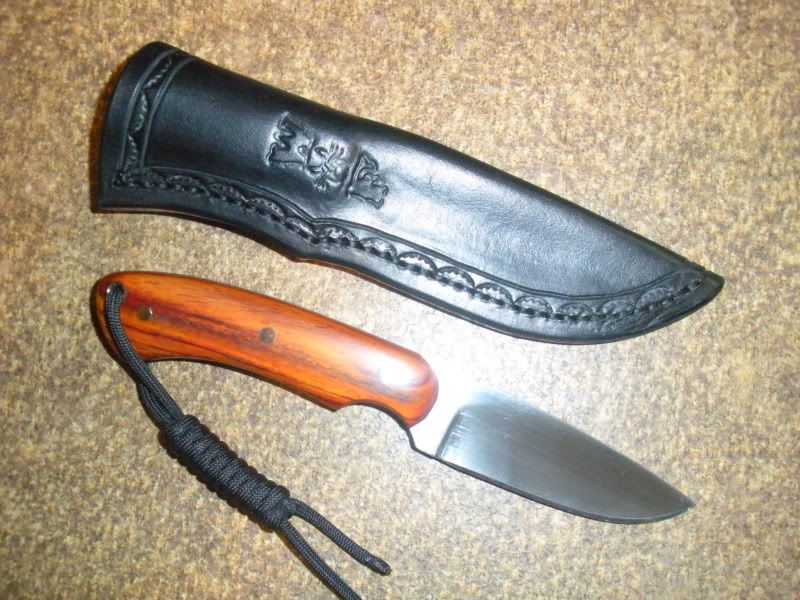
How do you all bring out the luster in your wood handles?

Joined
Dec 27, 2010
Messages
6,852
I'm having some difficulty getting my wood handles to look the way I want. I think I've made something like 20 knives so far, and have made good progress from my first one. But I can't get the wood to look the way I want it to. I'm using cocobolo, and finishing to 1500 grit, which is the finest grit sand paper I've been able to get so far. Is it mainly a matter of finishing to a finer grit? Using Tru oil? I'm not quite sure what I need to do to take my wood handles to the next level in terms of finish. Here's a couple of my most recent projects (I know the handle on the larger blade is kinda funny looking; it didn't come out quite the way I wanted it to), so you can see where I'm at.

2012-01-08134655.jpg

2012-01-08134737.jpg


And for laffs, here's the first one I ever made. Poorly thought through, really. Yay progress!

2011-09-18162935.jpg
 
With cocobola you have sanded fine enough but then either use a buffer with some white or green buffing compound or even a rag like you would shine a pair of shoes loaded up with the compound works well.
 
The key is to get everything as close to perfect as possible with 220 or even 150 grit first. Everything should be smooth and even and ALL file or machine marks need to be removed before moving on from 220 grit. Just as with sanding blades, you have to remove all of the previous grit scratches before moving on to the next finer grit. If it doesn't look good at 220, it won't look good at 1500.
 
Thanks for the buffing compound idea, I'll give that a go. I was hoping for tips to get it to shine like this:


I'm kinda wondering if maybe it's my lack of light box and good camera, or if maybe I can get that kind of look from lacquer, or the type of wood, or if I should be able to get that sort of look just with the wood and an oil finish or something.
 
The camera won't show a shine that isn't there -- well, maybe Coop could. :D

By the way, Customs & Handmade is for discussing custom knives, but Shoptalk is better for how-to so I moved this there.
 
I use several coats of Permalyn gunstock finish. Light sanding between coats, final coat buffed with Rottenstone using a soft towel to take the high gloss finish down to a softer satin sheen.

orig.jpg


orig.jpg


Roger
 
Roger those are lovely knives, and the leather work is outstanding. Do you make your own sheaths too?
 
I use stabilized wood, which I sand up to 2000 grit, then buff lightly on a dry cotton wheel. The buffing draws out the last of the luster for me. But the key is starting with stabilized wood. If I didn't do that, I'd be layering on tung oil or super glue to get the finish.

As an aside, I couldn't help noticing you are using phillips head screws and hex nuts for the pins. I'm wondering why you feel the need to use screws instead of standard pins.
 
What's the term for a finish that makes a deep three dimensional finish ...croyance ... ?
 
Roger those are lovely knives, and the leather work is outstanding. Do you make your own sheaths too?

Thanks - I have made my own sheaths, but they don't look ANYTHING like these fine examples from Paul Long and Treestump Leather.
 
This is the tip I got from Burl Source for stabilized redwoods

Best finish for stabilized redwood is sand then 3 light coats of tung, danish or true oil, then paste wax and hand buff.
It looks like i deleted an earlier PM from Mark about this, but his reasoning for only lightly buffing is that if you over buff you can hide some of the depth in the grain. I find this works with every stabilized wood I have used.

Another finishing technique I was given for stabilized woods was to sand to my finish grit, anywhere from 1500 to 2500 for me, then start burnishing the handle with
  1. the flesh side of some veggie tanned leather
  2. the smooth side of the leather
  3. an old piece of denim
In that order, this works too, but I find that Marks suggestion gives me a finish that I can look into and see everything the wood as going on.

I remember when doing my first few handles that when you are nearing your finished grit to wet sand with what ever finish oil you are using. This creates a slurry that fills in the pours, and then lightly buff. I have tried a few finishes on my handles. Tung Oil, CA, and Tru Oil. Tru Oil is the one I stick with now unless something else is requested.

Take some of your scrap pieces left over from cutting the handle shape out and test as many of the suggestion you get as you can, you should get a few of them. Then use what works best for you, because in the long run it doesn't matter what everyone else does, if you don't like the finished product or the way it is used.
 
The key is to get everything as close to perfect as possible with 220 or even 150 grit first. Everything should be smooth and even and ALL file or machine marks need to be removed before moving on from 220 grit. Just as with sanding blades, you have to remove all of the previous grit scratches before moving on to the next finer grit. If it doesn't look good at 220, it won't look good at 1500.

X2

It appears that your handles are extremely rough in their overall shape...while the wood may be smooth, the handle is not. You need to get the handle roughed to shape with a low grit like Jason suggested. Then progress through the grits.

Here's my rundown:

-60 grit or file to overall rough shape
-120 to smooth that up and get closer to what I really am going for
-220 starts getting smoothed out and I can make any changes in overall shape here
-320 starts the finer grits
-400 ends the dry sanding for me
-600 starts the wetsanding process
-800
-1000 You can stop here and decide just what direction you want your handle to go. At this point you will have a very fine satin finish and are good to wax and go or buff and finish.
-2000 This brings up an ultra fine satin finish one step further than the 1000. Depending on what I want, I may stop here or go even further.

-High grit polishing pads that run 1500-12000 grit. Most wood won't benefit from this unless ULTRA hard or stabilized. Osage Orange, Lignum Vitae and the like will polish like GLASS with these pads. Once again, these pads are used wet.

I find that cocobolo doesn't need an oil finish...it usually has enough natural oils to produce a fine luster.

These were finished to 1000 and waxed:
DSCN3866.jpg

DSCN3863.jpg

DSCN3861.jpg
 
Last edited:
Thanks guys. I'll do some experimenting with finishes here. My reading suggested that cocobolo didn't need to or couldn't be stabilized, or some such thing. The tru-oil finish on David's knife is great. Haven't gotten around to reading through the other thread. unki's tip about trying it out on scraps is a good one. I'll experiment with paste wax too (and the tip in David's thread about filling the tru-oil bottle to remove air is a good one to watch out for), and the buffing compounds.

If folks are interested, I'll put up some pics when I finally get all the stuff and get it tested out.

@tryppyr, I use those screws mainly because they're easy, and I'm still kinda experimenting, so my handles are all takedown. I prefer the phillips ones, because those can be removed with pretty much anything. They've also been a bit more secure than the few pinned ones I tried; my workshop isn't heated, and the epoxy I used before meant that any heavy chopping I did ended up cracking my scales right off. Darrin has since clued me into acra-glass, which I'm going to give a try (gotta be better than the cheapo epoxy I had).

I'm trying to make every knife better than the last, and experimenting with a bunch of different looks and profiles to see what fits me and my style. I don't feel like I'm ready to experiment with pins quite yet; that seems to me to be a step up in complexity from just screwing in, and, impatient me, I like to make my handles before I send out to Darrin for heat treat. It's easier for me to shape to the tang that way, and much faster to polish the edge on the tang than when it's hardened. I haven't figured out how that would be possible if I pin em. I think what I ought to do, moving forward, is use longer screws and not counter sink them, so I can get the rough shaping done, and then replace with pins/epoxy after heat treat and finishing the blade.

Incidentally, the blades that Darrin heat treated for me so far are fantastic; hold an edge very well and are nice and durable. He does a very very good job with 1095.
 
Back
Top