How do you all bring out the luster in your wood handles?

If you are looking for sheen follow Mr Bear's advice. Cocobolo does not need any type of finish and usually doesn't accept oil finishes very well any way. Follow with 2 coats of carnuba car wax. Buff each coat with a clean, soft buffing wheel that you use only for that, (keep mine in a zip lock when I'm not using it). Ya get your wet glass look buffing that car wax. I have found that hand buffing with a piece of denin prior to waxing is worth the effort.
 
I am not familiar with "rottenstone" for buffing. Can someone enlighten me?
 
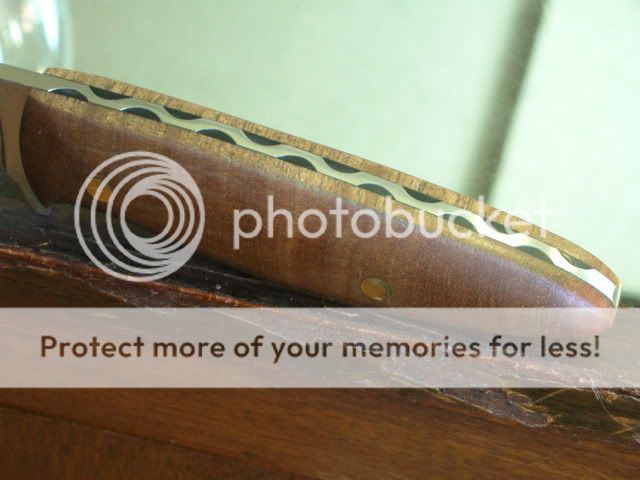
With proper prep and application you can even get a nice smooth finish with Tru-Oil on end grain like I did on this one. This is my first knife, from a blank, and it has held up very well.

DSCN1991.jpg


-Xander
 
Last edited:
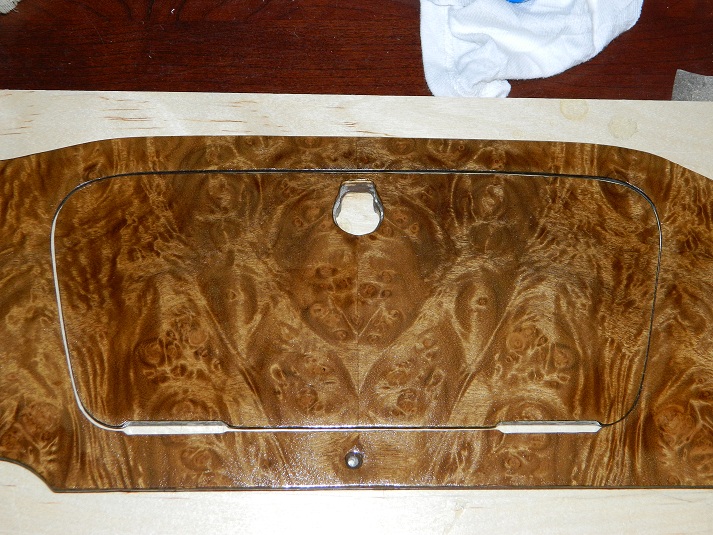
The best finishes I've found to preserve and really make the chatoancy of a fine wood stick out are, as mentioned above, oil finishes. This wont work for real dense / oily woods like cocobola or lignum vitae, but for things like maple, sycamore, yew, etc it works great. I've just had very good results with Formby's Tung Oil Finish (low gloss), which is a tung oil based rub-on varnish (NOT a pure tung oil) when doing a highly figured burlwood veneer dashboard.

It's very hard to get a good photo of chatoyance, since the effect depends on the movement of light over the object, but this was my best attempt to get a shot of the glove compartment door for my dashboard with that finish.


dash3.jpg


edit: spelling > me
 
Some woods do not respond well to the various oil finishes. These are the high oil woods like cocobola, rosewood, etc. These are often used as gunstock grip caps and forearm caps (My main experience was in gunstock making). These oil will come out and often make bubbles under the finish. On gunstocks, the better finishes for these woods were lacquer and epoxy. Some would use acetone to get rid of the surface oil, but it usually comes out eventually, anyways. Some oil finishes like tung oil are best applied a drop at a time then rubbed in vigorously. If applied in large amounts, it will appear (and FEEL to dry) but will turn sticky again in hot weather. No fun to put a bearded face up to the cheekpiece on one of these. Linseed oil is an old gun favorite, but unless dryers are added, never really hardens. It is also rather ineffective against moisture intrusion, rated at 15% in government tests against 75% for Tru-Oil which still contains some linseed oil. Linseed oil is photosensitive which will darken with age...but it takes many years. Pro-Custom Oil is another good product and does not darken the wood when applied...available from Brownells and can be applied thickly. Finishes can be "in" in the wood or gradually built up to be "on" the wood, but I personally prefer no finish on a working knife. Good buffing (use quality buffing compound and a very soft buffing wheel) is my preferred look. Remember, too, that not all sandpaper is created equal. Very fine sandpaper is found at car product stores for fine finishing of auto paint. Good luck.

 
Just my 2 cents worth. Bear in mind most of my woodworking is boxes. But I use a lot of figured wood.
Proper sanding is critical.

I like to keep a light source in back of the piece I am sanding. That way it is easier to see any scratches or other flaws.
I wear reading glasses when sanding. The eye doctor says I still have 20/20 vision but as I am getting older the reading glasses help with the close up vision.

After shaping I start with 120 grit to finalize the shaping and start sanding the surfaces to be finished.
I try not to make more than hundred grit jumps. After 120 I go to 220 grit.
From 220 grit and upward I look to make sure I have removed all the sanding scratches from the previous grit. When they are all gone I watch for lighter areas where the grain does not look to be in focus. When everything looks to be in focus, then I go to the next grit. It is a good idea to blow off with an air hose, or wipe down the piece between grits to prevent residue from a lower grit paper remaining and scratching the surface.

It is not just sanding to remove scratches. Watch the wood to see what is happening.
I can get a better finished surface the way I mentioned at 400 grit than someone skipping grits and doing a less thorough sanding would at 1000 grit.
I am not saying to stop at 400 grit. Just pay close attention and don't take shortcuts.

With any figured wood, what you get is in direct proportion to what you put into it.
Work on being able to get things just right before you even think about the time it is taking.
Your timing will get faster as you get better at what you are doing.
 
I am not familiar with "rottenstone" for buffing. Can someone enlighten me?

Quoting Wikipedia:

"Rotten stone, sometimes spelled as rottenstone, also known as tripoli, is fine powdered rock used as a polishing abrasive in woodworking. It is usually weathered limestone mixed with diatomaceous, amorphous, or crystalline silica. It has similar applications to pumice, but it is generally sold as a finer powder and used for a more glossy polish after an initial treatment with coarser pumice powder.

It is usually mixed with oil, sometimes water, and rubbed on the surface of varnished or lacquered wood with a felt pad or cloth. Rotten stone is sometimes used to buff stains out of wood. Some polishing waxes contain powdered rotten stone in a paste substrate. For larger polishing jobs, rotten stone mixed with a binder is applied to polishing wheels.

It has also been used to polish brass, such as that found on military uniforms, as well as steel and other metals. Plates used in daguerreotypes were polished using rotten stone, the finest abrasive available at the time."

Roger
 
As Burl Source stated, the angle of your light source is very important. A pin point light source parallel to the surface (from the side) shows up flaws best. Sand them all out. They will show up when you go to finer finishes. If they do, go back to the previous grit to get them out. Remember also that power finish sanders give a finer polish with the same grit than hand sanding. If you use hand sanding for an area that is too small for power finish sanding, use about a 4x smaller grit to look the same.

Rottenstone is usually not used as a pollishing compound. There are better compounds for this. It is usually used for taking the tits off finish to make the surface smoother and most adhesive for the following finish coat. 0000 steel wool is my preference for doing this.

There is not much need for finish on a knife handle. Stabilized woods do not need it. High oil content woods that cannot be stabilized, pollish very well without finish.

Use the softest buffing pad available with the best white diamond compound and use a light touch...after proper sanding.
 
I would say that you should sand at least till 400 or 600 grit. If you sand each stage very well before moving on it will look nice and smooth. You can always try rubbing a cloth dampened with paint thinner and the wood will show as if it had a finish and that can sometimes tell you what the wood will look like when it is done.
I have used a buffing wheel with compound an found it left wood very nice but I probably wouldn't leave that as the only protection on the wood.
I have had good results with tru-oil. I don't know how durable it is if handled rough but I think it is better than just straight danish oil but much nicer than poly urethane. The nice thing about it is that the more coats the more glossy. So if you put on 6 coats you are going to end up with a rather glossy handle but not as much of a wood feel. One coat will leave you with a protected surface where the color comes out but you can still feel the wood grain.

I forgot to add a sanding idea. When making tables I use one of those vibrating sanders and you can load them up with regular paper so it will do 600 or higher easily, leaves a nice finish on the table and much faster than hand sanding. I have not tried it on a knife handle yet but it just may work on the flat and slightly curved surfaces.
 
Back
Top